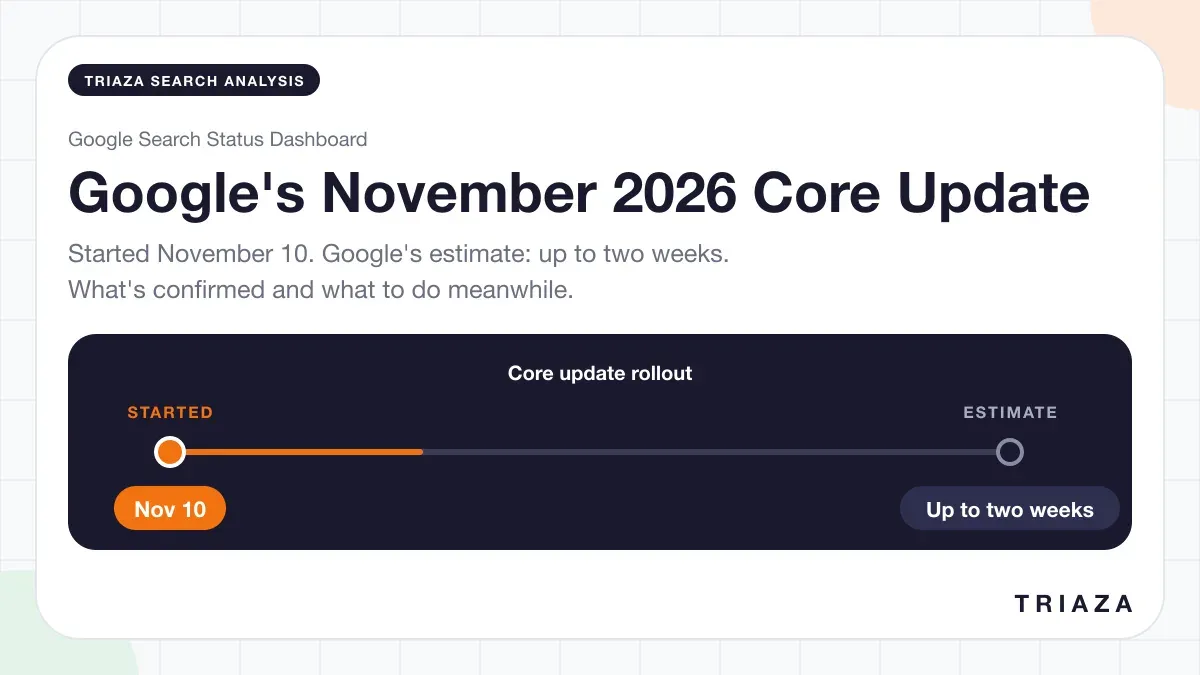
Google released the November 2026 core update on Tuesday, November 10, at 10:06 a.m. Pacific, and as of Wednesday, November 11, it is still rolling out. Google says the rollout may take up to two weeks and hasn’t said what the update changes, so for most small-business and startup sites the job today is to save a Search Console baseline and leave the site alone.
The Search Status Dashboard entry is two sentences long: “Released the November 2026 core update, which applies globally and to all languages. The rollout may take up to 2 weeks to complete.” By the dashboard’s ranking history, this is the third Search core update of 2026, after March and May, and it started 161 days after the May 2026 core update finished on June 2.
What Google has confirmed
On LinkedIn the same day, Google Search Central called it “a regular update designed to better surface relevant, satisfying content for searchers from all types of sites,” and said it will update the ranking history page when the rollout is complete. Search Engine Journal points out that Google used the same sentence for the March core update. We read it as a stock description of core updates that says nothing specific about this one.
Google’s core updates documentation describes these as broad changes to its ranking systems that don’t target particular sites or pages. It also says most sites don’t need to worry about core updates and may not notice one has happened.
Nothing else is running alongside it. The September 2026 spam update finished on October 8, and the core update is the only open entry in the dashboard’s incident feed. Our list of Google algorithm updates has the dates for every confirmed update since the start of 2025.
What isn’t known yet
As of Wednesday, November 11, 2026, a little over a day into the rollout:
- When it ends. The dashboard has no completion entry.
- What it changes, and how much. The dashboard entry names no ranking system, content type or kind of query, and gives no measure of size. The Search Central blog has no post about the update.
- Who gained and who lost. The only tracker data we found is the panel Search Engine Roundtable published on November 10, and it stops that day. In it, the Sistrix reading rose from 14.1 on November 7 to 30.7 on November 9, before the release, so that rise can’t be put down to this update. Barry Schwartz wrote on November 9 that the tools are hard to trust anyway, given the blocking Google has put in place.
How long recent core updates took
Up to two weeks is an estimate, so we checked it against the record: every completed Search core update on the dashboard from 2024 through 2026. To get each length, we took the start and end times from the incident page, converted them to UTC, subtracted, and divided by 24 hours. The table leaves out the February 2026 Discover core update, which covered Discover only, for English-language users in the US. It was also announced at up to two weeks, and it took 21.7 days.
| Core update | Started | Finished | Google’s estimate at launch | Actual rollout (days) |
|---|---|---|---|---|
| March 2024 | Mar 5, 2024 | Apr 19, 2024 | Up to a month | 45.0 |
| August 2024 | Aug 15, 2024 | Sep 3, 2024 | Up to a month | 19.2 |
| November 2024 | Nov 11, 2024 | Dec 5, 2024 | Up to 2 weeks | 23.5 |
| December 2024 | Dec 12, 2024 | Dec 18, 2024 | Up to 2 weeks | 6.1 |
| March 2025 | Mar 13, 2025 | Mar 27, 2025 | Up to 2 weeks | 13.9 |
| June 2025 | Jun 30, 2025 | Jul 17, 2025 | Up to 3 weeks | 16.7 |
| December 2025 | Dec 11, 2025 | Dec 29, 2025 | Up to 3 weeks | 18.1 |
| March 2026 | Mar 27, 2026 | Apr 8, 2026 | Up to 2 weeks | 12.2 |
| May 2026 | May 21, 2026 | Jun 2, 2026 | Up to 2 weeks | 11.9 |
The median is 16.7 days and the mean is 18.5, pulled up by March 2024. Two of the nine ran past the estimate Google gave at launch: March 2024, and November 2024, which was also announced at up to two weeks and took 23.5 days. The other four updates announced at two weeks finished inside it, and both earlier 2026 updates in the table took about 12 days.
As an illustration, not a forecast: a 12-day rollout would end around November 22, the full two weeks on Tuesday, November 24, and a rollout of median length on November 27. Nine updates is a small sample, ranging from 6 to 45 days.
The end date decides when you can read your data, because Google asks for a full week after completion. If the rollout ends on November 24, that week runs to December 1 and takes in Thanksgiving, Black Friday and Cyber Monday, as Search Engine Journal noted. Compared with early November, that week will show holiday traffic as well as the update, so look at the same week last year too.
What to do, and not do, while it rolls out
Save a baseline now. Export Search Console performance data for the week before November 10, by page and by query. Google’s comparison uses a week from before the rollout started.
Wait for completion, then one more week. That is the order Google gives: confirm on the dashboard that the update has finished, wait at least a full week, then compare. A drop that began before November 10 probably isn’t this update.
Then size the change. Google’s example of a small drop, one that needs no drastic action, is a page slipping from position 2 to 4. Its example of a large drop is a fall from position 4 to 29. For a large drop it suggests looking closely at the most affected pages and reviewing the site as a whole, ideally with someone who isn’t affiliated with it.
What to avoid:
- Don’t rewrite, delete or re-date pages mid-rollout; you can’t tell yet whether anything needs fixing. Google’s documentation separately warns against “quick fix” changes and calls deleting content a last resort.
- Don’t read a drop as a penalty. Google’s traffic-drop debugging guide says a drop after an algorithmic update may not mean anything is fundamentally wrong with your content.
- Don’t judge by one day. Search Engine Journal reported that third-party tracking tools showed elevated volatility at several points during the May rollout.
If a drop is still there a week after the rollout ends and you want a second opinion, our SEO service starts with an audit of where the site stands.
Questions site owners keep asking
When will the November 2026 core update finish?
Google hasn’t said, beyond its estimate of up to two weeks, which runs to November 24. Of the five earlier Search core updates given that estimate since 2024, four finished inside it and one ran to 23.5 days. The dashboard will show the end date when Google posts it.
What does the November 2026 core update target?
Google hasn’t named anything. Its documentation says core updates don’t target specific sites or pages, so any claim about a specific target is speculation at this point.
My traffic dropped before November 10. Is that the core update?
Probably not. The rollout began at 10:06 a.m. Pacific on November 10. Search Engine Roundtable reported big movements in the days before the release, but nothing Google has published ties them to this update.
Is a core update the same as a spam update?
No. A spam update improves how Google detects practices its spam policies already prohibit. A core update is a broad change to how Google ranks content, and when one is behind a drop, Google’s traffic-drop debugging guide says there might not be anything fundamentally wrong with your content. Our August 2026 spam update post covers the difference.
How long does recovery from a core update take?
Google says some changes take effect in a few days, while it can take several months for its systems to confirm that a site as a whole is helpful. If a few months pass with no change, that can mean waiting for the next core update, though Google also runs smaller ones it doesn’t announce. It gives no guarantee of recovery.
How we checked this
Every source linked here was read on Wednesday, November 11, 2026. The dashboard’s incident feed was last checked the same day, when it showed the November core update with a start time, one message and no end time.
Start and end times for the nine earlier Search core updates and the February 2026 Discover core update come from their dashboard entries. The rollout lengths, the median and the mean are our arithmetic on those times, counting a month as 30 days. The tracker readings are third-party figures from Search Engine Roundtable’s November 10 chart, which we didn’t collect and can’t vouch for. This post contains no first-hand ranking or traffic data.