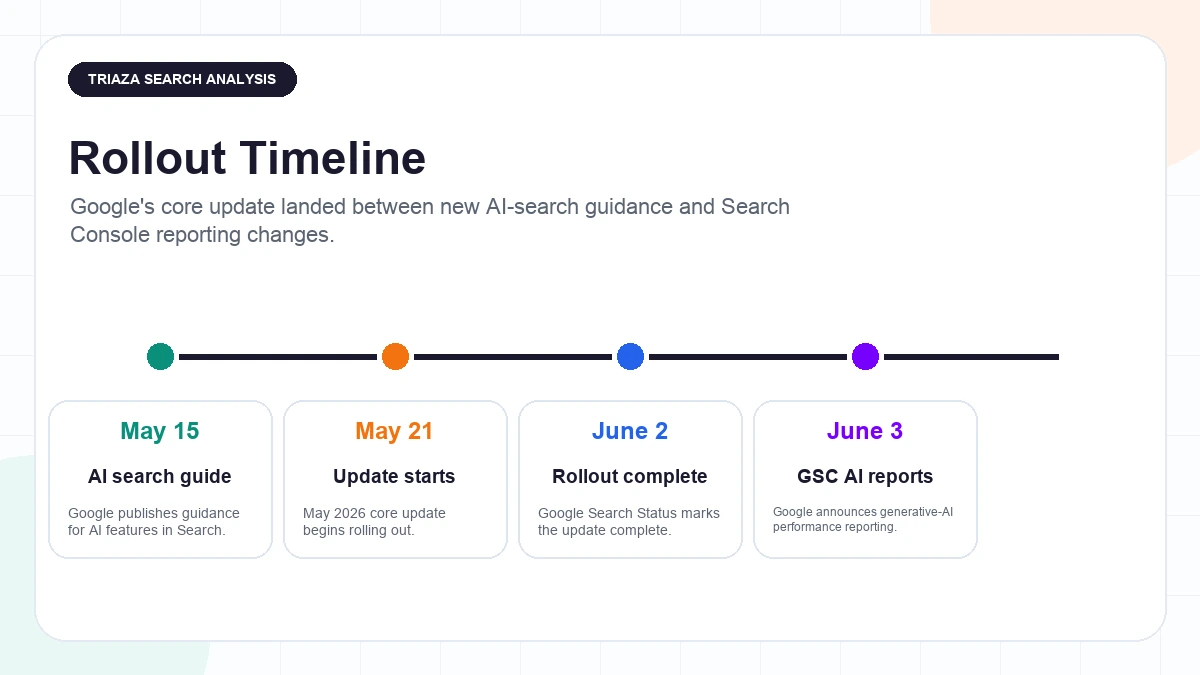
Google’s May 2026 core update was a broad ranking-system update that ran from May 21 through June 2. If your visibility fell, compare Search Console performance before and after the rollout, separate small movements from sustained large drops, and change only what would make the affected pages more useful. Google explicitly advises against quick fixes. Third-party visibility studies found large movements by source type and market, but they cannot explain why Google changed any individual ranking.
The rollout took 11 days and 21 hours, according to Google’s Search Status dashboard. Google did not publish a May-specific analysis of what changed. The sections below separate Google’s guidance from the patterns observed by independent analysts.
What Google said, and what it didn’t
Core updates are broad changes intended to keep results useful as the web changes; they do not target individual pages or sites. A ranking drop does not necessarily mean a page violated a policy. Google’s core-update documentation recommends waiting at least a full week after a rollout ends, then comparing Search Console data before and after the update. Small position changes generally do not call for drastic action. Sustained, large drops deserve a deeper review of the affected pages and queries.
Google did not publish a dedicated post explaining the ranking changes in this update.
Six days before the rollout, on May 15, Google released a guide to optimizing for AI features in Search. Google treats that work as part of SEO, not a separate discipline. AI Overviews and AI Mode use the Search index and ranking systems. The guide recommends useful, non-commodity content with original information or a distinct perspective.
Then on June 3, one day after the rollout finished, Google began rolling out generative-AI performance reports in Search Console to a subset of sites. If the report is available in your property, it provides impressions and other performance data for AI Overviews, AI Mode, and generative AI features in Discover.
The timing does not establish that the core update and those AI-search changes were connected. Google has not said they were. It does mean search teams now have to review classic rankings and generative-search visibility together.
What third-party data suggests about source fit
The most specific public analysis came from Aleyda Solis, who measured Sistrix visibility shifts in the US and UK from May 26 to June 2, with Sistrix publishing broader winner and loser lists for the same update. These figures describe ranking visibility in those datasets. They are not Google-confirmed causes and do not measure traffic, leads, or revenue.
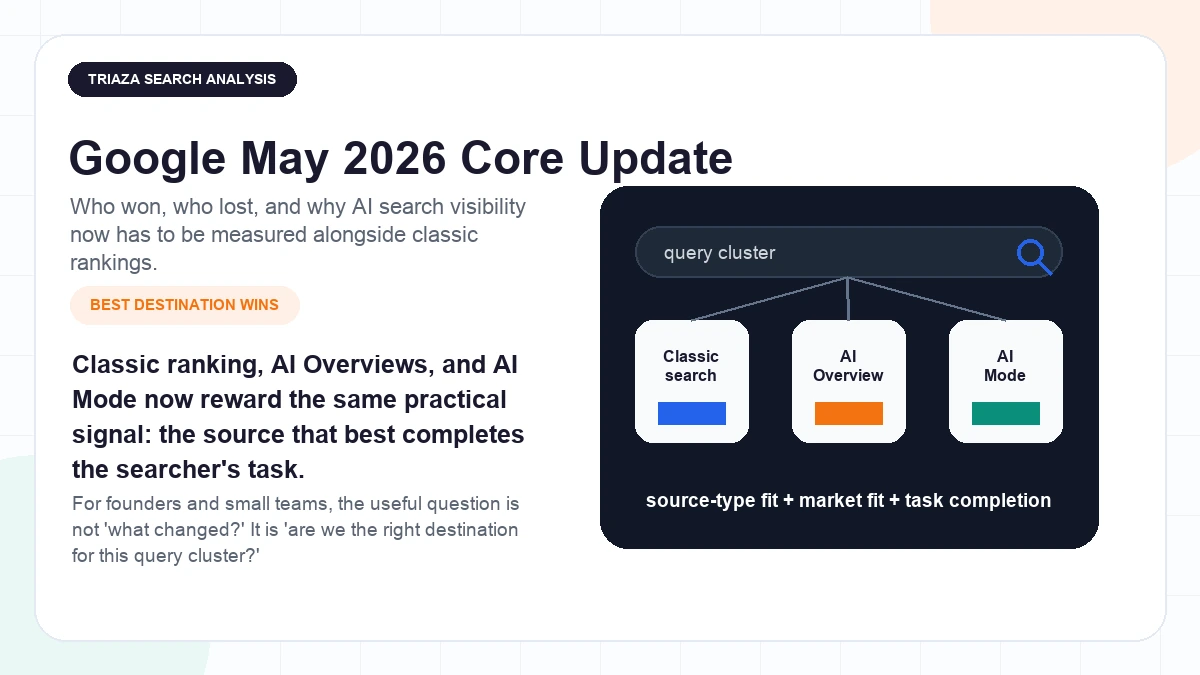
Solis described the pattern as an intent-destination reset. In her analysis, many of the gains and losses were consistent with a stronger match between the query, the market, and the type of page shown. That is a useful diagnostic hypothesis, not a confirmed ranking rule.
Canonical reference sites gained while several secondary tools lost visibility. In the UK index, cambridge.org gained 40.9%, thesaurus.com 39.7%, and merriam-webster.com 33.3%. Youglish.com fell 69.6%, forvo.com 68.1%, and hinative.com 62.9%. The movement is consistent with canonical sources matching more of the sampled definition and pronunciation queries, but the dataset does not prove that was Google’s reason.
Several forums lost, but user-generated platforms did not move as one category. Stack Exchange (-31.8% UK), Quora (-31.3% UK), and Reddit (-23.8% UK) contracted. X gained 14.5% in the US, Pinterest rose roughly 10% in both markets, and Fandom gained in both. The mixed result does not support a simple claim that Google demoted all user-generated content.
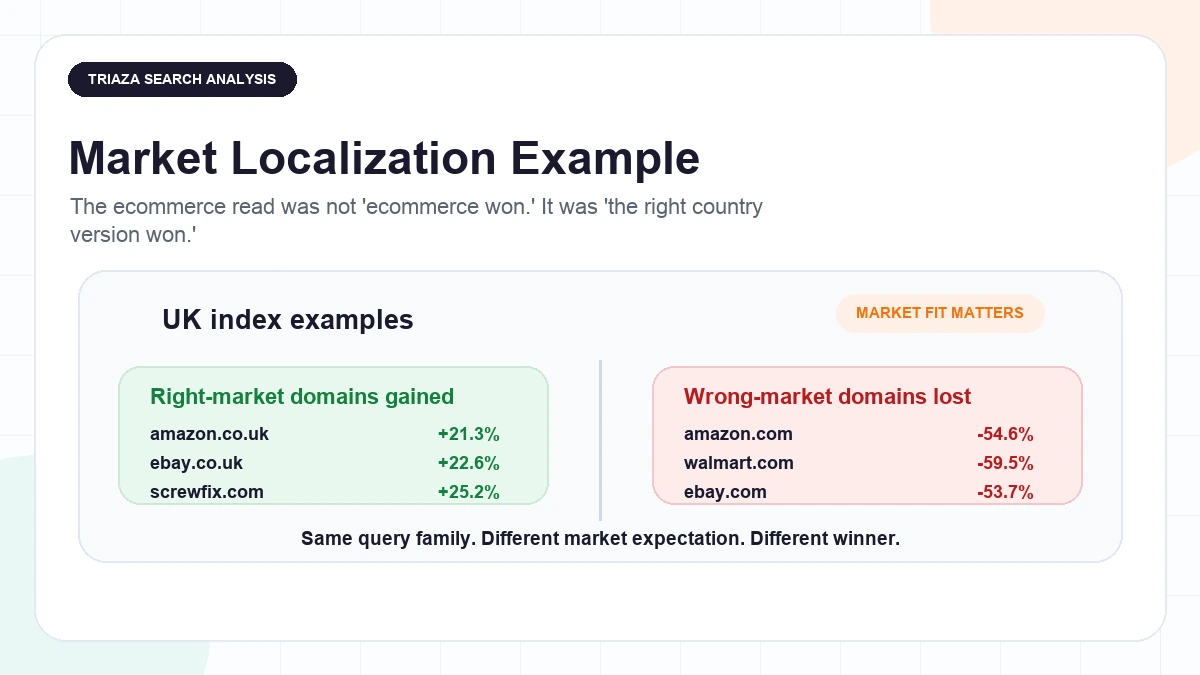
Ecommerce movement varied sharply by market. In the UK index, amazon.co.uk gained 21.3%, ebay.co.uk 22.6%, and screwfix.com 25.2%. Amazon.com dropped 54.6% in UK results, walmart.com 59.5%, and ebay.com 53.7%. Sistrix’s wider sample of 451 UK ecommerce domains showed little net movement overall. That supports a market-fit interpretation more than a blanket claim that ecommerce sites won.
Several task-completing marketplaces gained. Trip.com gained 82.2% in the US, Skyscanner 47.1%, ZipRecruiter 44.8%, Glassdoor 36.6%, Indeed 25.9%, and Booking.com 15.4%. Those results cut against a blanket claim that Google demoted aggregators. They are consistent with sites that let a user complete a task, such as booking a flight or applying for a job, matching those queries well.
Health results were mixed. WebMD held stable-to-positive in both markets, while GoodRx reportedly fell 80% in the UK index and Ubie Health dropped roughly 39% in both. Even the WHO slipped in some markets. That spread is not explained by a simple industry-wide or E-E-A-T narrative. Page-type fit is one plausible interpretation, not a proven cause.
Sistrix’s US loser list shows the breadth of movement: freepik.com -63%, onetonline.org -60%, thereciperebel.com -58%, twitch.tv -50%, macys.com -44%, sciencedaily.com -40%, and nypost.com -40%. UK news media as a group showed a net negative across Sistrix’s 77-domain sample.
Here’s the whole pattern in one view:
| Segment | Examples | What happened | Interpretation to test |
|---|---|---|---|
| Canonical reference | cambridge.org, merriam-webster.com | Strong gains | Canonical source may have fit the sampled queries better |
| Secondary reference tools | youglish.com, forvo.com, onelook.com | Sharp losses | Searchers may have preferred a primary reference source |
| Forums / Q&A | reddit.com, quora.com, stackexchange.com | Moderate-strong losses | Thread format may have fit fewer sampled queries |
| Social / visual communities | x.com, pinterest.com, fandom.com | Flat to positive | Visual or community format may still have fit the query |
| Local-market ecommerce | amazon.co.uk, screwfix.com (UK index) | Gains | Local market signals may have matched the searcher |
| Wrong-market ecommerce | amazon.com, walmart.com (UK index) | Sharp losses | Market mismatch is a plausible factor |
| Travel / jobs marketplaces | trip.com, ziprecruiter.com, indeed.com | Strong gains | Task-completion format may have fit the query |
| News / media (UK sample) | 77-domain Sistrix sample | Net negative | Review exposure to interchangeable coverage |
Source: Aleyda Solis’s analysis of Sistrix US/UK visibility data (measured May 26 to June 2, 2026) and Sistrix’s May 2026 visibility analysis.
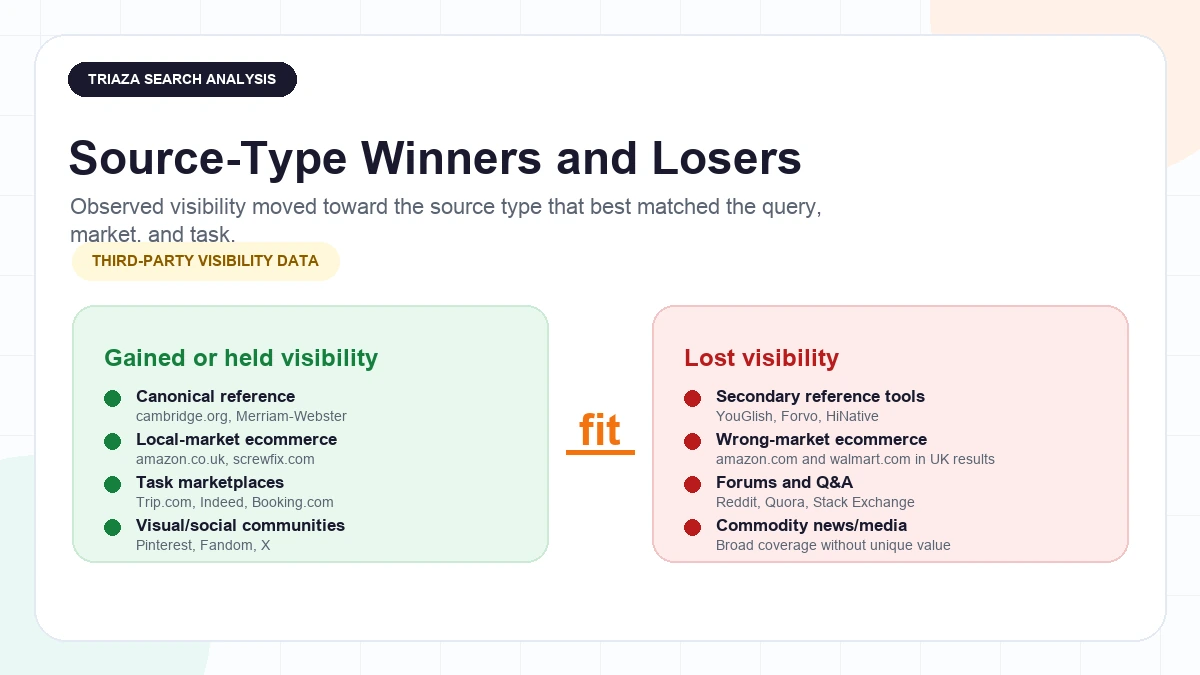
The recurring source-fit pattern makes a useful starting point for diagnosis across reference, forums, ecommerce, travel, jobs, and health. It remains a hypothesis to test against your own queries, pages, market, and conversion data.
Why this matters more because of AI search
This update also landed while generative answers were changing how search visibility is measured.
At Google I/O in May, Google said AI Overviews now has more than 2.5 billion monthly users and AI Mode has passed 1 billion. Ahrefs’ February 2026 study found the presence of an AI Overview correlated with a 58% lower click-through rate for the top organic result. And Ahrefs’ March 2026 citation study found only about 38% of AI Overview citations came from the top 10 classic results. AI visibility and blue-link visibility are related, but far from identical.
Those findings describe separate parts of the search journey. A page can rank in classic results, receive fewer clicks when an AI answer appears, and still not be cited in that answer. Where Google’s new report is available, teams can now measure some of that generative-search visibility directly instead of relying only on manual checks.
We cover citation selection engine by engine in AI Search in 2026: How to Get Cited. For Google’s search features, the same foundations still apply: crawlability, indexability, useful text and media, and original evidence. Those qualities can improve eligibility, but Google does not guarantee that any page will be shown or cited.
Five myths already spreading about this update
These five common claims do not match Google’s published guidance.
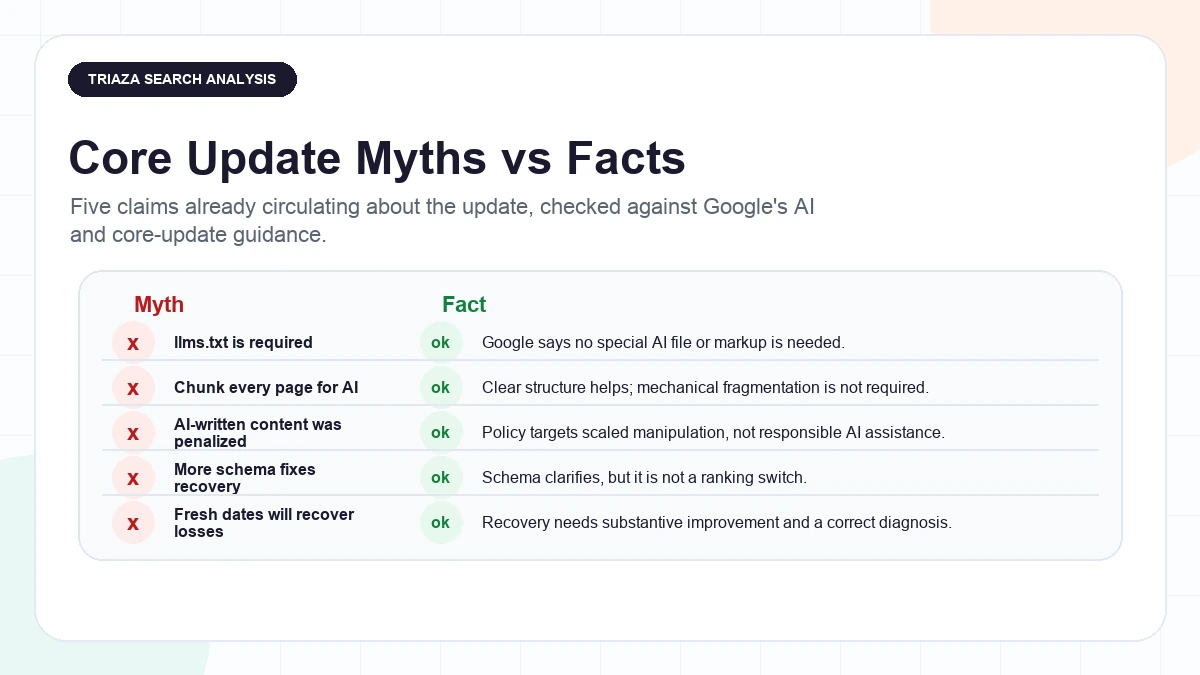
“You need llms.txt and special AI markup now.” Google’s AI guide says you do not need llms.txt, AI-specific markup, or special schema to appear in Google’s AI search features.
“You have to chunk your content into tiny blocks for AI.” The same guide says Google does not require AI-specific text chunking. Clear structure can help readers, but arbitrary fragmentation is not a Google requirement.
“AI-written content got penalized.” Google still says appropriate use of AI or automation is allowed. Using automation primarily to manipulate rankings violates its spam policies. Google has not said the May update targeted content based on how it was produced, and the third-party datasets cannot isolate writing method as a cause.
“More schema is the fix.” Schema clarifies entities and authorship, and it’s worth doing well. But Google explicitly warns against treating it as a citation or ranking switch, and nothing in the May data suggests markup separated winners from losers.
“You can recover with quick rewrites and fresh dates.” Google’s core-update guidance says to avoid quick fixes and make meaningful, sustainable improvements. Changing a date without improving the content does not do that. If the current results favor a different type of page, a light copy edit may not address the mismatch.
If you want the foundations underneath all of this, our deeper SEO guide covers the durable fundamentals Google continues to recommend.
What to do, by situation
For each query cluster that matters to revenue, ask: does this page help someone complete the task in the right market and in the format they expect?
If your traffic dropped. Pull the query clusters that lost impressions or position, and group them by intent rather than by URL. For each cluster, search the query and note what type of page ranks now: canonical reference, marketplace, local retailer, tool, or community thread. Check whether the leading pages match the market and format your page serves. If a different page type now dominates, decide whether you can create a genuinely useful version of that destination or whether the effort belongs in a query cluster that fits the business better.
Startups and SaaS. Review thin “topic coverage”: templated comparison pages, me-too glossary posts, and content built to capture searches rather than help someone decide. Consolidate or cut weak pages, and concentrate on fewer, more decisive assets: original benchmarks, real implementation guides, honest comparisons with pricing context, and customer stories with firsthand detail. A startup may not match an incumbent’s authority, but it can still create the clearest page for the specific job its product solves. This approach aligns with Google’s guidance and reduces dependence on interchangeable content. If you’re early on this, start with the basics in SEO Fundamentals for Startups before building out the cluster.
Small and local businesses. Protect the pages tied to calls, quotes, and bookings first. Make sure each service page states the area served, shows real proof, explains the service in specific terms, and matches current Business Profile information. Then publish what a local operator can document firsthand: neighborhood-level comparisons, permitting requirements, honest pricing variables, and before-and-after work. That material is harder to replace with a generic summary, although no page is update-proof.
Ecommerce and publishers. The most actionable ecommerce finding in these samples is market fit: verify that the correct country version ranks in each market, and review hreflang, currency, and shipping signals. Several wrong-market domains recorded large losses in the UK sample. For publishers, Sistrix’s UK news data is a reason to assess reliance on interchangeable coverage and invest in original reporting or formats that add value beyond a summary.
Quick answers
Was the May 2026 core update bigger than March? Google did not publish a comparative impact measure. Several independent trackers reported substantial volatility during the May rollout, but the answer depends on the sites and query sets each tracker monitors.
Did the update target AI-generated content? Google has not said so, and the available visibility studies do not test content-production method. Google’s standing policy allows AI-assisted content that is helpful and original; using automation primarily to manipulate rankings violates its spam policies.
How long does recovery take? Google says improvements can take effect in a few days or several months. Some changes may not be fully reflected until a later core update, but waiting for another core update is not always required. There is no guarantee of recovery, even after improvements.
Does this update change AEO? Google has not connected the core update to citation selection. Its AI-search guidance does reinforce the same foundation: pages must be indexed and eligible for a snippet, and they still need to be useful and reliable. None of that guarantees a citation.
Measure differently from here
Two changes to your reporting are worth making this month.
First, use the new Search Console generative-AI report if it is available in your property, and baseline that visibility alongside classic impressions and clicks. Second, do not use organic sessions as the only health metric. Ask whether you are visible for query clusters that drive revenue, whether AI answers cite you, whether branded demand is changing, and whether search still produces qualified conversions. Sessions can decline while some of those business signals improve.
Google did not announce a new ranking rule for the May update. Its standing advice is more durable: understand what changed in your own data, make substantive improvements for users, and avoid changes made only to chase the update. The third-party studies add a useful question to that review: does the page match the query’s task, market, and expected format?
Mapping losses by query intent, source type, and market can narrow the diagnosis before you commit to a rewrite or redesign. Our AI Search & Answer Engine Optimization service combines that analysis with the classic SEO fundamentals Google continues to recommend.