On July 22, OpenAI opened its self-serve portal to anyone with a credit card. Best Buy, Lowe’s, and VistaPrint were named among the early advertisers, but the part that matters for everyone else is what disappeared: the large minimum spend that had kept ChatGPT Ads a big-brand product since the February pilot.
So the gate is open. The question stopped being “can I get in” and became “what does a real test cost, and what will I know when it’s over.”
That second half is where most of the launch coverage goes quiet.
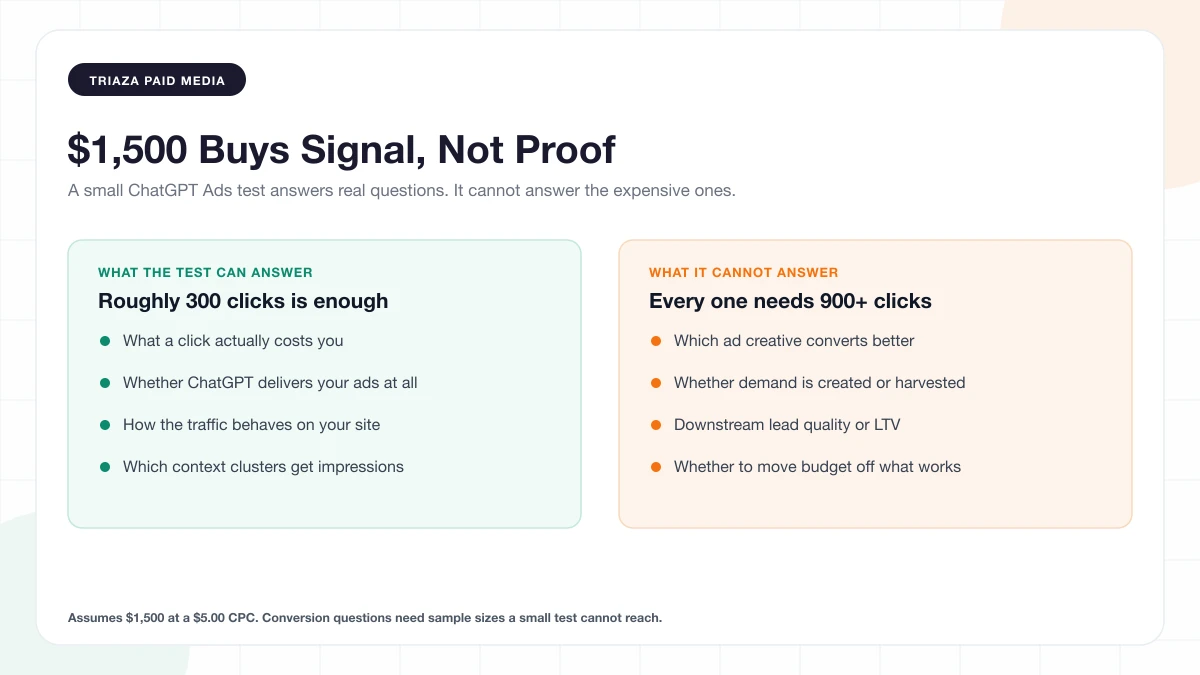
A $1,500 test on ChatGPT Ads buys somewhere between 83 and 428 clicks depending on your category, and that is enough to answer questions about delivery, click cost, and traffic quality. It is not enough to pick a winning creative, prove incrementality, or justify moving budget off a channel that already works. The binding constraint isn’t the CPC. It’s the sample size.
Here’s the arithmetic behind that, and the specific list of things the platform still can’t tell you.
What Actually Changed, and When
The rollout happened in stages, and the dates matter because most of the “benchmarks” circulating right now come from different stages of a moving product.
OpenAI started testing ads inside ChatGPT in February 2026, sold at a $60 CPM with a minimum spend that put it out of reach for small advertisers. On May 5, OpenAI launched the beta self-serve Ads Manager and added cost-per-click bidding alongside CPM. A conversion-optimized objective followed on June 5, letting you optimize toward a conversion event while still paying per click. July 22 opened the door to everyone.
Four months, four meaningful changes. Any case study you read needs a date attached to it or it’s describing a different product.
The ad itself is one format. A sponsored card below a ChatGPT response, labeled as sponsored, carrying an advertiser name, favicon, title, a line of copy, an image, and a landing page. OpenAI’s documented limits are tight: a title of 3 to 50 characters and body copy up to 100. That’s a display ad’s worth of room to make a search ad’s worth of argument.
Two constraints on that inventory are worth internalizing before you budget anything.
Ads only serve to adult accounts on the free and Go tiers. Plus, Pro, Business, Enterprise, and Edu users never see them. Whatever share of your market pays for ChatGPT is unreachable through this channel, and for B2B software in particular, that’s plausibly the segment you most wanted.
And you don’t buy keywords. You write what OpenAI calls context hints at the ad-group level, described in its own documentation as broad thematic guidance rather than exact-match terms. The auction is relevance-weighted and second-price, so the system’s read of whether your ad fits the conversation is competing with your bid for control of delivery. You are describing situations people bring to ChatGPT and letting the model decide when that’s you.
If you’ve spent years building negative keyword lists, understand what you’re giving up. There’s no equivalent lever here.
The Arithmetic of $1,500
Start with the floor, because it shapes everything else. The minimum daily spend is $25 per campaign. That single number decides your test’s structure before you’ve written an ad.
At the minimum, one campaign stretches $1,500 across 60 days. Two campaigns burn it in 30. Three campaigns finish in 20. Every campaign you add divides the same money and shortens the window, and since reporting runs on a delay, a 20-day test is really about two usable weeks of decision-making.
Two campaigns is the sensible ceiling for this budget. Expand ad groups, not campaigns.
Before any of that arithmetic matters, though, there’s a prior question: whether a new channel is where this $1,500 belongs at all. Sequencing a startup marketing budget puts a channel test behind the conversion path it feeds, on the logic that pushing more traffic into a path that leaks just buys more leakage.
Now the clicks. OpenAI recommends a starting max CPC bid of $3 to $5. Realized costs run wider than that in practice, so here’s the full plausible range applied to $1,500:
| Scenario | CPC | Clicks from $1,500 | Impressions at 0.68% CTR | Conversions at 2.5% |
|---|---|---|---|---|
| Early-mover pricing | $3.50 | 428 | ~63,000 | ~11 |
| OpenAI’s guidance ceiling | $5.00 | 300 | ~44,000 | ~8 |
| Tighter targeting | $7.00 | 214 | ~31,500 | ~5 |
| Competitive B2B | $12.00 | 125 | ~18,400 | ~3 |
| Expensive category | $18.00 | 83 | ~12,300 | ~2 |
That table is arithmetic, not measurement. It divides $1,500 by a CPC and applies a CTR and conversion rate drawn from the early public reporting discussed in the next section. Your own numbers will differ. The point isn’t the precision, it’s the order of magnitude, and the order of magnitude is dozens of conversions at best, single digits in most cases.
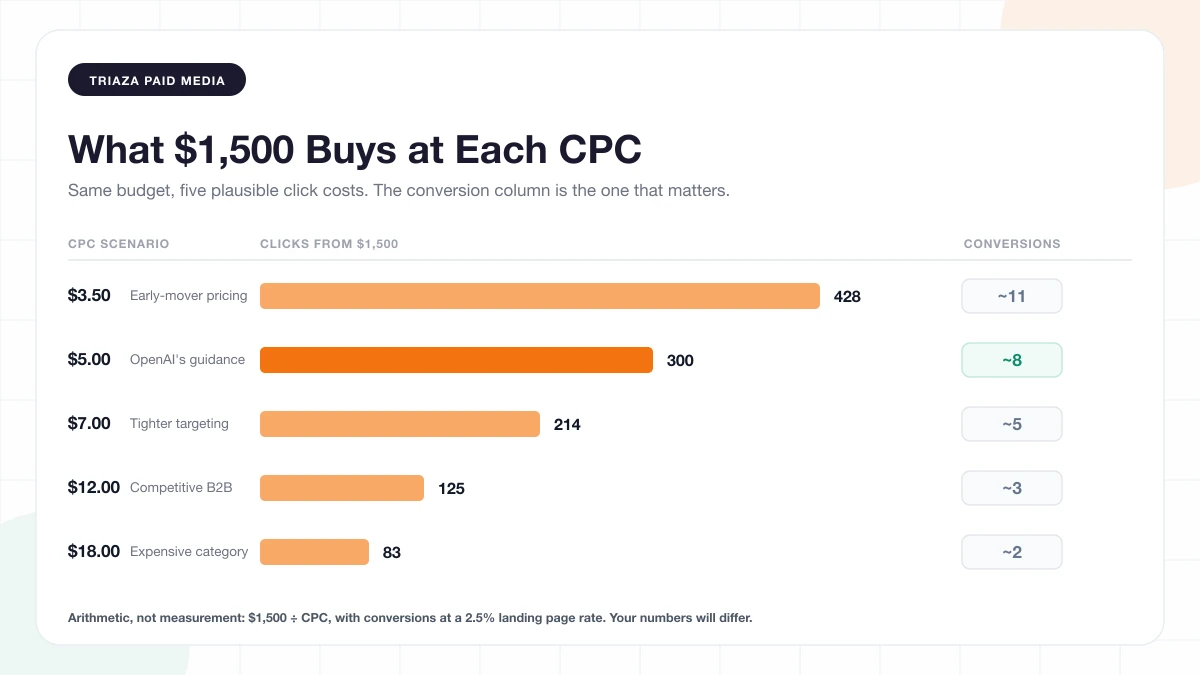
Hold that last column in mind. Eight conversions is the good case.
What the Early Numbers Actually Say
The public evidence on ChatGPT Ads performance is real, thin, and heavily retail-weighted. All of it is worth reading and none of it is worth planning against without caveats.
On click-through rate, Similarweb’s May 2026 analysis put the overall CTR at 0.68%, with the top quartile of advertisers at 1%, the best-performing brands at 1.57%, and an observed peak of 5.4%. For context, the same analysis pegs display advertising near 0.35%. That’s an outside observer measuring the platform rather than OpenAI reporting its own results, so treat it as a directional read on a market that was six weeks past self-serve launch when it was taken. Also note the shape of that distribution: the gap between 0.68% and 1.57% is the gap between average execution and good execution, not between platforms.
On conversion quality, the more interesting signal comes from Criteo. Across a sample of 500 US retailers, Criteo reported that users arriving from ChatGPT and similar AI platforms converted at roughly 1.5 times the rate of other referral channels, and a May update said AI-referred conversion rates were approaching twice those of traditional search in several retail categories. That is a partner reporting on its own client base in one vertical. It is not platform-wide, it isn’t audited, and retail is the category where conversational recommendation should work best. Still, the underlying logic is sound and it’s the same reason paid search commanded premium CPCs for two decades: someone who has been talking through a decision arrives further along than someone who saw a banner.
The most useful single account read comes from Opascope’s write-up of 15 days and roughly $60,000 in spend: about $1.72 CPC, a 2.35% conversion rate, and 1.49x blended ROAS. Read their caveats, because they’re the honest part. Daily ROAS swung between 0.2x and 2.9x, which means any single day told you nothing. They found the native dashboard under-reported conversions and ran on first-party tracking instead. And they say plainly that a $1.72 CPC reflects thin competition in a weeks-old auction, with OpenAI’s published $3–$5 range being the direction cost is more likely to travel.
Synthesizing across all three: broad-consumer and retail advertisers with a specific offer have the better early case. Competitive B2B, SaaS, and regulated categories face rising click costs against a still-immature measurement stack, with anecdotal CPCs in the $8 to $15 range, and the paying-tier exclusion cutting against them on top of it.
Which brings us to the actual problem with a $1,500 test.
The Sample Size Problem
This is the section I’d most like small advertisers to sit with, because it’s the one that doesn’t show up in launch coverage and it decides what your money can buy.
Statistical confidence in a conversion rate depends on the number of conversions, and conversions are the scarcest thing a $1,500 budget produces. Run the standard confidence interval math on a 2.5% conversion rate and the requirements land here:
| What you want to know | Sample needed | Achievable on $1,500? |
|---|---|---|
| CTR near 0.68%, within ±0.3pp | ~2,900 impressions | Yes, easily |
| CTR near 0.68%, within ±0.2pp | ~6,500 impressions | Yes |
| Conversion rate near 2.5%, within ±1.5pp | ~417 clicks | Only in the cheapest scenario |
| Conversion rate near 2.5%, within ±1.0pp | ~937 clicks | No |
| Detect a doubled conversion rate, 2.5% → 5.0% | ~902 clicks per variant | No |
| Detect a 20% lift, 2.5% → 3.0% | ~16,770 clicks per variant | Not remotely |
Those are standard two-proportion and binomial calculations at 95% confidence and 80% power, applied to the CTR and conversion assumptions above. They’re arithmetic about uncertainty, not claims about ChatGPT specifically.
Look at the last two rows. Proving that one creative doubles your conversion rate against another needs about 902 clicks in each arm. At a $5 CPC, that’s roughly $9,000 to run one clean creative test. Detecting a realistic 20% improvement, the kind of margin real optimization actually produces, needs about 16,770 clicks per variant, which is around $168,000.
You are not running a creative test on $1,500. You’re running four ads and watching which ones the system chooses to deliver.
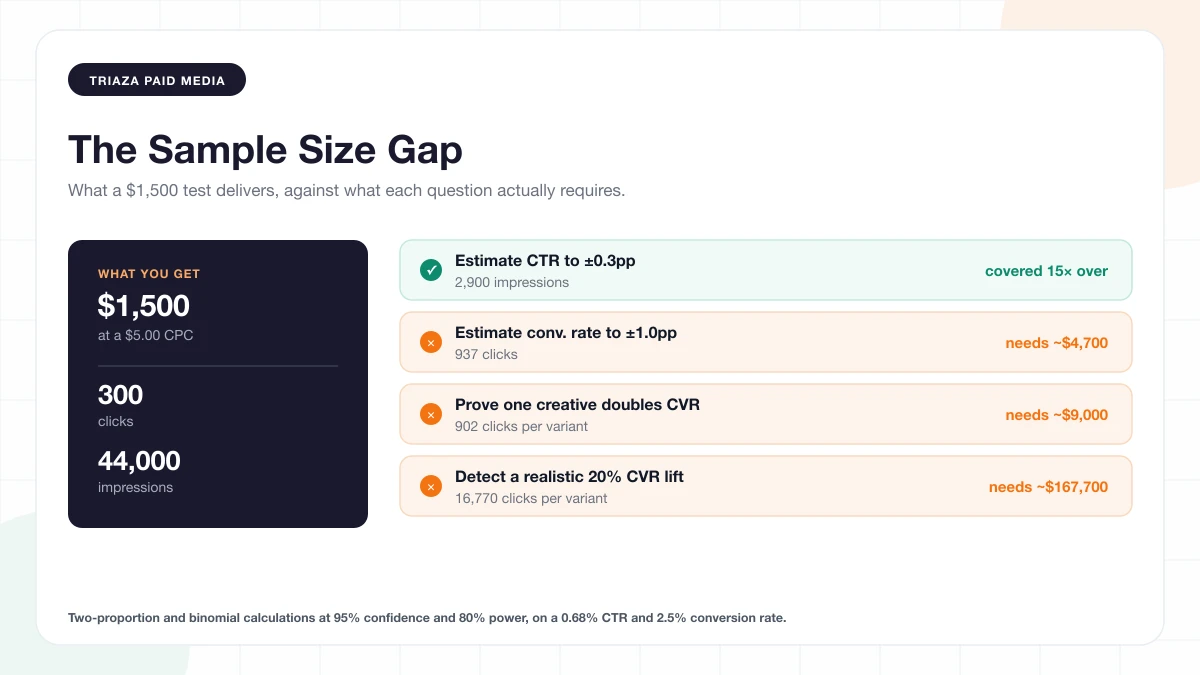
The useful reframe is that the CTR side of the ledger is comfortably answerable. At a $5 CPC you’ll generate roughly 44,000 impressions, and estimating click-through rate well needs only a few thousand. So the test can genuinely tell you whether ChatGPT finds your ads relevant enough to deliver, what your clicks cost, and how that traffic behaves on your site.
It cannot tell you which ad wins. Plan the spend around the questions it can answer.
What You Genuinely Cannot Measure Yet
Some of these gaps will close as the product matures. One of them won’t, and it’s the one that changes how you work.
There is no search terms report, and there isn’t going to be one. Nothing in Ads Manager tells you which prompts triggered your ads. OpenAI frames this as structural privacy design rather than a beta gap, and it follows from the product: advertisers get aggregated performance data, not conversations. Every paid search workflow that starts with reading the query report — mining for new themes, cutting the waste, discovering how people actually phrase the problem — has no equivalent here. Your context hints go in, delivery comes out, and the middle is closed. That’s the biggest working-habit change for anyone coming from Google Ads.
View-through attribution and attribution windows aren’t documented. Measurement is built around clicks, through the OpenAI pixel, the Conversions API, or both, using a first-party __oppref cookie and event-ID deduplication when you run both. What’s missing from public documentation is the surrounding scaffolding: view-through methodology, a clear default attribution window, lift studies, and incrementality tooling. For a channel whose whole pitch is influencing decisions mid-conversation, having no view-through measurement is a meaningful blind spot. Assume you’re undercounting and don’t pretend to know by how much.
Reporting lags. Impressions and clicks can take up to seven hours to appear, and OpenAI advises waiting a full day before flagging delivery problems. Same-day optimization on this platform is mostly noise-chasing.
Custom audiences need 25,000 matched users. OpenAI’s minimum for a usable audience, whether for inclusion, exclusion, or bid multipliers, is 25,000 matched users, and combinations must still clear that floor after exclusions. Most businesses spending under $5,000 a month don’t have a list that size. Plan as though this feature doesn’t exist for you, because for most readers of this article it doesn’t.
Native conversion counts may not match yours. The one published account study found the dashboard under-reported. Static UTM parameters do persist on clicks, so tag every URL and reconcile against your own analytics. Treat your analytics as the source of truth and Ads Manager as a delivery monitor.
One operational trap worth naming, since it silently kills campaigns: your landing pages have to allow OpenAI’s OAI-AdsBot crawler. If your bot management blocks it, ads get rejected at review. Check that before you build anything else.
How to Spend the $1,500 So the Learning Survives
Given all of that, the design of a good test follows fairly directly.
Instrument before you launch. Pixel and Conversions API if you can run both, static UTMs on every destination URL, OAI-AdsBot allowlisted, and a verified thank-you or confirmation event. A test that produces untrustworthy conversion data has wasted the entire budget, because conversions were already your scarcest resource. Check what happens after the conversion too, since a lead that lands in a shared inbox nobody owns will read as a channel failure when it was a handoff failure.
Two campaigns, at $25 a day each, for 30 days. One built around the broad problem your product solves, one around comparison and decision-stage situations. That split is the actual experiment: it tells you whether this channel reaches people who are deciding or people who are exploring, and those two answers lead to very different follow-up spends.
Write context hints as situations, not keywords. The system matches on conversational context, so describe the circumstance a person is in when your product becomes relevant. This is closer to writing an audience brief than a keyword list, and if your messaging is already documented, most of the work is done.
Point every ad group at a specific page. With 50 characters of title and 100 of body, the landing page carries the argument. Homepages waste the click.
Judge on rolling two-week windows. Daily ROAS swung from 0.2x to 2.9x in the one published account we have. Reading a single day of this data will make you change something you shouldn’t.
Write down your decision rule before you launch. Something like: if CPC stays under $X and ChatGPT sessions engage at or above our paid search baseline, we fund a second test; otherwise we stop. Deciding what would change your mind, in advance, is what separates a test from an experiment you rationalize afterward.
What a Good Result Actually Looks Like
Here’s the honest bar. A successful $1,500 ChatGPT Ads test ends with you able to say: our clicks cost roughly $X, the traffic engaged better or worse than our other channels, comparison-stage context outperformed broad problem context (or the reverse), and here’s the budget at which the next test becomes worth running.
That’s a real answer. It’s worth $1,500. It’s also not a verdict on the channel, and anyone who tells you their $1,500 test proved ChatGPT Ads work or don’t work is reading noise as signal.
The strategic case for testing now isn’t the performance data, which is too early to trust. It’s positional. This is a genuinely new inventory type with a relevance-weighted auction and no query report, which means the operational skill of writing good context hints has to be learned by doing rather than transferred from Google. Learning that on $1,500 while the auction is still soft costs less than learning it in eighteen months against advertisers with a year of practice. The same argument applies to showing up in AI search results organically, which is the cheaper half of the same bet and shouldn’t be skipped in favor of the paid version.
Test it if you have clean tracking, a specific offer, a landing page that isn’t your homepage, and $1,500 you can spend on information rather than revenue. Skip it for now if your tracking is shaky, if your buyers are the ones paying for ChatGPT Plus, or if that $1,500 is currently producing a known return somewhere else.
And if you’d like the test structured so the results survive contact with your existing reporting, that’s the conversation to have before the money goes in, not after.
Questions Small Advertisers Keep Asking
How much do ChatGPT Ads cost? OpenAI recommends a starting max CPC bid of $3 to $5, with a minimum daily spend of $25 per campaign. Realized costs vary widely by category: one published account reported about $1.72 CPC during the early low-competition period, while practitioners in competitive B2B categories report $8 to $15. Budget against the $3 to $5 range and treat anything cheaper as a temporary artifact of a young auction.
Is $1,500 enough to test ChatGPT Ads? Enough to answer some questions, not others. At a $5 CPC it buys roughly 300 clicks and 44,000 impressions, which is plenty to assess delivery, click cost, and how the traffic behaves on your site. It’s well short of the roughly 900 clicks per variant needed to compare two creatives on conversion rate with any confidence. Structure the test around the questions the budget can actually answer.
Can I see which prompts triggered my ads? No, and this isn’t a beta limitation. Ads Manager has no search-term or prompt-level reporting, and OpenAI describes this as a structural privacy design choice. You provide thematic context hints at the ad-group level and receive aggregated performance data. If your paid search process depends on mining query reports, that workflow doesn’t carry over.
Who actually sees ChatGPT Ads? Adult accounts on the free and Go tiers. Plus, Pro, Business, Enterprise, and Edu users don’t see ads at all. If your buyers are heavy paid-tier users, which is plausible for developer tools and B2B software, a meaningful share of your market isn’t reachable through this channel.
Does ChatGPT Ads traffic convert better than search traffic? The early evidence points that way in retail and is too thin to generalize. Criteo reported AI-referred users converting at roughly 1.5x other referral channels across 500 US retailers, with a later update saying some retail categories approached 2x traditional search. That’s a partner reporting on its own client base in the single vertical where conversational recommendation should perform best. Measure it yourself against your own baseline rather than assuming the premium transfers.
What’s the biggest measurement gap right now? No documented view-through attribution and no clear default attribution window. Conversion measurement is built around clicks via the pixel and Conversions API, so any influence the ad has without an immediate click is invisible. For a channel meant to reach people mid-decision, assume you’re undercounting conversions and don’t try to guess the magnitude.
Should I use custom audiences? Probably can’t. OpenAI requires at least 25,000 matched users for an audience to be usable, including after exclusions are applied. Most businesses under $5,000 a month in spend don’t have a CRM list that clears that bar. Plan your test without it.
How long should I run the test? Thirty days at two campaigns and the $25 daily minimum, which is exactly what $1,500 covers. Shorter than that and reporting delays plus day-to-day volatility eat your read. Judge results on rolling two-week windows, since daily swings in the one published account ranged from 0.2x to 2.9x ROAS.