Someone fills out your demo form on a Tuesday afternoon. The CRM creates a record. An email lands in a shared inbox that two people half-watch. Thursday your one salesperson is prepping a different call and never opens it. The following Monday the prospect signs with someone else, and nobody at your company ever knows it happened.
Nothing broke. No integration failed, no webhook errored, no validation rejected anything. The lead was captured correctly and then quietly went nowhere, because no single person had agreed to own it inside a stated window.
In our experience this is the most common revenue leak in an early-stage company, and close to invisible. Marketing reports leads generated. Sales reports deals closed. The gap gets explained away as lead quality, both sides are partly right, and neither has data, because the handoff was never defined and there’s nothing to audit.
The fix is not a CRM feature or a bigger tool budget. It’s a short set of agreements between the people generating demand and the people working it, and that’s what our sales and marketing alignment work is built around.
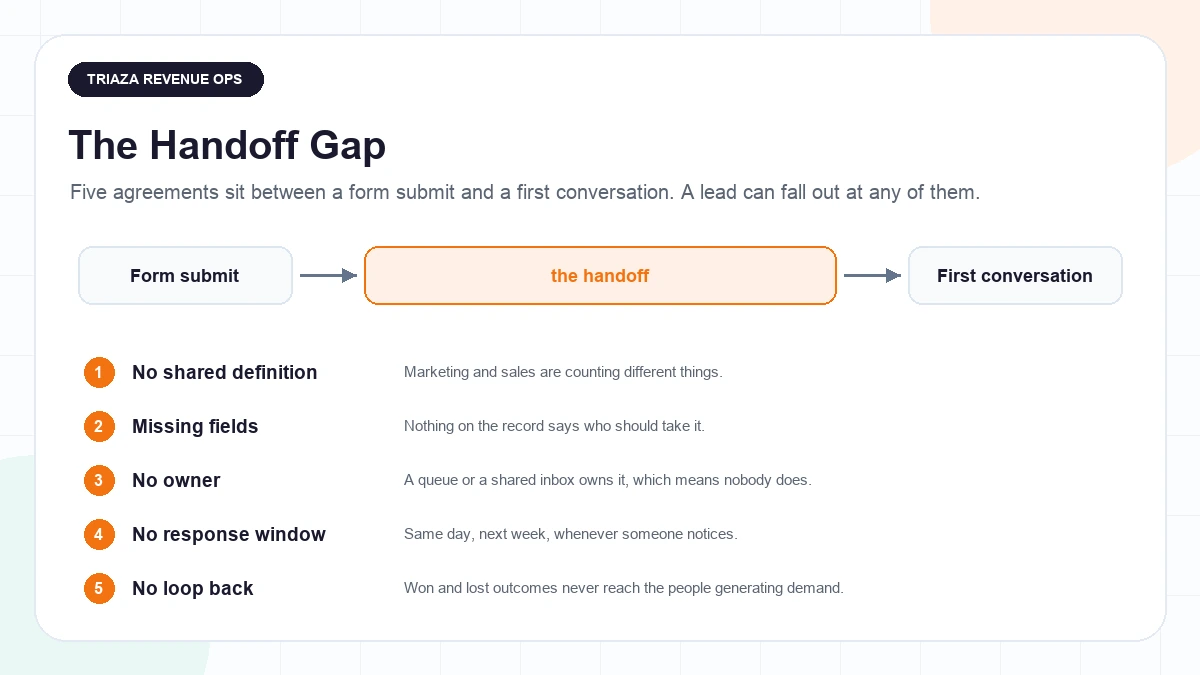
A working marketing-to-sales handoff is five agreements: a shared definition of a good lead, a small set of required fields, a named owner for every record, a response time you can actually hit, and a path that sends won and lost outcomes back to marketing. A two-person team can run all five without buying new software.
One warning before the evidence below: almost every number you’ve heard about lead response speed comes from a company selling lead response software, and the loudest ones are well over a decade old. This article uses them, dates each one, and says who funded it.
Why the Handoff Breaks, and Why It Is Usually Invisible
The handoff assumes a buyer moving in a straight line: marketing attracts, marketing qualifies, marketing passes the baton, sales runs. Gartner argued in an October 2018 release from its Sales and Marketing Conference that the linear handoff should no longer exist at all, because B2B buyers don’t work through purchase activities in sequence. Its model describes six buying jobs, problem identification, solution exploration, requirements building, supplier selection, validation, and consensus creation, and says buyers loop back through them. Gartner’s own qualifiers belong in the same breath: it says “nearly every successful B2B purchase” progresses through the first four jobs, and that “most B2B buyers” revisit nearly every job at least once. That’s analyst commentary in a press release rather than an empirical study with a disclosed sample, from a firm that sells advisory work on this exact problem. Gartner also never mentions MQLs or SQLs; connecting its critique to lifecycle stage naming is our reading, not theirs.
The practical version: a prospect reads two of your posts in March, forgets you, gets a new mandate in September, asks a peer for recommendations, checks pricing twice in one evening, and books a call. Your CRM sees the last of those events, and the stage the record sits in reflects your process rather than the buyer’s.
Gartner’s Future of Sales research, reported in September 2020, put numbers beside that: buyers spend roughly 17% of their purchase-consideration time in direct contact with any potential supplier, and 33% of B2B buyers said they’d prefer a completely seller-free purchase, rising to 44% of millennial buyers. Those figures come with no disclosed sample size or methodology in this coverage, which is secondary reporting on Gartner rather than Gartner’s own page.
If most of the buying happens where you can’t see it, the few moments you can see carry more weight than they used to. Losing one of them to a shared inbox is expensive in a way the pipeline report will never show you.
Start with a Shared Definition of a Good Lead
Gartner’s marketing practice put the first step plainly in an April 2020 release on aligning marketing and sales: marketing and sales should jointly define what makes a good lead as it moves through the funnel, and agree on the minimum criteria a lead has to meet before sales engages. That’s analyst recommendation from Gartner for Marketers, quoting VP analyst Noah Elkin, not survey data, so no number attaches to it. It’s also the step most small teams skip, because when there are three of you it feels like something you already agree on.
You usually don’t. A Gartner survey of more than 200 sales leaders, published March 2023, found 62% of respondents said sales and marketing define qualified leads differently at their company. That’s self-reported by one population, sales leaders rather than marketers, fielded across November and December 2022, from a firm that sells alignment advisory, so read it as a strong signal rather than a measurement. In our experience the disagreement is rarely philosophical. Marketing counts a director at a 200-person company who downloaded a guide. Sales wants someone with a budget line and a date. Both are defensible. Neither is written down.
Write the ICP Down or It Does Not Exist
An ideal customer profile living in one founder’s head isn’t a shared definition, it’s a preference. Getting it out takes about an hour. Start from your last ten closed-won deals and your last ten losses, and write what was actually true about them: company size band, who signed, what triggered the search, what they’d tried before you, how long it took. Patterns show up fast at small volumes, and they’re usually narrower than the market you describe to investors. It’s the same exercise underneath explaining a new category to buyers who don’t have a budget line for it.
Then put the agreement somewhere both teams can see it. A shared doc is fine. What matters is that it exists as an artifact you can point at during a disagreement, the same reason a documented message blueprint beats an unwritten one. Undocumented agreements get renegotiated in every argument, which is why our marketing strategy work usually starts here.
The Disqualification List Does More Work
Most teams write down what makes a lead good. Fewer write down what makes one unworkable, and that second list earns its keep faster: no budget authority and no path to it, a use case you’ve already failed at twice, a company small enough that your price is a non-starter, a competitor doing research. A disqualification list lets one salesperson clear a queue in ten minutes instead of an hour, and gives marketing a concrete answer when a campaign starts producing volume nobody can work. That’s our recommended practice rather than a sourced finding, and it costs nothing to test against your own last thirty leads.
MQL, SQL, and Whether a Two-Person Team Needs Either
Lifecycle stages ship with every CRM, so startups adopt the full set because it’s there. Then the MQL stage becomes a graveyard: leads go in, nobody defines the exit, and six months later 400 records sit there permanently.
There’s directional evidence that alignment matters. That same Gartner survey of 200-plus sales leaders, published March 2023, found organizations aligning cross-functional KPIs were nearly three times more likely to exceed new-customer-acquisition targets, which is a correlation between two self-reported measures rather than demonstrated causation, from one respondent population in a two-month window, published by a firm selling alignment advisory. What it doesn’t establish is how many stages you need, and we’re not going to invent a number.
A stage is only useful if it answers one question: who is responsible for this record right now, and what has to be true for it to move? Open your CRM, list your stages, and write the owner and the exit condition for each. Any stage where you can’t fill both blanks is a label, and labels rot.
The Two-Person Version: Fewer Stages, Clearer Exits
For one or two sellers we’d run three states rather than five: new and unworked, working, and either qualified into a real opportunity or disqualified with a reason. The reason code matters more than the stage count, because reason codes are what let you tell marketing something useful later.
If you already have an abandoned MQL field, don’t delete the history. Freeze it, stop writing to it, and run the new states forward from today. Retroactively reclassifying 400 stale records is how this project dies in week two. That’s operating judgment rather than a benchmarked practice, and the counter-argument is real: if you expect to raise and scale the team inside a year, adopting standard stage names early saves a migration later.
How Fast Do You Actually Have to Respond
This is where the advice is loudest and the evidence is thinnest, so it’s worth walking through in order.
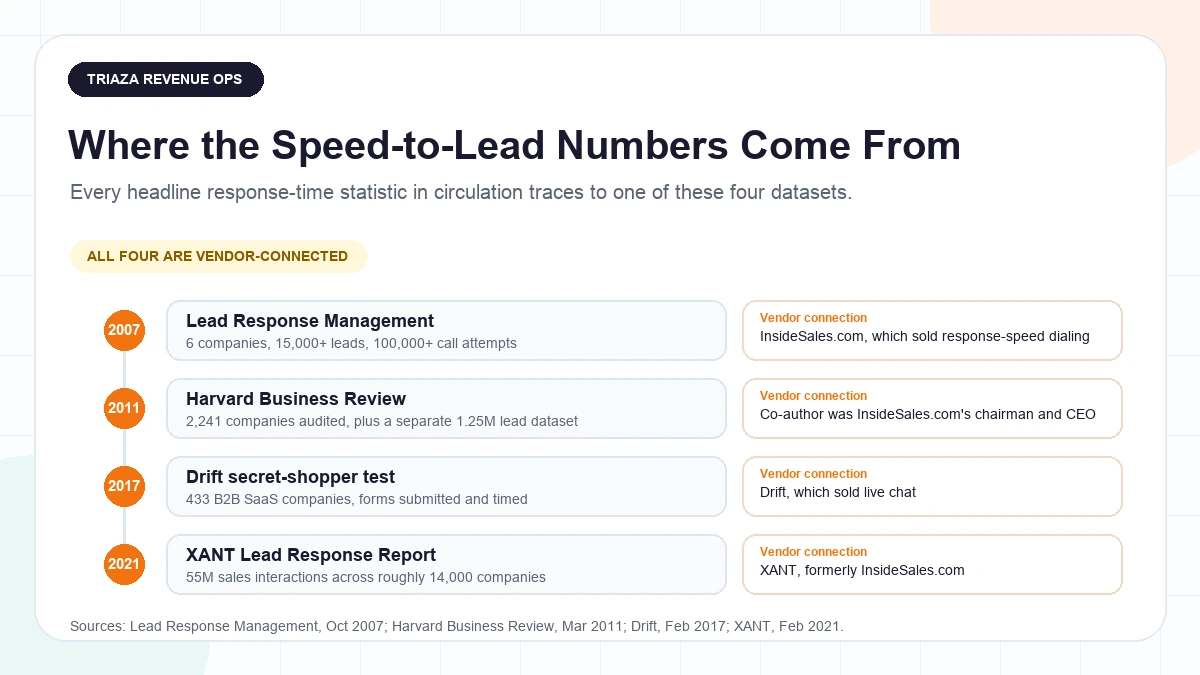
The famous multipliers come from a study presented on October 16, 2007. Dr. James Oldroyd, then a research fellow at MIT Sloan, worked with InsideSales.com on the Lead Response Management study, covering roughly three years of data, more than 15,000 leads and more than 100,000 call attempts across six companies. It found that contacting a lead at five minutes rather than thirty made the odds of reaching them 100 times higher and the odds of qualifying them 21 times higher. Read those with the document open: it’s a vendor-commissioned, self-published white paper from a company selling response-speed calling technology, the available version is explicitly an abridged seven-page summary of a 35-page study, that same document markets InsideSales.com’s own product, the sample is six companies, and it measured odds of contact and qualification only. It says nothing about close rates. Worth correcting while we’re here, because it shows up constantly: the 100x and 21x figures are not Harvard Business Review’s.
HBR published its own research in March 2011, by Oldroyd, Kathleen McElheran and David Elkington, and it reports different numbers. The audit portion planted one web-generated test lead at each of 2,241 US companies and timed the reply: 37% responded within an hour, 16% within one to 24 hours, 24% took longer than 24 hours, and 23% never responded. Among companies that did respond within 30 days, the average response time was 42 hours. That measures contact behavior via a planted lead rather than sales outcomes, the 42-hour average applies specifically to companies responding inside 30 days, co-author Elkington was chairman and CEO of InsideSales.com at the time, and the dataset is now more than fourteen years old.
The same article reports a second, separate dataset of 1.25 million leads across 29 business-to-consumer and 13 business-to-business US companies. There, contacting within an hour made a firm nearly seven times as likely to qualify a lead as contacting an hour later, and more than 60 times as likely as waiting 24 hours or more. “Qualify” in that paper means reaching a meaningful conversation with a key decision-maker, a much lower bar than a deal, the authors publish no methodology for how those 1.25 million leads were assembled, and it’s a different dataset from the 2,241-company audit, though the two get blended constantly.
Six years later Drift ran a secret-shopper test and published the results in February 2017: real forms submitted to 433 B2B SaaS companies, timed. Only 7% replied within five minutes, and 55% never replied at all within five business days. Drift also found 14% of the 433 used live chat, and that all ten of the fastest responders did. That last correlation deserves a raised eyebrow, since Drift sold live chat and the test was designed and published by Drift’s own director of marketing. The sample is B2B SaaS specifically rather than B2B generally, and Drift discloses no method for selecting the 433. If you see “45% responded” quoted anywhere, that’s arithmetic on Drift’s 55%, not a figure Drift published.
The most recent entry is XANT, the company InsideSales.com renamed itself into. Its February 2021 Lead Response Report drew on 55 million sales interactions across roughly 14,000 companies and reported conversion rates about eight times higher when contact happened within the first five minutes. It also found that in lead flows where marketing automation led the prospecting, only 23% of leads were ever touched by a rep at all, and 57.1% of the ones that did get a first call waited more than a week for it. That 57.1% is specific to marketing-automation-led flows and isn’t a general first-call statistic. All of it is XANT’s own platform data released as a press release, with no published methodology, no confidence intervals and no independent audit, from a company selling the sales-engagement software that produced the numbers.
What the Evidence Actually Supports
Line those four up and the pattern is obvious. Nobody outside the response-speed software industry has published a serious speed-to-lead study, and the newest of these is from 2021. The 2007 study and the 2011 article share an author, and the 2011 article’s third author ran the company that funded the 2007 one. Drift is the only dataset outside that lineage, and Drift sold chat software.
That doesn’t make the finding wrong. Four datasets, gathered by different methods across fourteen years, point the same direction, and the direction matches how anyone behaves after submitting a form: still at the desk, still holding the problem, still shopping. Faster is better, and the drop-off is steep early. What none of it supports is treating five minutes as a threshold with physics behind it. That number comes from a six-company vendor white paper and has been repeated until its provenance vanished. Build on the direction, not the decimal.
A Defensible SLA for a Two-Person Team
Everything here is our operating judgment, not a study finding, and we’d rather say so than dress a recommendation up as research.
What we’d run at two people: a stated target of one business hour for a first human response to anything from a demand form, with a hard backstop of same business day. Not five minutes, because a two-person team that promises five minutes will miss it, stop measuring, and be back to a shared inbox within a month. One hour is aggressive enough to change behavior and achievable enough to survive a busy Tuesday.
Two habits make that number real. Give inbound a single named owner per day rather than routing to a group, because a group owns nothing. And measure it: pull your last twenty leads, compare record creation time to first outbound touch, and read the distribution rather than the average, which will be flattered by whichever three someone happened to catch instantly. An automated confirmation email is worth sending and doesn’t count as the response. None of the four studies tested auto-replies, so there’s no evidence either way, but what all of them measured was a human attempting contact.
Form Strategy: What to Ask and What to Stop Asking
Every field is a trade: information you might use for routing against the probability the person finishes. Most teams argue this from opinion, because the public evidence is genuinely bad.
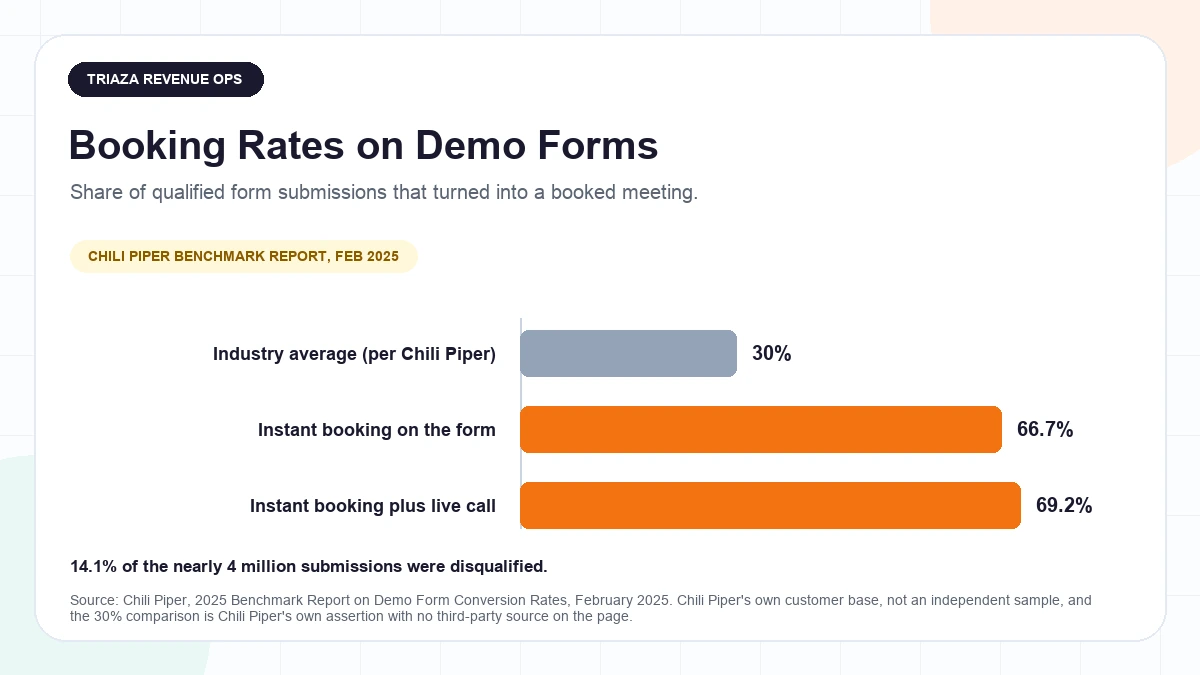
What exists is vendor data. Chili Piper’s 2025 benchmark report on demo form conversion, published February 2025, analyzed nearly 4 million form submissions from 2024 and reported a 66.7% booking rate for qualified submissions when the form let the prospect book a meeting instantly, against a 30% industry-average booking rate the report cites with no third-party attribution anywhere on the page. It also found 14.1% of submissions, 561,977 of them, were disqualified. All of that comes from Chili Piper’s own customer base, a self-selected population that had already invested in sales operations tooling, and Chili Piper sells the instant-scheduling product being credited.
The same report found that offering a live-call option immediately after submission produced a 69.2% booking rate against that 66.7% average. The gap is 2.5 percentage points; Chili Piper’s own framing calls it a 3.75% increase, which is the relative figure rather than a percentage-point difference, and it’s still one vendor’s customer data rather than an independent test. Discount the specific numbers and keep the structural point, which is that the step after the form is part of the form. If submitting produces a thank-you page and a promise, you’ve added a wait. If it produces a calendar, you’ve closed the handoff at the moment of highest intent.
How Many Fields Is the Wrong Question
The honest answer is worth stating plainly, because the internet is full of confident alternatives: we could not find a single dated primary source with real B2B lead-form field-count conversion data. The precise percentages that circulate, forms with five fields converting 120% better and so on, trace back to listicles citing other listicles, and several of the most-quoted tables don’t appear in the reports they’re attributed to.
The closest defensible reference comes from a different discipline. Baymard Institute’s checkout research, updated June 2024, found the average e-commerce checkout flow contained 11.3 form fields, down from 11.8 in 2021 and 12.7 in 2019. That’s e-commerce checkout research, not B2B lead generation, and citing it as a lead-form statistic would be a factual error; it’s here strictly as an analogy for field-count friction over time. Baymard discloses no sample size for the 11.3 figure beyond its cumulative research-hours claim.
So the useful question isn’t how many fields, it’s which fields change what happens next. If a field doesn’t route the lead, qualify it, or let you attribute it later, it’s costing completions for nothing. Ask for what you’ll act on within the hour and get the rest from the conversation. If the form is part of a site you’re building, this belongs in the same pass as the rest of the launch checklist, and it’s one of the places our website work usually finds easy gains.
The Fields That Actually Have to Be Captured
No confirmed source supports any particular field list, so what follows is our operating recommendation rather than a benchmark. A field earns its place if a human or a rule makes a decision from it, which splits your CRM into three groups.
Required, because routing depends on them. Enough identity to reach a person, enough context to know which of you should take it, and the fields the system stamps for free: source, campaign, landing page, timestamp. The buyer fills the first two groups. The system fills the third, which is why the third should never be a form question.
Optional, because they help but shouldn’t block. Company size, timeline, current tooling. Useful for prioritizing, not worth losing a submission over. Ask on the call.
Delete, because nobody decides anything from them. Any picklist you added for a report you stopped running, any free-text field that’s empty on 80% of records, any field whose only consumer left the company. Run that audit quarterly and the CRM stays legible. Skip it for two years and you get the classic situation where six fields mean roughly the same thing and none is reliable.
Contact data also goes stale on its own. People change jobs, domains change, numbers get reassigned, and a record captured eighteen months ago is partly fiction now. We looked for a citable dated decay rate and didn’t find one we’d stand behind, so treat it as a known operational reality rather than a number: stamp a last-verified date on records you work, treat anything older than your typical sales cycle as needing confirmation, and resist bulk-importing lists you can’t maintain.
Routing and Ownership: Every Lead Has a Name on It
This section carries no statistic, deliberately. We went looking for credible dated research on how many leads sit unassigned, how long assignment takes, or which routing model performs better, and there isn’t any. The one thing that surfaced was a single-customer vendor case study, which is collateral rather than a benchmark. Anyone quoting you a percentage on unassigned leads is quoting something they can’t source.
What we can say from operating experience: the unowned record is the most common failure point in the whole system, and the hardest to notice. Every other failure is at least visible in a report. An unowned lead looks exactly like a worked one until you go looking.
Round Robin Versus Routing by Fit
At two sellers, round robin is usually right. It’s simple, obviously fair, and the alternative requires you to already know your fit criteria and to have them in a field at the moment of submission. Most early companies have neither. Routing by fit starts earning its keep when your sellers genuinely specialize, when deal sizes vary enough that a mismatch is expensive, or when you’re selling into segments with different vocabularies.
Whichever you pick, write down what happens when the owner is out. A round robin that assigns Thursday’s leads to someone on vacation until Monday is worse than no routing at all, because it manufactures a record that looks assigned.
How to Find Leads Sitting Unassigned
Three filters, and they work in any CRM you’re likely to be running: records with no owner or an owner that’s a queue, a team, or a deactivated user; records created longer ago than your SLA window with no logged activity of any kind; and records owned by someone who has since left, changed roles, or changed territory.
Run all three, count what comes back, and resist bulk-assigning the results. Work the most recent twenty by hand first. That tells you whether these are dead leads or a live leak, and the answer changes what you fix.
Attribution When the Buyer Never Tells You
Your CRM records a last touch. The buyer had a journey. Those aren’t the same thing, and the gap is wider than most teams assume.
Refine Labs published a study in April 2023 comparing software-based attribution against self-reported first-party attribution and found a 90% measurement gap between them, across 620 declared-intent conversions and $21.5 million in closed-won annual recurring revenue over twelve months. Its example is stark: podcasts were credited with 53% of self-reported revenue, $11.4 million closed-won, and 0% by software attribution. That’s Refine Labs studying its own agency client roster, a self-selected sample rather than a representative B2B population, using self-reported data by design through “how did you hear about us” fields, published to promote its own proprietary attribution framework and not independently audited. Read the specific percentages skeptically and the direction seriously.
The direction matters more now, because the number of places a buyer can encounter you without generating a trackable click keeps growing: a recommendation in a private Slack group, a podcast, a peer’s answer, and increasingly an AI-generated answer that summarizes your page without sending anyone to it. Getting cited inside those answers is its own discipline, answer engine optimization (AEO), and we’ve covered how answer engines choose their sources separately. For the handoff, the consequence is narrower: some of your best demand will arrive with a lead source of “direct” and no way to prove otherwise, the same measurement problem that shows up when you try to measure content performance in a zero-click world. Our AI search optimization work runs into it constantly.
Closed-Loop Reporting for a Team of Two
The minimum viable version has three parts and takes an afternoon. A self-reported source field on the form or the first call, phrased as a question a human would answer, kept as open text because picklists give you clean data about the wrong thing. Closed-won and closed-lost status visible on the original lead record, not only on a separate opportunity object, since if someone has to join two reports to find out what happened, nobody will. And a monthly review where one person reads both the tracked source and the self-reported source for every closed deal. At startup volume that’s twenty minutes, and the disagreements between those two columns are the interesting part. That’s a recommendation rather than a benchmarked practice, and its honest limit is that it produces judgment rather than proof.
The Feedback Loop from Sales Back to Marketing
Everything so far moves one direction. What closes the system is what comes back, and it’s the piece small teams almost always skip. We looked for citable dated research on win-loss review programs and found only undated vendor pages, so this is practice rather than a finding. It’s still worth running.
Once a month, take every deal that closed either way and write two sentences on each: what they were actually trying to solve, and what nearly stopped them from buying. Capture it as text on the record rather than a picklist value, because a picklist you designed in advance encodes what you already believed.
Then read the objections in aggregate. When the same one appears three times it’s a content gap, and it belongs in the queue as a page rather than an objection-handling script. Sales objections are the highest-signal content brief you’ll ever get, because they come from people with budget who almost said no. That’s the loop our content marketing work tries to close.
Does a Small Team Need RevOps
RevOps became a named function quickly. Gartner analyst Doug Bushée predicted at the firm’s CSO and Sales Leader Conference in May 2021 that 75% of the world’s highest-growth companies would deploy a RevOps model by 2025, framing it as a shift from sales enablement to revenue enablement. That’s an analyst prediction made in 2021 about the current year, not a measured or surveyed adoption rate, and the release discloses no sample or methodology behind the 75%. The title climbed around the same period: LinkedIn’s Jobs on the Rise 2023 list, published January 2023, ranked Head of Revenue Operations first among the 25 fastest-growing US job titles, which is LinkedIn’s own platform data on roles members reported starting rather than a government labor survey, based on a roughly four-and-a-half-year lookback ending July 31, 2022, and excluding internships, volunteer and interim roles, and titles dominated by a handful of employers.
Owning the Process Without Owning the Title
Neither of those tells a five-person company to hire a RevOps person, and neither will we. What the growth of the category does suggest is that the work is real and someone ends up doing it.
At your size that someone is probably a founder or the first marketing hire, spending two to four hours a month: keep the field definitions honest, watch the response-time distribution, run the unassigned-lead filters, chair the monthly closed-loop review. It becomes a hire when those hours stop fitting, when routing logic gets conditional, or when you have enough sellers that consistency stops happening by proximity. That’s our judgment, not a threshold anyone has published.
What AI Actually Does in the Handoff Today
AI inside the CRM isn’t new at this point, which is worth saying because the marketing around it implies otherwise. HubSpot launched Breeze at INBOUND in September 2024, an embedded copilot plus four agents covering content, social, prospecting and customer support, per HubSpot’s own launch announcement, which states availability and carries no adoption or usage figures. Salesforce took Agentforce to general availability in October 2024, also a vendor availability announcement rather than third-party data on how well any of it works, and announced Agentforce 360 on October 13, 2025, stating that “With 12,000 customers, Agentforce 360 has delivered transformative results.” That customer count is Salesforce’s own and unaudited, and the release carries a forward-looking-statements disclaimer noting it may describe capabilities still in development, some arriving in pilot and beta over following months.
So the features exist and have for a while. What doesn’t exist is independent evidence on whether they improve handoff outcomes for a company your size.
Where It Helps a Two-Person Team and Where It Does Not
Our read, offered as judgment rather than a tested result: the useful applications right now are the boring ones. Drafting a first-touch reply you edit before sending. Summarizing a long inbound message. Enriching a record so the seller isn’t tabbing to LinkedIn mid-call. Flagging records that have gone quiet.
The ones we’d hold off on make decisions you can’t inspect. Automatic qualification and disqualification are where a small team can’t afford a silent error, because you don’t have the volume for mistakes to show up as a pattern before they cost you deals. If you’re assembling tooling around this, the AI marketing stack for lean teams covers what’s worth paying for at small scale, and the broader sales tool roundup covers the layer underneath it.
A Handoff Audit You Can Run This Week
None of these checks carries a statistic, because none needs one. They run against your own data and an afternoon is enough.
- Count records with no owner, a queue owner, or a deactivated owner.
- Count records with a blank or “unknown” lead source.
- Pull your last twenty inbound leads and measure creation time to first outbound human touch. Look at the spread, not the average.
- Check whether closed-won status is visible on the original lead record without joining a second report.
- Find your written ICP. If you can’t produce the file in two minutes, it doesn’t exist.
- Ask your salesperson and your marketer separately to define a qualified lead in one sentence, then compare the answers.
- List every lifecycle stage with its owner and exit condition. Delete any stage where you can’t fill both.
- Count fields on your main demand form and mark which ones changed a routing or qualification decision in the last month.
- Check what happens to an inbound lead that arrives while its assigned owner is out.
- Compare tracked lead source against self-reported source for last month’s closed-won deals.
Anything that fails is a specific fix, not a strategy project. Most teams find three or four failures, and one of them is usually the one quietly costing the most.
If this is all broken at once, fix ownership first, because it’s the failure that hides the others. Once every lead has a name attached and a window to be touched in, the rest become measurable, and measurable problems get fixed on their own schedule. If you’d rather build the process with someone than assemble it from articles, that’s what our sales and marketing alignment work is for.
Questions Founders Keep Asking About Lead Handoffs
Is the five-minute rule real research or a vendor claim? Both, and the provenance matters. The 100x and 21x multipliers come from the Lead Response Management study presented in October 2007 by Dr. James Oldroyd with InsideSales.com: six companies, more than 15,000 leads, roughly three years of data, published as a vendor white paper by a company selling response-speed software, and available only as an abridged seven-page summary of the full study. It measured odds of contact and qualification, not close rates. They are not Harvard Business Review’s numbers, despite constant attribution.
How fast do we actually have to respond to a new lead? Faster is better and the drop-off is steep early, but no independent benchmark exists. Harvard Business Review’s March 2011 research found that in a dataset of 1.25 million leads across 29 consumer and 13 business companies, contact within an hour made a firm nearly seven times as likely to qualify a lead as contacting an hour later. “Qualify” there means a meaningful conversation with a decision-maker, no methodology is published for that dataset, and a co-author was CEO of a lead-response software vendor. Our own recommendation for a small team is a one-business-hour target with a same-day backstop, which is operating judgment rather than a study finding.
Can a two-person sales team realistically hit those response times? Yes, if you name one person per day rather than routing to a shared inbox, and if you pick a number you’ll actually hit. We recommend one business hour precisely because teams that promise five minutes miss it, stop measuring, and revert. No source we found tested response-time targets for two-person teams specifically, so this is judgment.
Does an automatic reply count as a response? No. Send one anyway, since it sets expectations, but none of the four speed-to-lead datasets tested auto-replies, and what all of them measured was a human attempting contact.
Do we actually need MQL and SQL stages? Not necessarily. Gartner’s April 2020 alignment guidance recommends that marketing and sales jointly define what makes a good lead and agree on minimum criteria before sales engages, which is analyst recommendation rather than survey data and attaches no stage count. For one or two sellers we’d run three states, new and unworked, working, and qualified or disqualified with a reason, and treat any stage without an owner and an exit condition as deletable.
How do we get marketing and sales to agree on what a good lead is? Write it down from your own closed-won and closed-lost history, then keep the document visible. It’s a common gap: a Gartner survey of more than 200 sales leaders, published March 2023, found 62% said sales and marketing define qualified leads differently at their company, self-reported by sales leaders specifically, fielded November to December 2022, from a firm that sells alignment advisory.
How many fields should our lead form have? Ask only for what you’ll act on within the hour. We could not find a dated primary source with real B2B lead-form field-count conversion data, and the percentages circulating online trace to listicles citing listicles. The nearest defensible reference is Baymard Institute’s checkout research, updated June 2024, which found the average e-commerce checkout flow held 11.3 fields, down from 12.7 in 2019. That’s checkout research rather than lead generation and discloses no sample size, so use it as an analogy about friction and nothing more.
How do we prove which channel generated a closed deal? You mostly can’t, and you should plan for that. Refine Labs’ April 2023 study found a 90% measurement gap between software attribution and self-reported attribution across 620 declared-intent conversions and $21.5 million in closed-won recurring revenue, with podcasts credited 53% of self-reported revenue and 0% by software. That’s Refine Labs’ own agency client roster, self-reported by design, published to promote its own attribution framework and not independently audited, so treat the direction as the finding. Ask buyers directly and compare their answer to your tracking.
Do we need a RevOps hire at five to ten people? Probably not, though someone has to do the work. Gartner predicted in May 2021 that 75% of the highest-growth companies would deploy a RevOps model by 2025, an analyst prediction with no disclosed sample rather than a measured adoption rate, and LinkedIn’s Jobs on the Rise 2023 list ranked Head of Revenue Operations first among fast-growing US titles, from LinkedIn’s own platform data over a lookback ending July 2022 rather than a labor survey. Neither speaks to a company your size. Budget a few hours a month for a founder or first marketer instead.
Where This Leaves a Small Revenue Team
The handoff isn’t a tooling problem and a bigger CRM won’t solve it. Five agreements that fit on one page will, plus one person checking every month whether they’re still true.
The evidence base behind the loudest advice here is thinner than its confidence suggests, which is an argument for building on logic you can inspect, measuring your own numbers, and being suspicious of anyone selling you a threshold. The leads you’re losing are already in your CRM, unowned and unread. Start there.