A growing share of your future customers will never scan a results page for your link. They’ll ask ChatGPT, Perplexity, or Google itself, read a generated answer, and maybe glance at the three to five sources it cites. If your site is one of those sources, you’re in the conversation. If it isn’t, you’re invisible in a way your rank tracker won’t even show you.
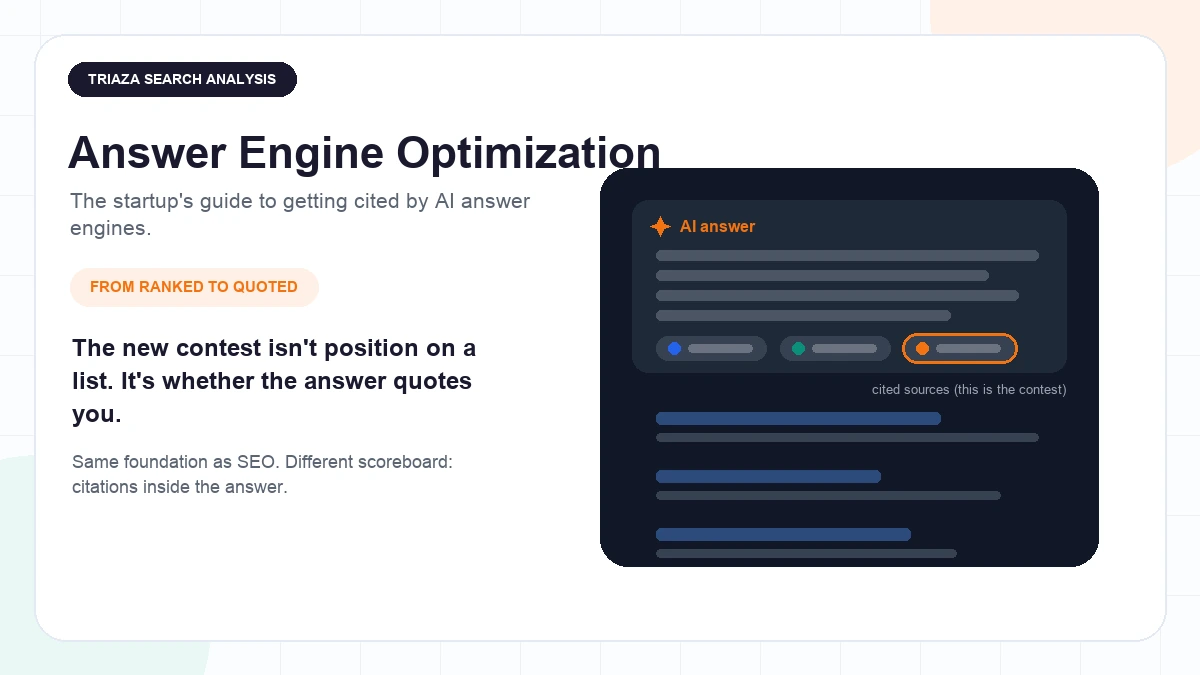
Answer engine optimization (AEO) is the practice of structuring, writing, and technically preparing your content so AI answer engines such as ChatGPT search, Perplexity, and Google’s AI Overviews cite your site as a source in their generated answers. Instead of competing for a ranking position, you’re competing to be quoted.
The shift is measurable. ChatGPT reached 400 million weekly users in February 2025, and its search function now works without an account. Perplexity was already handling more than 100 million queries a week last October. Gartner predicted in early 2024 that traditional search volume would fall 25% by 2026 as queries move to AI assistants. Here’s what AEO actually involves, how it differs from the SEO you’re already doing, and a playbook a lean team can run this quarter.
What Is Answer Engine Optimization, Really?
An answer engine is any system that responds to a query with a synthesized answer plus citations instead of a ranked list of links. By Search Engine Land’s count last month, there are six worth caring about right now: Google AI Overviews, Google’s experimental AI Mode, Gemini, Microsoft’s Bing Copilot, ChatGPT search, and Perplexity. Different products, same pattern: one answer, a few cited sources, and everyone else nowhere.
AEO is the discipline of earning those citations. It covers how your content is structured (can a model extract a clean answer from it?), what it contains (is there anything worth quoting?), and whether the underlying plumbing lets answer engines find and trust it at all.
AEO, GEO, and Why the Names Differ
You’ll see two names for roughly the same work. The academic term came first: researchers from Princeton, Georgia Tech, the Allen Institute, and IIT Delhi coined “Generative Engine Optimization” in a November 2023 paper that was later presented at KDD 2024. The industry has mostly settled on “answer engine optimization,” which is the term we use, because it names the thing users actually experience: an engine that answers.
We’ve written before about pairing classic SEO with AI-era optimization in our guide to SEO and AI-driven search. AEO is the sharper name for the citation-earning half of that work, and it’s the term we’ll use from here on.
AEO vs. SEO: What Actually Changes (and What Doesn’t)
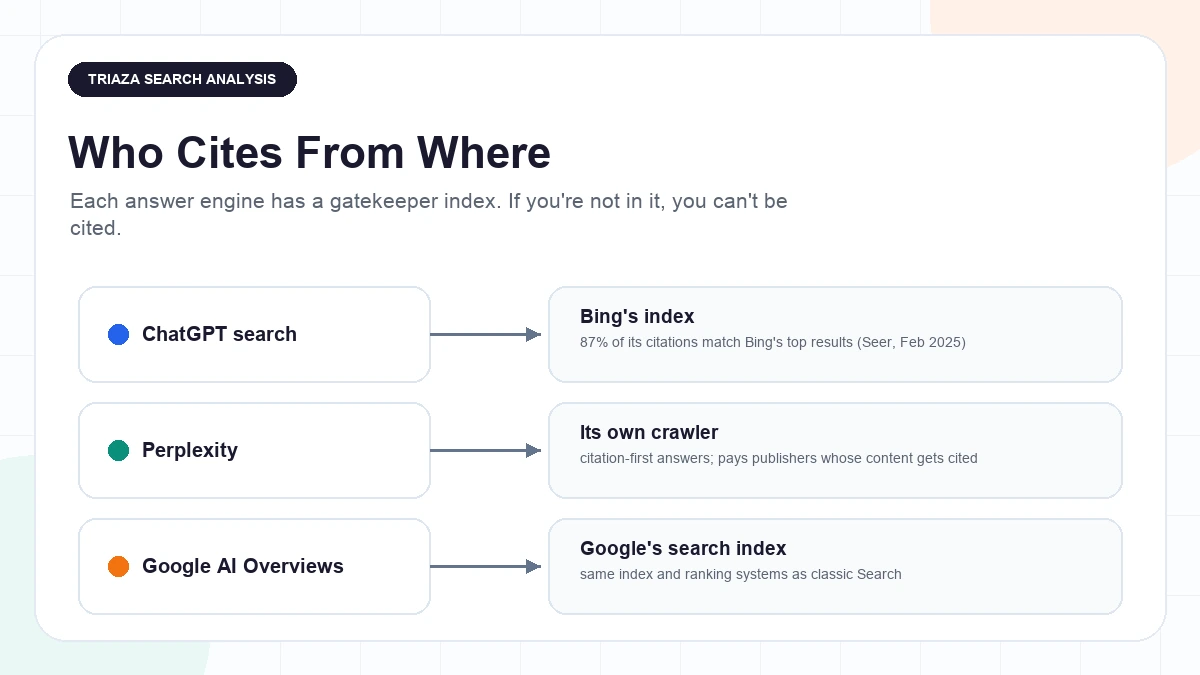
The foundation doesn’t change. Answer engines don’t bypass the boring fundamentals; they depend on them. Microsoft’s Bing team put it plainly in November: there’s no secret sauce or special code that games AI search, just content that resolves what the searcher actually wants. The same logic holds for AI Overviews, which run on the same index and ranking systems as classic search. If your pages aren’t crawlable, indexed, and credible, no AEO tactic rescues them.
What changes is the scoreboard. SEO success is a position on a list. AEO success is presence inside the answer: being one of the cited sources, quoted or paraphrased, for the questions your buyers ask. Those two outcomes correlate, but they’re not the same thing. You can rank fourth and get quoted. You can rank first and be invisible below an answer that cites three other sites.
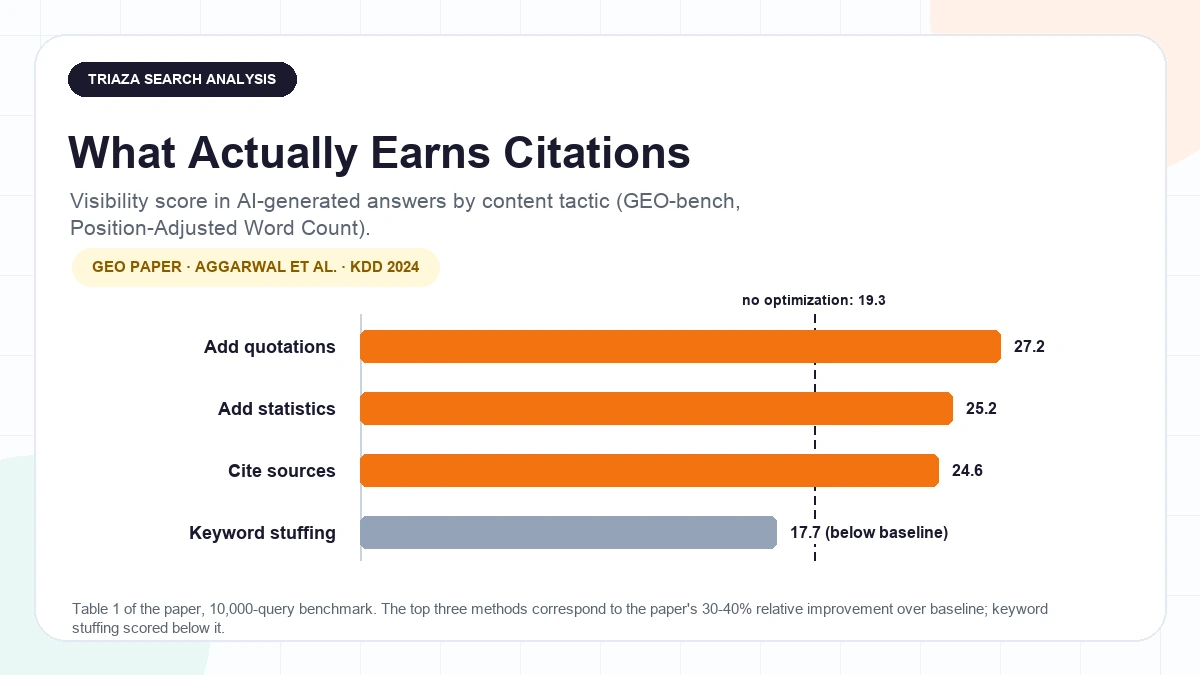
And there’s real evidence about what moves the new scoreboard. The GEO paper tested content changes across a benchmark of 10,000 queries and found that its top-performing tactics, adding quotations, statistics, and cited sources, lifted a source’s visibility in generated answers by 30 to 40% relative to unoptimized content. The classic trick that didn’t transfer: keyword stuffing, which actually scored below the no-optimization baseline. Substance gets quoted. Repetition hurts.
How Each Answer Engine Picks Its Sources
Google AI Overviews: Same Index, New Bar
AI Overviews synthesize an answer from Google’s existing search index using Gemini models, and Google claims that links included in an Overview earn more clicks than the same page would as a standard listing. That’s Google’s number, not an independent one, and the first large independent studies just complicated the picture. Ahrefs compared March 2024 to March 2025 desktop Search Console data across 300,000 keywords and found that position-1 organic CTR fell 34.5% year over year on keywords that trigger an AI Overview. Amsive’s study of 700,000 keywords, published April 16, measured an average CTR drop of 15.49% on keywords showing an Overview, deepening to 37.04% when an Overview and a featured snippet appear together, while branded queries actually gained 18.68%.
The takeaway isn’t “abandon ship.” It’s that unaided rank is losing value while citations hold theirs. We covered the mechanics and the early click data in depth in our AI Overviews explainer.
ChatGPT Search Runs Through Bing
ChatGPT search launched October 31, 2024 and has been open to everyone without an account since early February. Under the hood it leans on third-party search providers, including Bing, plus OpenAI’s publisher partners rather than a homegrown index of the whole web.
That has a very practical consequence. Seer Interactive checked more than 500 ChatGPT search citations and found 87% matched a page in Bing’s top organic results for the same query, versus a 56% match rate against Google’s top results. In other words: if Bing hasn’t indexed your page, ChatGPT search effectively can’t cite it. Most startups have never once opened Bing Webmaster Tools. That’s now a gap.
Perplexity Is Citation-First by Design
Perplexity built its product around visible sourcing: every answer leads with the citations it drew from. It crawls the web itself, and it has put money behind the model, launching a Publishers’ Program in July 2024 that shares ad revenue with publishers whose content gets cited. You don’t need a revenue deal to show up; you need pages Perplexity’s crawler can reach and answers worth quoting.
Where AI Mode Fits (for Now)
Google’s AI Mode, introduced March 5 as an opt-in Search Labs experiment for Google One AI Premium subscribers, is a fully conversational search experience built on a custom version of Gemini 2.0. Google opened it to millions more Labs users in early April, no subscription required, but it remains opt-in and experimental. It’s worth watching and it isn’t worth building a strategy around yet: AI Overviews are what the mainstream of Google’s users actually see. Optimize for that first.
The AEO Playbook for a Lean Startup Team
None of what follows requires new headcount or an enterprise tool budget. It’s a short list because the evidence base is short; AEO rewards a handful of things done consistently.
Get Indexed Where the Engines Actually Look
Set up Bing Webmaster Tools, submit your sitemap, and check index coverage, because ChatGPT search sees the web through Bing. Then make a deliberate robots.txt decision: AI companies operate separate crawlers for model training and for search or live answering, and blocking one doesn’t block the other. If you want citations, make sure the bots that fetch pages for answers aren’t locked out. If you also want to opt out of training, that’s a separate line, not the same decision.
Make Your Pages Quotable
The GEO paper’s three winning tactics are a content brief in miniature: add real statistics, quote named experts, and cite your sources. Answer engines reward exactly the material that generic content lacks, because a model assembling an answer needs concrete, attributable substance to quote. Original data from your own work, even small-sample data, beats another summary of someone else’s summary. If writing capacity is your constraint, this is the muscle our content marketing work builds for clients: fewer pieces, each one dense enough to be worth citing.
Answer Real Questions in Plain Language
Write question-shaped headings that match how buyers actually ask, then answer directly in the first sentence or two beneath each one, in 40 to 80 words. Save the nuance for after the answer, not before it. This is the same answer-first discipline that won featured snippets, promoted from tactic to table stakes. You’ll notice this article does it; that isn’t an accident.
llms.txt: Cheap, Optional, Unproven
llms.txt is a proposal from Answer.AI’s Jeremy Howard for a markdown file that gives language models a curated map of your site. Some tools read it; adoption is uneven, and no one has demonstrated a visibility benefit yet. It costs twenty minutes and does no harm, so add one if you like, but treat anyone selling llms.txt as an AEO requirement with suspicion. It isn’t one.
Measure What You Can (the Tooling Is Young)
There’s no Search Console for citations yet, and GA4 has no AI traffic channel, so measurement is manual for now. Two habits cover most of it. First, filter GA4’s traffic acquisition report by session source/medium for referrals like chatgpt.com to see what AI answers already send you. Second, run a monthly prompt audit: ask ChatGPT, Perplexity, and Google the ten questions that matter most to your pipeline, and record who gets cited. Early citation-tracking tools are emerging, but a spreadsheet and thirty minutes a month will tell you the trend. If you want a structured starting point, our AI search visibility audit guide walks through the full pre-work.
What This Means If You’re a Startup
Citations reward a different kind of strength than rankings do. Outranking an incumbent for a head term can take years of accumulated domain authority. Getting cited requires being the clearest, best-evidenced source for a specific question, and that’s a contest a focused startup can win now, while most competitors haven’t started. The April CTR data shows the cost of waiting: the traffic value of an unaided ranking is eroding on exactly the informational queries most startup content targets.
The honest caveat: AI answer traffic is still small next to classic search, so AEO earns its place as an extension of your SEO program, not a replacement for it. The work compounds, though, because the same structure and substance that earn citations also strengthen rankings. This is the overlap our AI Search & Answer Engine Optimization service is built around: auditing where you stand across the answer engines, restructuring the pages with citation potential, and setting up measurement so you can see whether it’s working.
Questions Founders Keep Asking About AEO
Is AEO just SEO with a new name? No, but it’s not a from-scratch discipline either. It shares SEO’s foundation (crawlability, indexation, authority) and changes the goal: citations inside AI answers instead of positions on a results page. The evidence says different tactics move that goal, so it earns its own name.
Should I stop investing in SEO? No. Every major answer engine leans on a classic search index: ChatGPT search on Bing’s, AI Overviews on Google’s. Weak SEO removes you from the pool answer engines choose from. AEO sits on top of SEO; it doesn’t replace it.
How do I know if ChatGPT or Perplexity cites us? As of April 2025, no official report exists. Filter GA4 for AI referral sources like chatgpt.com, and run a monthly prompt audit of the questions that matter to your pipeline, logging which sources each engine cites. Manual, but sufficient at startup scale.
What kind of content actually gets cited? Content a model can quote: direct answers near the top, real statistics, named expert quotes, and cited sources. Peer-reviewed testing found those additions lifted visibility in generated answers by 30 to 40%, while keyword stuffing scored slightly below doing nothing at all.
Should I block AI crawlers in robots.txt? Decide by goal, not reflex. Blocking the crawlers that fetch pages for AI search removes you from AI answers, which is the opposite of AEO. Training-data crawlers are a separate, independent decision. Audit your robots.txt so you’re not blocking citations by accident.
Do I need an llms.txt file? It’s optional. The proposal is real and the cost is trivial, but adoption is uneven and no measurable citation benefit has been demonstrated. Add one if you want; just don’t mistake it for a strategy.
Are AI Overviews and AI Mode the same thing? No. AI Overviews are the summaries already appearing above Google’s regular results for a growing share of queries. AI Mode is a separate, still experimental Search Labs feature you have to opt into, and as of this writing it doesn’t touch the main results page. Optimize for AI Overviews first; treat AI Mode as a preview of where search is heading.