This guide first ran on February 7, 2025. We substantially rewrote it on July 29, 2026, against current Google and Bing documentation. If you read the original, the changelog below shows exactly which advice changed and why.
When we first published this guide, the honest framing was “AI search is coming, get ready.” That framing is dead. AI Overviews now appear for billions of users, AI Mode sits one tab over in Google Search, Copilot answers sit inside Bing and Windows, and ChatGPT sends measurable referral traffic with its own UTM tag. The question stopped being whether AI changes search visibility and became which parts of your SEO playbook still earn it.
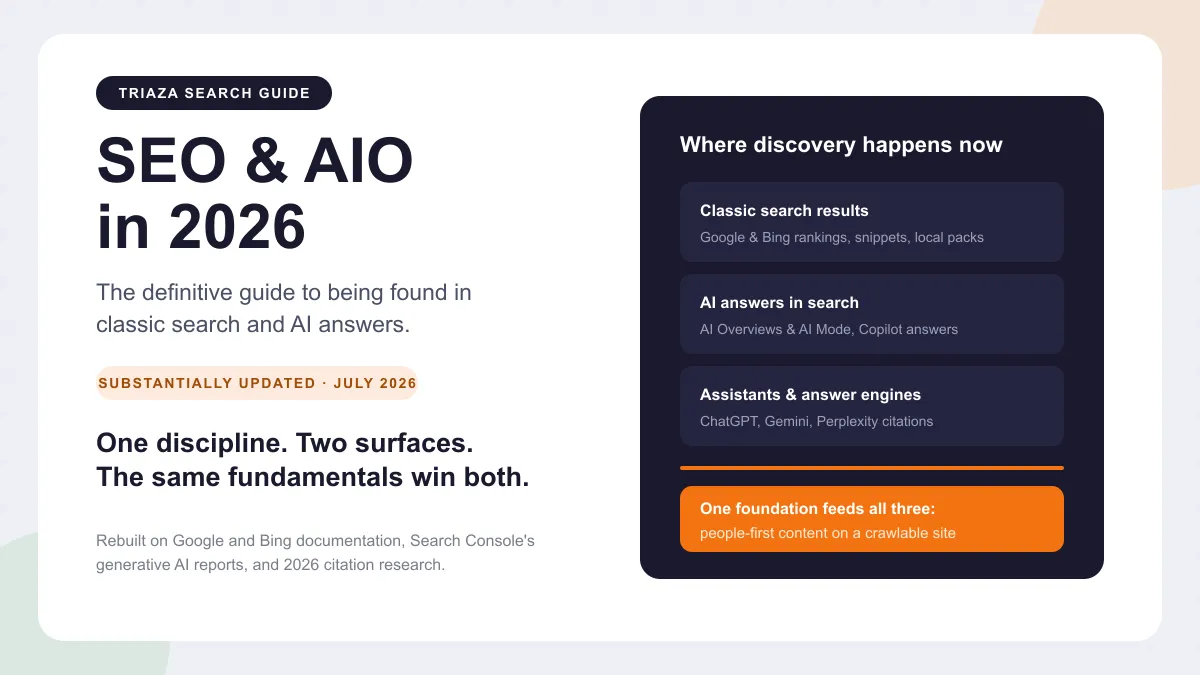
Most of it does. That is the part the hype cycle keeps missing. Google’s own guide to succeeding in AI search, published May 2026, says optimizing for AI Overviews and AI Mode is still SEO: same index, same ranking and quality systems, no special markup. What has changed is the shape of the work — what you measure, which schema still pays its way, how you govern AI-assisted writing, and which tactics are now confirmed dead weight.
This is the full picture for founders, marketing leads, and small teams. It is long on purpose; it is the hub for our deeper guides on each subtopic.
What are SEO and AIO?
SEO (search engine optimization) is the practice of making your site easy to find, crawl, understand, and trust so it earns visibility in search results. AIO (artificial intelligence optimization) is the same discipline extended to AI-mediated surfaces: AI Overviews and AI Mode in Google, Copilot in Bing, and assistants like ChatGPT, Gemini, and Perplexity that cite web sources. Google is explicit that AIO is not a separate practice with its own tricks — content surfaces in its AI features through the same systems that rank ordinary results. You will also see the labels AEO (answer engine optimization) and GEO (generative engine optimization); they point at the same work.
What changed since the 2025 edition
An update you cannot see is an update you cannot trust, so here is the honest ledger. Every row is something the 2025 version of this guide recommended or assumed that we have now corrected.
| The 2025 edition said | What is true in 2026 |
|---|---|
| Optimize for SGE, Google’s experimental AI search | SGE shipped and split into AI Overviews and AI Mode, both core parts of Google Search |
| Watch Bard and Bing Chat | Bard became Gemini in early 2024; Bing Chat became Copilot |
| Keep First Input Delay (FID) under 100ms | INP replaced FID as the Core Web Vitals responsiveness metric in March 2024 — target 200ms or less |
| Test with Google’s Mobile-Friendly Test | Google retired that tool in December 2023; use PageSpeed Insights, Lighthouse, and real devices |
| FAQ schema is a quick rich-results win | Google deprecated FAQ rich results in May 2026 after restricting them for years; the markup earns no SERP treatment |
| Schema is “crucial” for AI visibility | Google says structured data is not required for AI features — useful for understanding, not an AI switch |
| Cultivate unlinked “implied link” brand mentions | Google’s AI-search guide warns against chasing inauthentic mentions; earned coverage still matters, manufactured buzz does not |
| RankBrain reads CTR, dwell time, and bounce rate | Google describes RankBrain as a system that relates words to concepts; the behavioral-metrics story was never confirmed |
| Search Console might add “AI answer impressions” someday | It did: generative AI performance reports launched June 3, 2026, and Bing shipped its AI Performance report that February |
If a competitor’s guide still tells you to add FAQ schema everywhere and optimize FID, you now know how old it is.
What still matters most: people-first SEO
Strip away the AI framing and the discipline still rests on three kinds of work. On-page: content that fully answers what a searcher intended, under titles, headings, and internal links that make its structure obvious. Technical: a site that crawlers can fetch, render, and index without obstacles. Off-page: proof from the rest of the web — coverage, citations, links, reviews — that you are who your site claims you are.
Google’s people-first content guidance is the standard to write against, and its self-assessment questions are blunter than most audits: Does the content show first-hand experience? Would a reader feel they got what they came for? Would this page exist if search engines did not? That last question has more teeth in 2026 than it did in 2025, because commodity content is exactly what generative answers replace. A summary of the top ten results is now something the engine produces on demand; publishing an eleventh version of it is not a strategy.
E-E-A-T — experience, expertise, authoritativeness, trust — remains the working rubric from Google’s quality rater guidelines. It is not a score you can optimize directly, but it describes what both rankings and AI citations keep selecting for: named authors with verifiable backgrounds, first-hand detail, accurate sourcing, and a site that is transparent about who runs it. Semrush’s January 2026 study of content patterns in AI answers found E-E-A-T signals among the strongest positive correlations with citation, right behind clarity and summarization. Correlation is not mechanism, but it points the same direction as Google’s own advice.
Two honest corrections from the old edition belong here. First, retire the “content and links are the top two ranking factors, then RankBrain” framing — it came from a 2016 quote and Google’s current documentation describes many interacting systems instead of a ranked top three. Second, be careful with the behavioral-signals story. Click-through rate, dwell time, and bounce rate are worth watching because they tell you whether pages satisfy readers, not because Google confirmed them as ranking inputs. Write for the reader; let the metrics diagnose.
Search intent still decides formats. A “best CRM for contractors” query wants a comparison with real criteria; “how to fix a leaking faucet” wants steps; a brand query wants your site, fast. Voice queries deserve one demotion from the old edition: voice is a query format — longer, conversational, question-shaped — not a separate channel with its own playbook. Content that answers questions plainly serves typed, spoken, and AI-fanned-out queries alike, and the dated “X% of searches are voice” statistics we once cited did not survive a source check.
If your team is early on this foundation, start with our SEO fundamentals for startups guide and come back; everything after this point assumes the basics are in place.
How Google and Bing actually use AI in search
Google runs two generative surfaces on top of its ordinary index. AI Overviews are the synthesized summaries above classic results; AI Mode is the conversational tab that answers follow-ups. Both work by retrieval-augmented generation with query fan-out: the system issues several related sub-queries, retrieves candidate pages from the Search index, and composes an answer with links. At I/O 2026, Sundar Pichai put AI Overviews past 2.5 billion monthly users and AI Mode past 1 billion, and BrightEdge’s tracking has Overviews appearing on roughly 48% of queries it monitors. This is not an experiment you can wait out.
Fan-out changes a strategic assumption most SEO habits were built on. Ahrefs analyzed 863,000 SERPs in March 2026 and found only about 38% of URLs cited in AI Overviews also ranked in the top ten for the query; nearly a third came from beyond position 100. Citation goes to whoever best answers the sub-questions, not whoever holds position one on the headline term. A page that ranks fourteenth can be quoted daily; a page that ranks first can be summarized and skipped. We unpack what that did to click curves in our AI Mode traffic retrospective — short version: Ahrefs measured a 58% lower top-result CTR when an Overview is present, while sitewide organic traffic across 40,000+ sites fell only about 2.5% year over year. Clicks are being repriced, not erased, and the losses concentrate on commodity informational pages.
Microsoft’s version runs through Bing: Copilot generates a search query, retrieves through Bing’s index, and cites sources in its answers. The practical consequence is pleasantly boring — classic Bing hygiene (indexability, clarity, sitemaps, and IndexNow for freshness pings) is what feeds Copilot visibility.
Then there are the assistants outside search engines. ChatGPT browses with its own crawler (OAI-SearchBot) and tags referral clicks with utm_source=chatgpt.com; Perplexity indexes with PerplexityBot and is citation-forward by design; Gemini grounds answers through Google Search. Each has quirks worth knowing when they become a real referrer for you — our guide to getting cited by AI search engines covers them engine by engine, and the AI Overviews deep dive stays on Google specifically.
AIO, AEO, GEO: what the labels mean, and what they do not
The acronym soup is a naming problem, not a strategy problem. AIO, AEO, and GEO all describe earning visibility inside AI-generated answers. Use whichever your team already says. What matters is Google’s position on the substance: there is no parallel discipline with separate technical requirements. Being indexed and snippet-eligible makes you eligible for AI features, full stop.
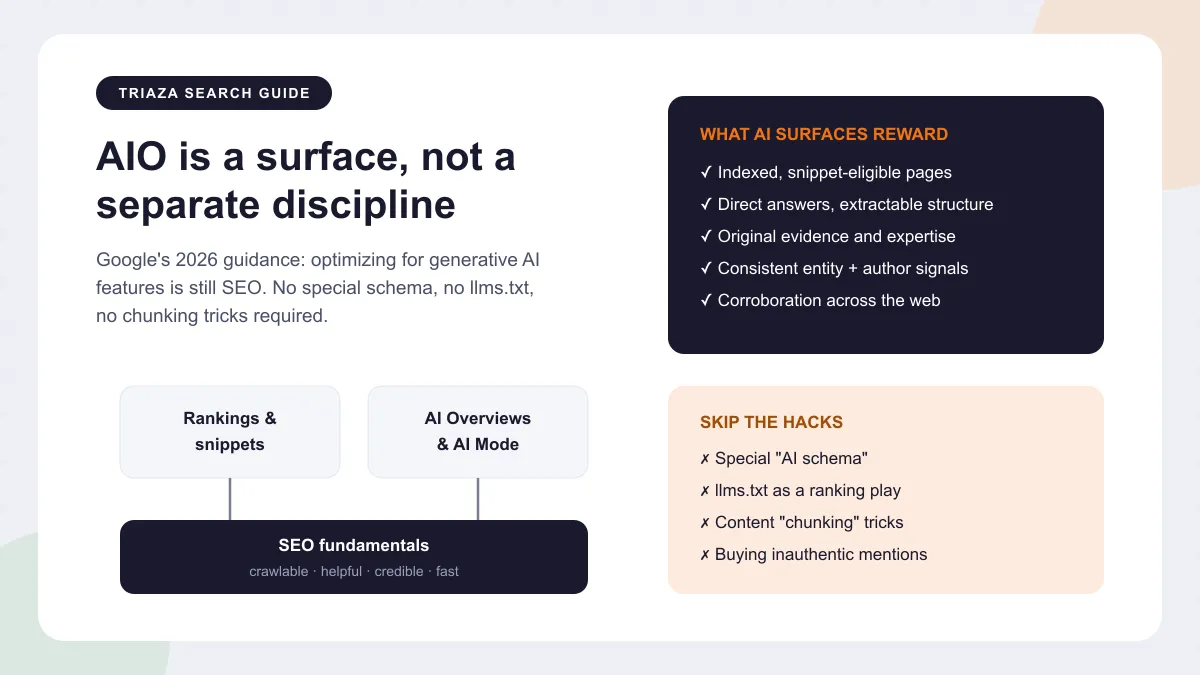
Google’s guide is unusually direct about the shortcuts being sold right now, and it is worth quoting the spirit of it plainly. You do not need special AI schema. You do not need to restructure prose into robot-friendly “chunks.” You do not need llms.txt for Google’s AI features, and buying mentions to look popular to language models lands in the same bucket as buying links. Each of these is currently being packaged into “GEO audits” at consulting rates.
Two of those deserve nuance rather than dismissal. An llms.txt file costs nothing and some non-Google tools choose to read it — publish one if you like, just do not book it as a ranking play. And writing in clear, extractable sections is genuinely good practice; it was good practice in 2015 too. The scam is only the claim that a secret AI format exists. What the evidence actually supports — direct answers up top, honest headings, Q&A where it helps, original data — is covered tactically in our answer engine optimization guide and the fix-by-fix AEO checklist.
Technical foundations for search and AI discovery
Everything downstream depends on machines reaching and rendering your pages, and in 2026 more machines are trying: Googlebot, Bingbot, OAI-SearchBot, PerplexityBot. The most common self-inflicted wound we find in audits is a CDN or firewall rule quietly blocking a crawler the marketing team is actively courting. Check your robots.txt and server logs before you touch a line of copy.
While you are in there, fix a distinction the old edition of this guide blurred: robots.txt controls crawling, not indexing. A URL blocked in robots.txt can still be indexed from links elsewhere — and Google will never see a noindex tag on a page it is not allowed to fetch. If you want a page out of the index, let it be crawled and serve noindex, or put it behind authentication. Robots.txt is for managing crawl load, not for making pages disappear.
Core Web Vitals remain the performance rubric, with one correction that dates every pre-2024 SEO article on sight: Interaction to Next Paint (INP) replaced First Input Delay in March 2024. Current thresholds for a good experience at the 75th percentile: LCP within 2.5 seconds, INP within 200 milliseconds, CLS at 0.1 or less. FID measured only the first input’s delay; INP scores responsiveness across the whole visit, which is why script-heavy sites that passed FID now fail. Measure with PageSpeed Insights and Lighthouse — the Mobile-Friendly Test, which we recommended in 2025, was retired in December 2023, so any checklist still pointing there needs the same refresh this article got. Vitals remain a tie-breaker, not a golden ticket, but slow sites lose readers regardless of what Google weighs. If your stack needs ongoing care, that is what our website maintenance service exists for.
Mobile-first indexing is finished rolling out, which makes parity a hard requirement rather than advice: Google indexes the mobile version of your content. Whatever the desktop page has — primary content, structured data, robots directives, metadata — the mobile page must have too. Content that only loads after a tap or click is content Google may never index.
The rest of the technical baseline has not moved: HTTPS everywhere; an XML sitemap submitted in both Search Console and Bing Webmaster Tools; canonical tags on duplicate paths; internal links that connect every page you care about to the pages it supports; and a site architecture flat enough that nothing important is four clicks from anywhere. For sites that ship frequent updates, IndexNow gives Bing and its partners a push notification instead of a crawl wait — cheap freshness insurance now that answers cite recent sources.
Structured data that still matters
The honest 2026 framing: structured data helps machines understand and disambiguate your content, and it still powers a set of rich results. It is not an AI-visibility switch, and Google says so directly. Sold correctly, it is still worth doing — Semrush’s study of 5 million cited URLs found Organization, Article, and BreadcrumbList markup disproportionately common on pages AI features cite. That is correlation (well-run sites do schema and get cited), but clarifying entities is exactly the kind of ambiguity-reduction retrieval systems reward.
Maintain the set that earns its keep:
Organizationsite-wide — name, logo,sameAslinks to your real profiles. This is entity plumbing: it helps engines connect your domain to your brand everywhere else it appears.ArticleorBlogPostingon editorial content, with realauthor,datePublished, and — the reason this article’s own markup changed today —dateModifiedthat matches the visible dates on the page.BreadcrumbListso section structure is explicit.LocalBusinesswith accurate hours and service area if you serve a geography;Productwith price and availability if you sell;VideoObjectif you publish video.
The subtraction matters as much as the list. Google deprecated FAQ rich results in May 2026, years after restricting them to government and health sites, and How-To rich results died back in 2023. FAQ content is still excellent — readers and answer engines both use it — and leaving valid FAQPage markup in place does no harm. Just stop expecting a SERP treatment from it, and stop letting anyone sell it to you as a quick win. Validate whatever you ship with the Rich Results Test and the Schema.org validator, and keep markup synced with visible content — schema that contradicts the page is worse than none. The deeper evidence review, including where the schema-and-citations studies overstate their case, lives in our technical SEO for AI search guide.
Controlling how AI surfaces use your content
Visibility controls got real teeth once AI features started quoting pages, and they are the same controls that govern snippets — documented on Google’s robots meta tag reference. nosnippet keeps a page’s text out of snippets and AI Overviews entirely; data-nosnippet fences off specific passages; max-snippet:[n] caps how much can be quoted; noindex removes the page from Search, AI features included. One adjacent control is regularly misunderstood: Google-Extended governs whether your content trains future Gemini models and grounds Gemini apps — it has no effect on Google Search or AI Overviews. Blocking it is a licensing stance, not an SEO tactic.
Before reaching for any of these, decide what you actually want. For most businesses whose model is being found, restricting AI reuse mostly guarantees a competitor gets cited in your place. The controls earn their keep for paywalled work, gated research, and pages where an out-of-context quote does damage. Restriction is a business decision; make it deliberately rather than by default in either direction.
AI-assisted content without the policy risk
AI is now standing infrastructure in content production, ours included. The risk was never the tool; it is unreviewed volume. Google’s spam policies name scaled content abuse — mass-producing pages that add little value for readers — and apply the policy “however the content is produced.” Human sweatshop or model API, same violation. The March 2024 core update that deindexed thin-AI content farms made the enforcement concrete, and nothing since has softened it.
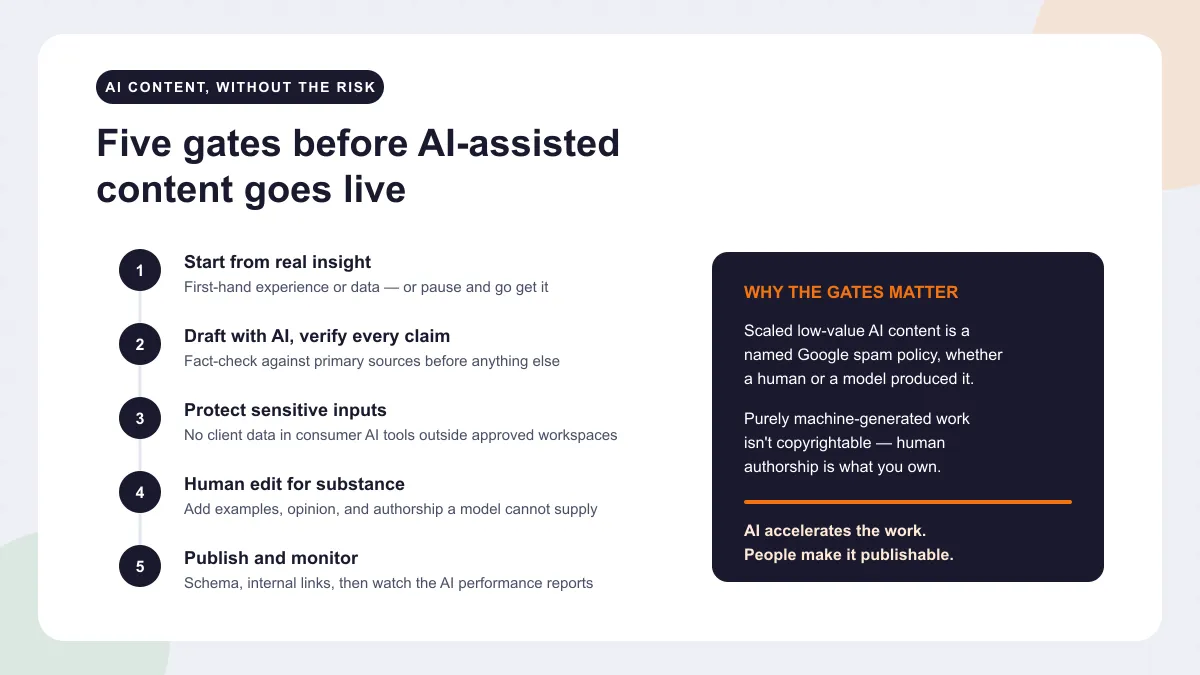
The workflow that holds up is a set of gates rather than a prompt library. Start from something real: first-hand experience, client patterns, proprietary data, an actual opinion — if you have none, the honest move is to go get some before drafting. Let AI accelerate structure, drafts, and summaries, then verify every factual claim against a primary source, because models fabricate fluently and a confident wrong number costs more trust than no number. Have a human add what a model cannot: examples you lived, positions you will defend, the judgment calls. Then publish and watch the measurement reports below to learn what earns citations.
Two governance items sit outside the writing itself. Privacy: be deliberate about what goes into prompts. Consumer AI chat tiers may use conversations for training or human review unless you configure otherwise, and deleted chats are not always instantly gone — OpenAI’s enterprise privacy commitments (business data not used for training by default) and the Gemini privacy hub are the pages to read before anyone pastes a client list or an unreleased deck into a chat window. Put client data, credentials, and confidential material off-limits outside approved workspace tiers, in writing. Copyright: the U.S. Copyright Office’s reports on AI and copyrightability hold that protection requires human authorship — prompts alone do not make you the author of a model’s output. Meaningfully edited, human-shaped work is protectable; raw generations are not. If your content is an asset on the balance sheet, the human pass is what makes it yours. This connects to a broader point we make in treating brand voice as a data asset: the distinctive material only you can produce is exactly what both copyright and citation engines value.
Local, shopping, and entity signals
For service businesses, the AI answer layer leans on the same assets local SEO always did, which is convenient if you have maintained them and expensive if you have not. Google’s AI guidance points at Business Profile and Merchant Center data as inputs for business and product answers: hours, services, reviews, prices, availability. An accurate, active profile and a clean product feed are no longer just map-pack plumbing — they are what the answer engine reads aloud when someone asks “who repairs heat pumps near me and what does it cost?”
The broader pattern is entity consistency. Engines cross-check what your site claims against what the rest of the web says. Muck Rack’s analysis of 25 million AI citations found earned media made up 84% of them — journalism, industry publications, expert commentary — with LinkedIn and YouTube heavily overrepresented as sources. That reframes link building the way it always deserved: the durable asset is editorial endorsement from credible, relevant sources, earned with original research, real expertise, and work worth referencing. Domain suffixes carry no magic — a relevant industry publication’s link beats a random .edu page’s — and manufactured mention campaigns are on Google’s ignore-this list. Keep your name, address, phone, founders, and category claims identical across your site, profiles, and directories; contradictions read as risk to a system deciding whether to cite you. The full architecture for this — clusters, hubs, and entity-consistent internal linking — is in our guide to structuring content for AI citation.
How to measure AI visibility now
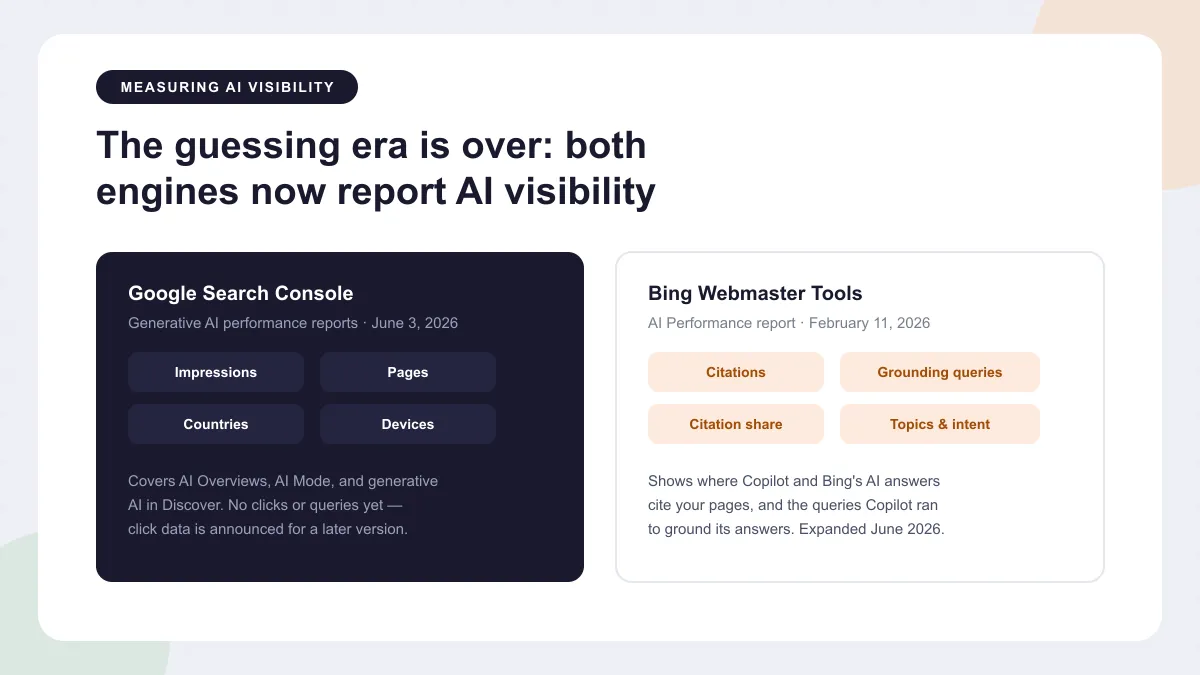
The 2025 edition of this guide predicted Search Console “might” someday report AI answer impressions. Retire the prediction: on June 3, 2026, Google launched generative AI performance reports in Search Console, covering AI Overviews, AI Mode, and generative AI features in Discover. You get impressions, pages, countries, and devices; clicks and query data are promised for later versions, and the rollout is staged, so do not panic if your property lacks the report this week. Microsoft moved first: Bing Webmaster Tools shipped its AI Performance report in February 2026 — citations across Copilot and Bing’s AI answers, plus the grounding queries Copilot generated to retrieve your content — and expanded it in June with topic groups, intent labels, and citation share.
Round out the stack with analytics you already own. AI referrals identify themselves: ChatGPT appends utm_source=chatgpt.com, and Perplexity, Gemini, and Copilot referrals are separable by hostname in GA4. Expect small numbers and resist judging the channel on them — Previsible’s analysis of 1.96 million LLM-driven sessions put AI traffic around 0.13% of sessions but concentrated on high-intent pages like pricing and tools, and Adobe’s retail data showed AI-sourced traffic up 393% year over year with above-average conversion. Low volume, high intent, growing fast: measure revenue per session, not sessions.
The questions these reports let you ask are finally the useful ones. Which pages get impressions in AI features but few classic clicks? Which grounding queries is Copilot running where you are absent? Did last quarter’s refresh move citations? That is an optimization loop instead of a guessing game — and it pairs with watching core-update weather like May 2026’s with data instead of vibes.
The 2026 publish-and-QA checklist
The condensed version of this whole guide, in the order we run it on client work:
- Access: Googlebot, Bingbot, OAI-SearchBot, and PerplexityBot can fetch and render the page; robots.txt, CDN, and WAF rules verified in logs, not assumed.
- Indexability: the page is in the sitemap, canonical is correct, and noindex is only where you mean it.
- Answer-first structure: the core question answered plainly near the top; headings that say what sections contain; Q&A and tables where they genuinely help.
- Original value: something on the page — data, experience, position, example — that did not come from the top ten results.
- Sourcing: every statistic dated and linked to a primary source; no claim you could not defend to the person it is about.
- E-E-A-T surface: named author, real bio, and visible dates — published and updated, told honestly.
- Schema: Organization, Article/BlogPosting with accurate
datePublished/dateModified, breadcrumbs, plus LocalBusiness/Product where true; validated before ship. - Performance: LCP ≤ 2.5s, INP ≤ 200ms, CLS ≤ 0.1 at the 75th percentile; images sized and lazy-loaded below the fold.
- Parity: mobile page carries the same content, markup, and directives as desktop.
- Distribution: internal links from the pages readers actually visit; IndexNow ping; entity details consistent everywhere the piece will be referenced.
- Measurement: a note in the calendar to check Search Console’s gen-AI report and Bing’s AI Performance report against this URL next month.
Before a full site rewrite, run the longer AI search visibility audit first — rewriting copy on top of unaudited technical debt is how teams spend a quarter to stand still.
Questions marketers keep asking
Is AIO different from AEO and GEO?
Only in etymology. All three name the practice of earning visibility inside AI-generated answers, and Google’s documentation treats that practice as part of SEO. Pick one label for internal consistency and spend the argument budget on content instead.
Will AI Overviews take all my clicks?
They take a specific kind: low-intent informational clicks where a summary genuinely suffices. Ahrefs measured 58% lower top-result CTR when an Overview appears, yet aggregate organic traffic across large site sets fell only about 2.5% year over year. Commodity explainer pages absorb the damage; pages with depth, tools, original data, and commercial intent keep earning visits — and AI referrals, small as they are, convert unusually well.
Should I remove my FAQ schema now that the rich result is gone?
No need — valid markup does no harm and other systems can still read it. Just book zero SERP benefit from it going forward, and never let FAQ markup substitute for actually answering questions well in the visible content.
Can Google detect and penalize AI-written content?
Google’s position is that it polices low-value content at scale, not the tool that produced it. AI-assisted work that carries real expertise, verification, and editing is fine and increasingly normal. Mass-generated pages with nothing new to say are a named spam policy, and the enforcement since March 2024 has been visible in every core update since.
How do I see whether AI search is sending me anything?
Three places: Search Console’s generative AI performance report (impressions in AI Overviews, AI Mode, and Discover’s AI features), Bing Webmaster Tools’ AI Performance report (Copilot citations and grounding queries), and GA4 referrals — ChatGPT tags itself with utm_source=chatgpt.com. Judge the channel on conversion quality, not session count.
Do backlinks still matter in 2026?
Yes, understood correctly: as editorial endorsements from relevant, credible sources. Earned media dominates what AI engines cite — 84% in Muck Rack’s 25-million-citation dataset — so the work looks like PR grounded in original material, not link-volume arithmetic. TLD prestige and manufactured mentions were never the mechanism, and Google now says so out loud.
Where this leaves you
The strategic spine of the 2025 edition survived its own audit: build genuinely useful content on a technically sound site, prove who you are, and be easy to quote. What changed is everything around that spine — the surfaces, the metrics, the schema mix, the governance, and the list of shortcuts confirmed useless. Expect this page to change again; that is what the updated date at the top is for.
If you want the work done with you rather than by you, Triaza’s SEO and AI Search & Answer Engine Optimization services run this exact playbook, and our content marketing team builds the original material engines actually cite. Talk with us about where your visibility stands — or, if you are evaluating partners, our guide to choosing an SEO agency tells you what to ask anyone, including us.