You’ve read the theory. AI Mode is live in more than 200 countries and territories, ChatGPT search works without an account, and the definitional ground is covered in our guide to answer engine optimization. What most teams are missing in early 2026 isn’t another explainer. It’s a list.
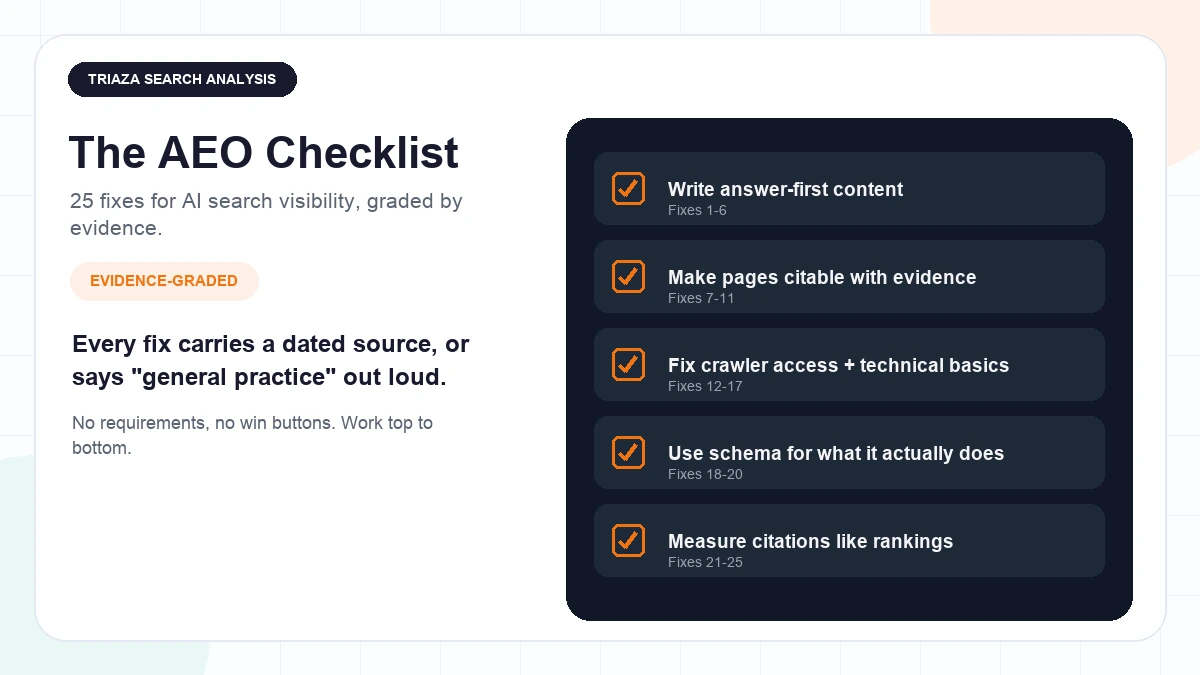
Answer engine optimization (AEO) is the work of making your content easy for AI systems such as ChatGPT search, Google’s AI Overviews and AI Mode, and Perplexity to find, extract, and cite. This checklist covers 25 concrete fixes across content structure, evidence, crawler access, schema, and measurement, current as of February 2026.
One ground rule before the list. Most AEO checklists circulating right now are recycled SEO advice with a fresh acronym and no sources. This one is evidence-graded: every item carries either a dated study you can check or an explicit “general practice” label when it rests on practitioner reasoning instead. You should know which is which before you assign the work.
Write Answer-First Content (Fixes 1-6)
1. Put a direct answer under every major heading
Write a 40 to 80 word answer immediately below each important H2, before any elaboration. Real AI Overview answers are short: in Semrush and Datos’ study of AI Overviews across 200,000 tracked keywords, the average answer ran 119 words on desktop and 91 on mobile. That’s a single September 2024 snapshot of a fast-moving surface, but the shape of the lesson holds. If the whole generated answer is a paragraph, the extractable unit you offer should be one too.
2. Phrase key subheadings as literal questions
In the same Semrush/Datos data, 35% of desktop and 32% of mobile keywords that triggered an AI Overview were question-based, and about 80% carried informational intent. Same snapshot caveat as above. Match the phrasing your buyers actually type and ask, then answer it directly underneath.
3. Stop chasing a word count
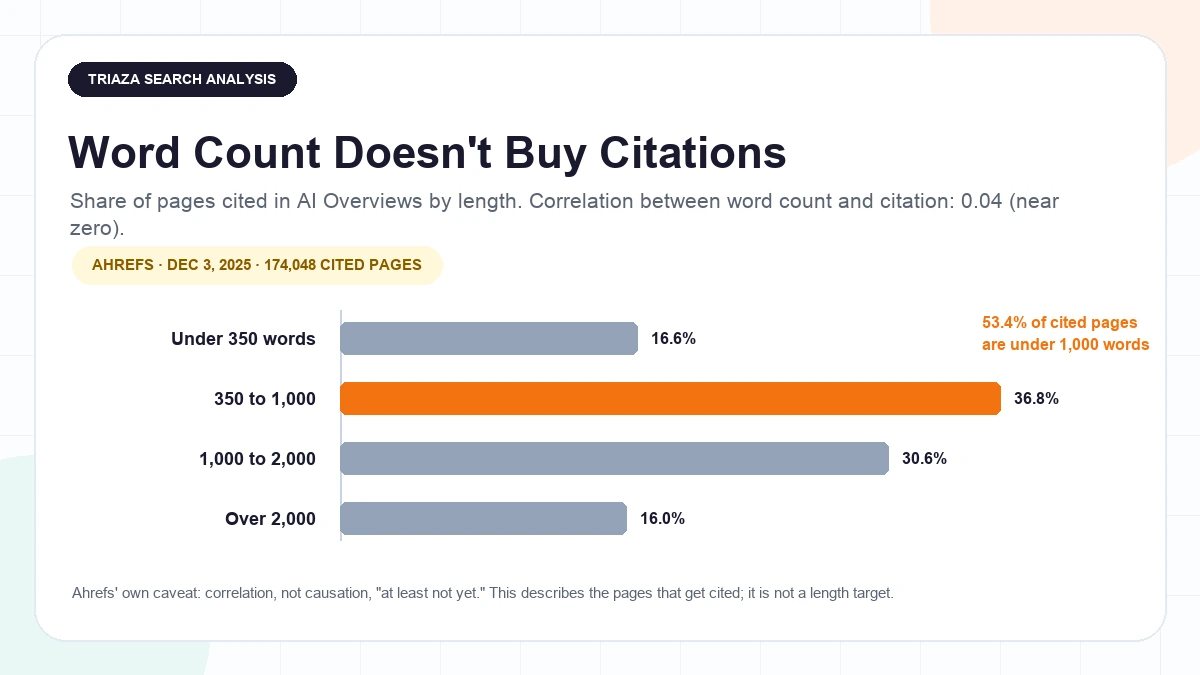
Ahrefs measured the relationship between length and AI Overview citation across 174,048 pages in December 2025 and found a Spearman correlation of 0.04, which they call near-zero, with 53.4% of cited pages running under 1,000 words. Their hedges belong with the number: it’s correlation, not causation, and their conclusion is “at least not yet.” Write to cover the question, then stop.
4. Make every section a self-contained passage
Answer engines retrieve passages, not pages, which we unpacked in structuring content for AI citation. So write each section to stand alone: state the full claim, avoid pronouns that depend on three paragraphs of prior context, and keep any caveat in the same paragraph as the claim it qualifies. This is general practice reasoned from how retrieval works, not itself a measured citation stat.
5. Give the page one short, complete answer section
Keep at least one section under roughly 120 words that fully answers the page’s core question on its own. That target comes from the measured shape of real answers, the 119-word desktop average in the Semrush/Datos snapshot noted above; the specific practice of building one deliberate standalone section is ours. The bolded definition near the top of this page is this fix, applied.
6. Use real lists and tables, not prose about lists
If content is a sequence of steps, mark it up as an ordered list. If it’s a comparison, make it a table. Extraction systems have always favored structure that matches meaning, and this is long-standing snippet-era practice; no dated study ties HTML list formatting to AI citation specifically, so take it as general practice.
Make Pages Citable With Evidence (Fixes 7-11)
7. Add statistics with named, checkable sources
The Princeton and IIT Delhi GEO benchmark (published November 2023, presented at KDD 2024) tested content changes across roughly 10,000 queries and found adding statistics lifted a source’s visibility in generated answers by about 34% relative to baseline on the paper’s position-adjusted word count metric. Its authors are clear about the limits: it’s a constructed benchmark, not a live A/B test, and efficacy varies by domain. Directionally, though, numbers get quoted.
8. Quote named experts
Quotation addition was the single strongest tactic in the same benchmark, moving visibility from a 19.3 baseline to 27.8, roughly a 44% relative gain, with the same benchmark-not-production caveat. A specific person saying a specific thing is exactly the material a synthesized answer wants to borrow.
9. Cite your own sources inline
Linking out to authoritative sources lifted visibility about 29% relative in the GEO paper’s tests, same caveats as above. Citing sources signals checkable claims, and checkable claims are what an answer engine can safely repeat. This article’s own format is the tactic in use.
10. Don’t keyword-stuff for answer engines
In the same tests, keyword stuffing dropped visibility below the no-optimization baseline, from 19.3 to 17.8, roughly 8% worse than doing nothing. One tactic the paper did not validate: rewriting in a more “authoritative tone” showed no significant gain. Substance moves the needle; posture doesn’t.
11. Put a real byline with credentials on citation-worthy pages
Named authorship with visible credentials makes your content easier to trust and your organization easier to resolve as an entity. Label this one honestly: it’s general practice. No dated study measures bylines against AI citation, and Google has long said authorship alone isn’t a ranking switch. Do it because anonymous content gives both readers and machines one less reason to trust the claim.
Fix Crawler Access and Technical Basics (Fixes 12-17)
The technical layer buys eligibility, not selection. We went deep on the evidence in technical SEO for AI search; these six fixes are the checklist version, and they lean on the same SEO fundamentals that were load-bearing before answer engines existed.
12. Confirm you’re indexed and snippet-eligible in classic Search first
Google’s May 2025 Search Central guidance says meeting the standard technical requirements for Search “covers you for search generally, including AI formats.” No separate AI-specific technical bar is described there. If a page isn’t indexed, crawlable, and returning a 200, nothing else on this list matters for it.
13. Audit robots.txt bot by bot, on purpose
Paul Calvano’s analysis of the July 2025 HTTP Archive crawl (about 12.2 million sites) found roughly 21% of the top 1,000 sites had GPTBot-targeting rules, with far patchier coverage of ClaudeBot, Google-Extended, PerplexityBot, and Applebot-Extended. That pattern is accumulated accident, not strategy, and robots.txt is voluntary, so a Disallow is a request rather than a guarantee. Decide training access and retrieval access separately for each vendor, and remember that blocking retrieval crawlers removes you from AI answers entirely.
14. Serve everything you want cited as server-rendered HTML
Vercel’s December 2024 crawler analysis found GPTBot, ClaudeBot, PerplexityBot, Meta-ExternalAgent, and Bytespider fetch JavaScript files without executing them; of the crawlers they measured, only Google’s Gemini-related crawling and AppleBot rendered. It’s a one-month snapshot drawn mostly from Vercel’s own network, so treat it as directional. The fix is old and reliable anyway: server-render or statically generate anything you want an AI system to read.
15. Check Bing Webmaster Tools if ChatGPT search matters to you
Seer Interactive found more than 87% of ChatGPT search citations matched a page in Bing’s top results for the same query, versus 56% against Google’s, across 500-plus citations from about 100 queries. Seer calls the sample limited and the finding directional, not causal. It’s still the cheapest arbitrage on this list: most startups have never opened Bing Webmaster Tools.
16. Expect crawls to outnumber referrals, and plan accordingly
Cloudflare measured the crawl-to-refer ratio in mid-2025 and found Anthropic’s crawler making roughly 70,900 page fetches per referral visit in the June week they sampled. Cloudflare notes traffic from native apps carries no referrer header, so the ratios may overstate the gap. The takeaway isn’t outrage; it’s expectation-setting. Judge AI visibility by citations and branded demand, not by referral counts alone.
17. Treat llms.txt as optional future-proofing, nothing more
The llms.txt proposal (Jeremy Howard, Answer.AI, September 2024) is real and cheap. It’s also unproven: SE Ranking’s analysis of about 300,000 domains (November 2025) found 10.13% adoption and no measurable relationship with AI citation frequency, hedged with “at least not yet,” and Duane Forrester points out that no major LLM provider is known to consume the file in production. Ship one if it takes an hour. Never pay for it as a visibility lever, and never let it displace the fixes above it on this list.
Use Schema for What It Actually Does (Fixes 18-20)
18. Mark up what your content actually is
AccuraCast examined roughly 9,000 cited pages across ChatGPT, AI Overviews, and Perplexity in September 2025 and found 81% carried some schema markup. Their own warning travels with the number: that’s correlation, AI systems parse well-structured content without schema, and FAQPage markup specifically appeared on just 1.8% of cited pages. Implement Organization, Person, and Article markup because it makes you machine-legible, not because anyone has shown it earns citations.
19. Don’t buy schema as an AI win button
Google’s Danny Sullivan said it plainly in December 2025: it’s not “structured data and you win AI.” Structured data supports understanding and presentation, the same role it has played in classic Search, and Sullivan frames the whole AEO discipline as a subset of standard SEO. That’s a vendor’s policy statement rather than a study, but it’s the vendor whose surfaces most of this list targets. Anyone selling a schema package as an AI-visibility guarantee is contradicting the platform they’re invoking.
20. Keep markup matched to visible content
Whatever you mark up must be present and visible on the page. Mismatched or invisible markup risks manual action and helps nothing. This is general practice under Google’s standing structured-data guidelines; there’s no AI-specific study behind it and none is needed.
Measure Like Citations Are the New Rankings (Fixes 21-25)
21. Track citations separately from rankings
Ranking first doesn’t guarantee presence in the answer: the Semrush/Datos snapshot found the #1 organic result appeared in only 46% of desktop AI Overviews (34% mobile), with the same September 2024 snapshot caveat as before. And presence pays: Seer Interactive’s data, covered by Search Engine Land in November 2025, showed pages cited inside AI Overviews earned 35% more organic clicks and 91% more paid clicks than uncited pages on the same results pages, across 3,119 queries and 42 organizations. Seer’s caveat: clicks were falling broadly across the same period anyway, so the causal share isn’t cleanly isolated. Run a monthly prompt audit of the questions that matter to your pipeline and log who each engine cites; our AI search visibility audit guide covers the pre-work.
22. Model a click discount on AI-answered queries
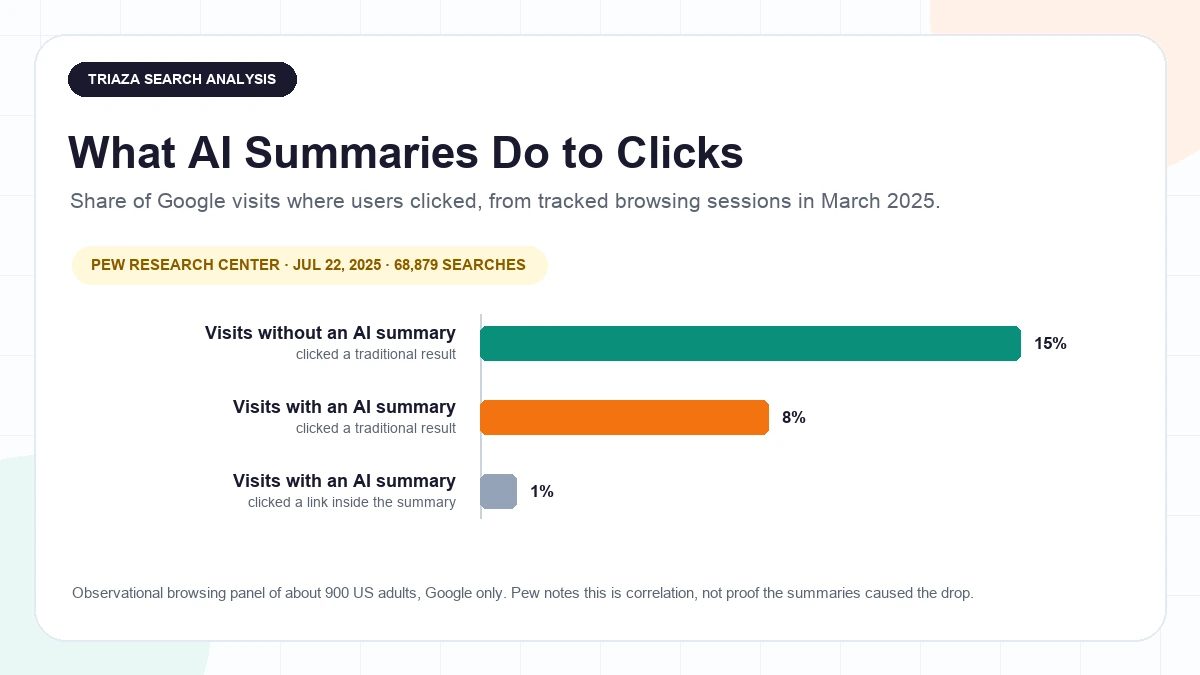
Pew Research Center tracked about 900 US adults across 68,879 Google searches in March 2025: users clicked a traditional result on 8% of visits where an AI summary appeared versus 15% without one. It’s an opt-in observational panel, Google-only, and not proof the summaries caused the gap. Ahrefs’ April 2025 study of 300,000 keywords points the same direction: a 34.5% relative drop in position-1 desktop CTR on AI Overview keywords year over year, which the authors call an approximation since Google exposes no true AI Overview click data. Budget your content ROI against the discounted click reality, not 2023 CTR curves.
23. Watch trigger rates without panicking at any single month
How often AI Overviews appear keeps moving. Semrush/Datos tracking data, as refreshed through November 2025, showed the trigger rate rising from 6.49% of tracked keywords in January 2025 to a 24.61% peak in July, then settling at 15.69% in November, while the zero-click share on those same keywords actually fell slightly after AI Overviews appeared, from 33.75% to 31.53%. That’s a living tracker rather than a fixed study, so check the current state before quoting it in a board deck. The operational lesson: measure your own click data per query class before reallocating budget off a headline.
24. Value citations as brand exposure first, traffic second
In Pew’s browsing data, users clicked a source link inside the AI summary on just 1% of visits where one appeared, with the same observational-panel caveats as fix 22. A citation mostly buys presence in the answer your buyer reads, not a session in your analytics. Set stakeholder expectations that way, and pair citation tracking with branded-search and direct-traffic trends. How Overviews assemble those answers is covered in our AI Overviews explainer.
25. Aim third-party effort at citation types you can influence
Ahrefs analyzed the top 1,000 pages ChatGPT cites (October 2025): Wikipedia took 29.7%, homepages and landing pages 23.8%, and blog or article pages just 1.9%, with roughly a third of citation types realistically influenceable by a marketer. Ahrefs notes its Claude-based categorization is “not 100% fool-proof” and it’s one vendor’s tool on one platform’s top 1,000. Direction anyway: presence on the reference-shaped sources engines already lean on (reviews, educational content, industry references) is worth more than another blog post shouting into the 1.9%.
What to Do With This List
Don’t run all 25 at once. Sequence it: confirm eligibility first (fixes 12-14), make your highest-stakes pages extractable and evidence-dense (1-10), then stand up measurement (21-25) so you can tell whether any of it moved. The schema and llms.txt items are deliberately last-priority; they’re cheap, so do them, but nothing in the evidence says they carry a strategy.
If you’re a team of one to three and the real question is which software to point at this, we sorted that separately in the AI marketing stack for lean teams, by job rather than by vendor.
If you’d rather hand the audit to someone who runs this list weekly, that’s the shape of our AI Search & Answer Engine Optimization work: we assess where your site stands on each of these fixes, prioritize by impact, and set up the measurement to prove movement.
Questions Marketers Keep Asking About AEO Fixes
Is AEO different from SEO? Less than the acronym suggests. Google’s Danny Sullivan frames answer engine optimization as a subset of standard SEO: the same crawling, indexing, and quality work, with extraction-friendly writing on top. That’s Google’s stated position rather than an independent finding, but nothing in this checklist contradicts it. We laid out the full relationship in our earlier guide to pairing classic SEO with AI-era search.
Do I need an llms.txt file? No. SE Ranking’s 300,000-domain analysis (November 2025) found no measurable relationship between having one and being cited, with their own hedge that this could change: “at least not yet.” It costs an hour and does no harm, so ship one if you like. Fix 17 has the full framing.
Does schema markup get me cited in AI answers? Nobody has shown that it does. AccuraCast found 81% of cited pages carried some schema but warns against reading their own correlation as a requirement, and Google’s Danny Sullivan says directly that it’s not “structured data and you win AI.” Mark up what your content is, then move on.
How long until AEO work shows results? No dated study measures this, so distrust anyone quoting a precise timeline. Practitioner consensus, and it’s only consensus, expects the first citation movement within weeks on lower-competition questions and stable patterns over a few months. Your own monthly prompt audit (fix 21) is the honest clock.
Should I cut my long content down for AI search? Not because of length alone. Ahrefs found essentially no correlation (0.04) between word count and AI Overview citation in December 2025, with more than half of cited pages under 1,000 words; their caveat is that this is correlation, not causation. Cut padding because padding buries your extractable answer, not to hit a number.
Why doesn’t ChatGPT search cite us when we rank fine in Google? Probably because its retrieval leans toward Bing. Seer Interactive matched 87% of ChatGPT search citations to Bing’s top results versus 56% for Google, on a sample its authors call limited and directional. Check your Bing indexation and rankings before assuming a content problem (fix 15).
Is AI Mode something separate I need to optimize for? Not separately, no. AI Mode has been generally available in the US since May 2025 and in more than 200 countries and territories since October 2025, and it runs on Google’s Search infrastructure, so the eligibility work in fixes 12-14 covers it. Google’s own guidance treats AI experiences as part of Search, not a parallel system with separate requirements.