Most website rewrites start with design comps. That order has always been risky for SEO, and it just got riskier, because the systems reading your site now include AI search experiences that summarize, cite, and answer — not just rank.
Google rolled AI Overviews out to everyone in the U.S. last May, expanded them internationally in August, and by late October said they reach more than a billion users a month across 100+ countries. OpenAI launched ChatGPT search at the end of October and opened it to everyone in supported regions at the start of this month. If your buyers research online, some of them are already meeting your company through an AI-generated answer instead of a list of blue links.
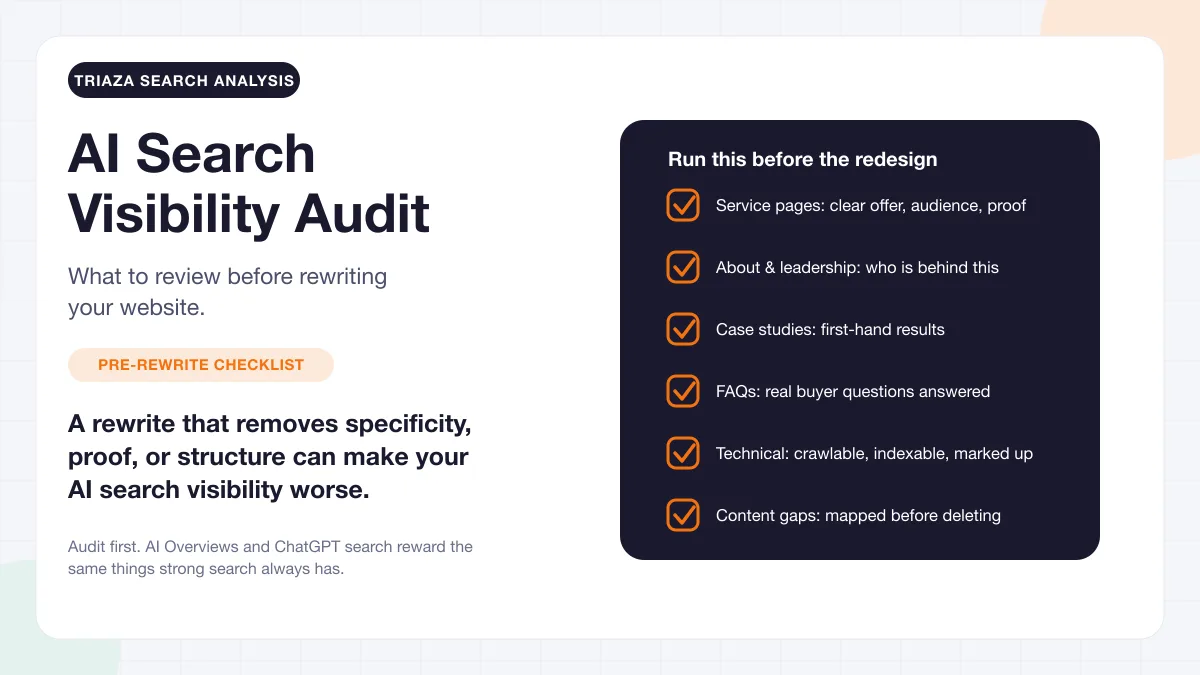
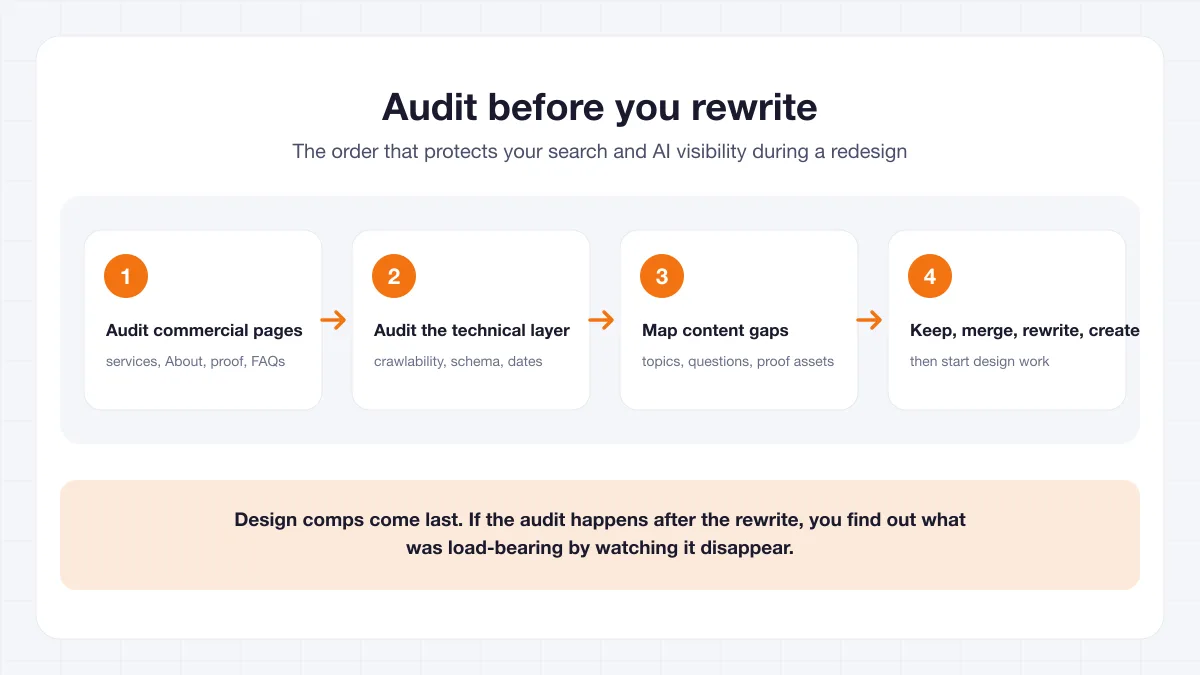
None of the official guidance describes a special “AI format” you can bolt on. What it describes is a site that’s easy to trust, easy to parse, and easy to cite. A rewrite that improves the visual design but strips out specificity, proof, author clarity, internal links, or indexable content can make your AI search visibility worse — and you’ll find out what was load-bearing by watching it disappear.
So before anyone touches copy or templates, run this audit.
Why AI search readiness belongs in a pre-rewrite audit
Start with what the platforms themselves say, because it’s more boring — and more useful — than the hype.
Google’s own explanation of AI Overviews is that they’re built on its core ranking systems and designed to show links to relevant web results. Google also claims that when a page is included in an AI Overview, the links it gets tend to earn more clicks than a traditional listing would have for that query. That’s Google’s number, not an independent one, but the direction of the advice is consistent: the way in is through the same quality systems that already rank you.
Microsoft says the same thing more bluntly. Bing’s Webmaster team wrote in November that there’s “no secret sauce or special code” for visibility in AI-powered search — their advice is intent-driven keyword research and content that actually resolves what the searcher is trying to do.
And underneath all of it sits the standard Google has repeated since the helpful content update: original, people-first content that demonstrates experience, expertise, authoritativeness, and trustworthiness. Google’s guidance on AI-generated content says quality matters more than how content is produced, and points creators at three questions — who created this, how was it created, and why does it exist.
Read together, the audit brief writes itself. Before a rewrite, you’re checking whether your site clearly answers: who you help, what you do, why you’re credible, where the proof lives, how pages connect, and whether search systems can reliably crawl and interpret all of it.
Audit your commercial pages before you rewrite anything
This is where startups lose the most during rewrites, because commercial pages are where specificity dies in the name of “cleaner” copy.
Service pages: clarity and intent match
Review every core service page against one question: could a first-time visitor — or a system summarizing this page — state plainly who it’s for, what problem it solves, how it’s delivered, and what outcome to expect? Pass if each major service has its own indexable page with a clear audience, problem, outcome, proof point, and next step. Fail if one vague “Services” page tries to cover everything, or if jargon hides what you actually do. Bing’s intent-driven framing is the useful lens here: every service page should map to something a real buyer is trying to solve, in the buyer’s language.
About and leadership pages: who is behind this
Google’s AI-content guidance made “who, how, and why” explicit, and the helpful content standard keeps asking whether content demonstrates first-hand expertise. Your About and leadership pages are where a careful reader — human or machine — goes to verify that. Pass if the site shows who’s behind the company, why they’re qualified, and how to verify them (names, roles, history, consistent entity details that match your LinkedIn and anywhere you’ve been covered). Fail if the team is anonymous, the About page is a paragraph of adjectives, or your company details contradict themselves across the web. An About page won’t rank you by itself — it’s how a careful reader decides whether to believe the rest of your site.
Case studies: first-hand proof
Generic capability claims are exactly the kind of content the helpful content standard was written against. Pass if your case studies show the problem, the approach, and a measurable result with enough context to prove you actually did the work — dates, screenshots, numbers, named quotes where you can get them. Fail if your “proof” is a testimonial wall of two-sentence praise. In an environment where AI systems summarize the consensus, first-hand material is the part of your site nobody else can produce.
FAQs: the questions buyers actually ask
One expectation to reset first: Google restricted FAQ rich results to authoritative government and health sites back in 2023, so FAQ markup is no longer a snippet shortcut for most companies. That doesn’t make FAQs less valuable — it clarifies what they’re for. Pass if real objections and buying questions are answered plainly on the pages where those questions occur, close to the conversion point. Fail if the answers only exist in sales calls. Question-and-answer content earns its keep by making pages genuinely resolve queries, which is the behavior every AI search surface is built to reward.
Audit the technical layer before you change templates
A redesign usually means new templates, new routing, and sometimes a new stack. Check the foundation before the movers arrive.
Crawlability, indexing, and architecture
If crawlers can’t reach a page, nothing else on this list matters. Search Engine Journal’s guide to ChatGPT search indexing is a good operational reference: ChatGPT search leans on Bing’s index plus OpenAI’s own crawlers, and visibility starts with robots.txt, crawler access, and a clear site architecture. Pass if your important pages are crawlable, indexable, canonicalized, and reachable through a sensible structure — and if your robots rules reflect a deliberate decision about AI crawlers rather than an accident. Fail if key content is blocked, duplicated, buried in JavaScript, or orphaned. Audit this on the current site first, so the rewrite has a baseline to protect.
Structured data, without overengineering
Schema is one of the most over-promised items in AI search advice, so anchor on the sober version: Search Engine Land’s late-2024 assessment is that schema isn’t required for AI-driven search to understand your content, but it still helps in the right places. Pass if your markup is accurate, matches what’s visibly on the page, and is used where it genuinely clarifies — organization details, articles, dates, products. Fail if schema is sprayed across the site describing things the page doesn’t show. While you’re in there, follow Google’s date guidance: visible dates that agree with datePublished and dateModified.
Dates, freshness, and honest maintenance
Stale pages erode trust in both directions — readers bounce, and systems learn your site can’t be relied on for current answers. Pass if important pages show clear, accurate dates and claims get refreshed when something materially changes. Fail if the site is fake-freshened (dates bumped without changes) or visibly out of date. Worth remembering: Google’s March 2024 update tightened spam policies around scaled and manipulative content practices, which raised the cost of shortcuts in exactly this area.
Find content gaps before you consolidate or delete pages
Rewrites love deleting pages. Sometimes that’s right — thin, overlapping pages should be merged. But do the gap analysis first, or you’ll delete pages that were quietly doing work and skip pages you never knew you needed.
Three lists to build before anything gets cut:
- Missing topics and use cases. Run a keyword-gap review against two or three competitors: what do they cover — and rank for — that you don’t? Which audience segments or use cases have no page at all?
- Missing buyer questions. Collect the questions from sales calls, support threads, and the queries already bringing you impressions. Every recurring question with no on-page answer is a gap.
- Missing proof. For each core service, is there at least one piece of first-hand evidence — a case study, a teardown, a benchmark, real numbers? If not, that’s a content project that matters more than the redesign.
Internal linking belongs in this pass too. Search Engine Land’s guidance on internal linking for an E-E-A-T-focused strategy describes the structure worth auditing for: pillar pages connected to supporting cluster pages with descriptive anchors, so both users and search systems can see how your expertise hangs together. Pass if service pages, proof, and explainers all link to each other contextually. Fail if your most important pages are reachable only from the navigation.
The one-page pass/fail checklist
Run this in one sitting before greenlighting any copy rewrite. Not every “yes” is a ranking factor — together, they describe a site that search systems, AI or classic, can confidently understand and trust.
| Question | Pass | Fail |
|---|---|---|
| Does each core service have its own page with a clear audience, problem, delivery model, and outcome? | Each service is explicit and distinct | One generic services page covers everything |
| Can a first-time visitor tell who leads the company and why to trust them? | About and leadership pages are specific and verifiable | The team is vague or anonymous |
| Do case studies prove first-hand expertise with process and outcomes? | Named context, method, and results | Generic testimonials only |
| Do important pages answer natural-language buyer questions directly? | Objections and FAQs are visible on-page | Answers are missing or hidden |
| Are your most important pages linked contextually from other relevant pages? | Service, proof, and educational pages support each other | Pages are isolated or orphaned |
| Have you mapped missing topics, use cases, and competitor-covered queries before deleting pages? | A gap analysis exists | The rewrite is design-led only |
| Is schema accurate, aligned with visible content, and used strategically? | Markup matches what users can see | Markup is bloated or decorative |
| Can search engines and AI crawlers reach the pages that matter? | Robots, architecture, and indexing are in order | Key pages are blocked, duplicated, or hard to crawl |
| Are dates and claims accurate and updated when things materially change? | Visible and structured dates are clear and honest | Pages are stale or fake-freshened |
| Would a reader leave the page feeling the question is resolved? | The page completes the task | It teases an answer or restates other people’s summaries |
Decide what to keep, merge, rewrite, or create
With the audit done, sort every meaningful page into one of four buckets:
- Keep the pages that pass — and protect their URLs, internal links, and content through the redesign.
- Merge overlapping thin pages into one strong page, with redirects.
- Rewrite pages whose substance is right but whose clarity fails the audit.
- Create the missing pieces the gap analysis surfaced — usually proof content and question-answering pages before anything else.
Only then does design and template work start, with the audit as its constraint sheet rather than an afterthought. If the rewrite is part of a larger rebuild, this is the sequence we run website design projects on: content decisions first, so the new site launches with its visibility intact instead of rebuilding it from zero.
Questions founders keep asking
How do I get my site indexed in ChatGPT search?
Start with access: ChatGPT search draws on Bing’s index and OpenAI’s own crawlers, so check that your robots.txt isn’t blocking the crawlers you want, verify your site in Bing Webmaster Tools, and keep your architecture clean enough that important pages are easy to reach. It’s unglamorous, and it’s most of the battle.
Does schema still matter in AI search?
It’s not required — AI systems can read plain text — but it still helps selectively: organization details, articles, dates, and products, wherever markup clarifies what’s visibly on the page. Treat it as support, not a citation switch.
Should I still use FAQ schema?
For most sites, FAQ rich results have been gone since 2023, so don’t expect SERP treatment from the markup. Keep the FAQs themselves: clear on-page answers to real buyer questions are more valuable in AI-summarized search, not less.
Will AI Overviews reduce my traffic?
As of early 2025, nobody outside Google has definitive data. Google’s position is that included links earn better clicks than traditional listings; plenty of marketers are skeptical. What you control is whether your pages are worth citing and worth clicking — specific, evidenced, and clearly yours. That’s the same work either way. For a closer look at how Overviews pick their sources and what the first CTR studies show, see our AI Overviews explainer.
Audit first, then rewrite
The point of all this isn’t that AI search demands a new kind of website. It’s that AI search raises the price of the flaws a rewrite tends to introduce: vagueness, missing proof, broken structure, blocked crawlers. Pages with clear purpose, clear ownership, first-hand evidence, explicit answers, good internal structure, honest dates, and selective markup were the goal before AI Overviews existed. Now they’re also what gets you into the answers.
For the deeper strategy behind this — how classic SEO and AI-era optimization fit together — we published our full SEO and AIO guide earlier this month. And if you’d rather have a second set of eyes on the audit itself, that’s exactly what our AI search optimization work covers, from the first crawl check to the rewrite plan.