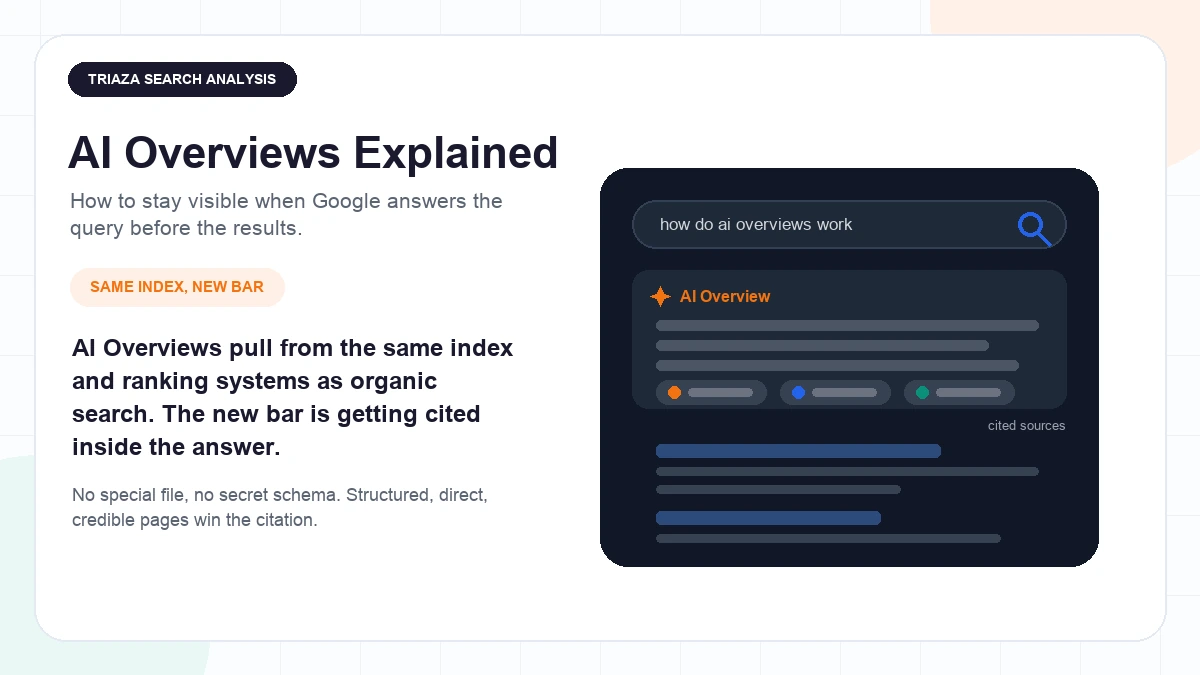
You’ve noticed it if you watch your analytics closely: a page that still ranks well is pulling fewer clicks than it used to. Chances are it’s showing up under, or being summarized inside, a Google AI Overview, the AI-generated answer box that now sits above the organic results for a growing share of searches.
Google AI Overviews are AI-generated summaries that appear at the top of search results, synthesizing information from multiple web sources into a single answer with citation links. They draw from the same search index and ranking systems as regular organic results, so there’s no separate technical standard to chase.
They launched broadly in the US in May 2024 and now touch a meaningful share of queries. What changes is the bar: getting cited inside the summary matters more than getting ranked first below it.
Here’s what founders and marketers need to know about how they actually work, what the early data shows, and how to structure content that gets pulled in rather than passed over.
What Are Google AI Overviews, Really?
Google introduced AI Overviews at I/O in May 2024, after testing the concept in Labs under the name Search Generative Experience. The mechanics are straightforward: for a growing set of queries, Google generates a synthesized answer, pulls supporting links from multiple sources, and places that block above the traditional “ten blue links.” It’s a heavier, more citation-oriented cousin of the old featured snippet, not a replacement search engine.
By early 2025, AI Overviews had been live in the US for roughly ten months. In October 2024, Google announced its largest expansion yet, saying AI Overviews would reach more than 1 billion monthly users across more than 100 countries. Google doesn’t publish how often an Overview appears, and third-party estimates vary depending on which keywords a tracker watches, but every announcement through early 2025 pushed the same direction: more question types, more languages, more markets.
How AI Overviews Choose Their Sources
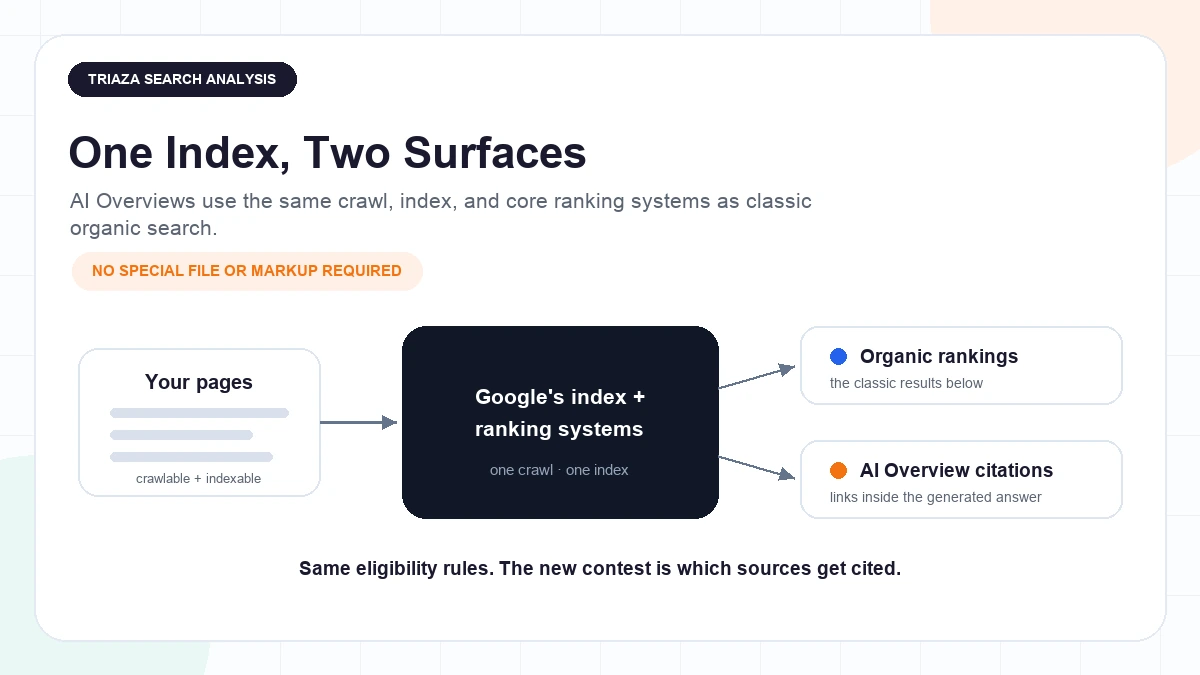
The most important thing to understand, and the thing most likely to get misrepresented in “AI SEO” pitches: Google has consistently said that AI Overviews pull from the same underlying search index and use the same core ranking systems as classic Search. There isn’t a parallel AI-only crawl, and there isn’t a special file or markup format required to be eligible.
In practice, this means the sites showing up inside AI Overviews are, overwhelmingly, sites that already rank well organically. If your page isn’t indexed, isn’t crawlable, or isn’t competitive for the query in regular search, it isn’t going to leapfrog into the AI Overview either.
Do You Need New Structured Data or Files?
No, at least not anything beyond what already helps regular SEO. Clear entity markup (Organization, Article, breadcrumbs) supports how Google’s systems understand your page, but it’s a support signal, not a citation switch. There’s no dated, official guidance from Google as of March 2025 suggesting you need an AI-Overview-specific schema or file to be eligible. Be skeptical of anyone selling that as a quick fix.
Where AI Overviews Are Showing Up in Early 2025
Coverage has been expanding steadily rather than all at once. The rollout started in the US and has moved outward market by market.
The March 2025 European Expansion
On March 25, 2025, Google expanded AI Overviews to nine more European countries: Austria, Belgium, Germany, Ireland, Italy, Poland, Portugal, Spain, and Switzerland. Language support widened at the same time, adding German, Italian, Polish, Portuguese, Spanish, and French alongside English, with the exact mix varying by country. If you serve those markets, this is a live, current change worth watching in your own search traffic, not a future hypothetical.
A Quick Look at Google’s New Labs Experiment: AI Mode
Three weeks earlier, on March 5, 2025, Google introduced something adjacent but distinct: AI Mode, an early, opt-in Search Labs experiment available to Google One AI Premium subscribers in the US, built on a custom version of Gemini 2.0. It’s worth knowing about, but it’s important not to overstate where it is today. This is an experimental, opt-in feature for a subscriber subset, not a default search experience. Don’t build your strategy around AI Mode yet; build it around AI Overviews, which is the feature actually reaching the mass of searchers right now.
The Real Cost: What Early CTR Data Shows
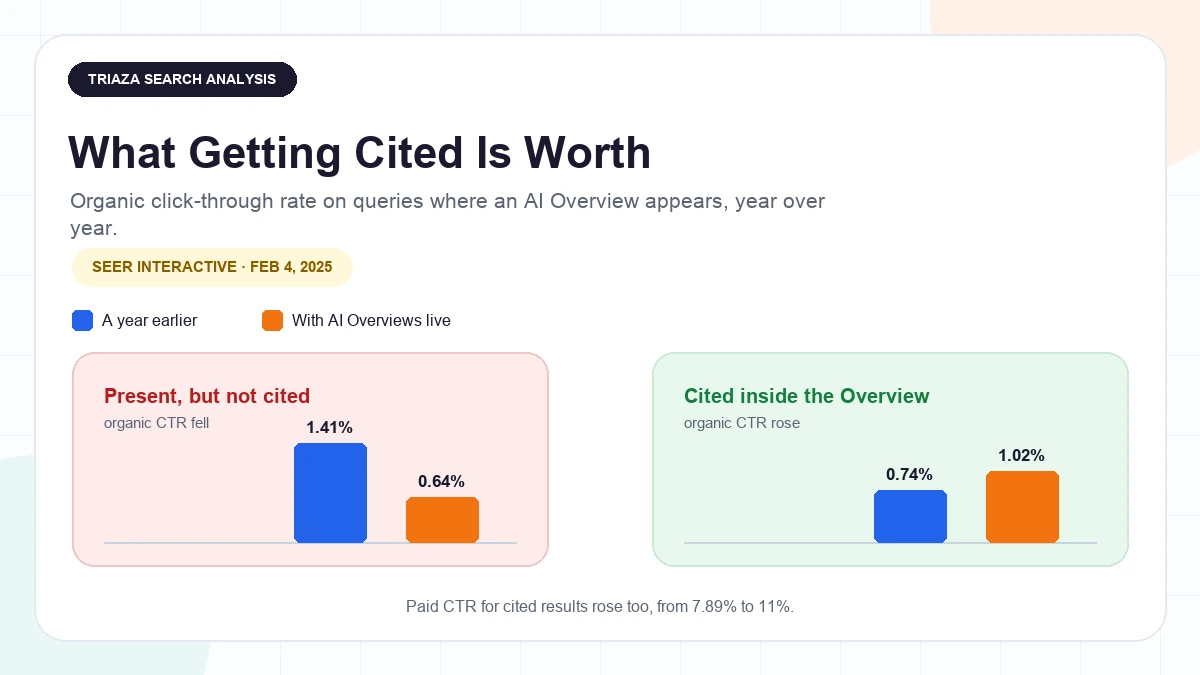
The traffic conversation isn’t hypothetical anymore. Seer Interactive published a study on February 4, 2025 looking at click-through rate on queries where AI Overviews appeared. The topline number is blunt: organic CTR on those queries fell from 1.41% to 0.64% year over year.
But the same study had a more useful finding buried in it. For queries where a brand’s own result was cited inside the AI Overview, organic CTR actually rose, from 0.74% to 1.02%, and paid CTR rose too, from 7.89% to 11%. Seer notes a fair caveat: many of those cited queries are branded, with a naturally higher click-through baseline, so some of the lift reflects brand strength rather than the citation itself. Even so, the direction is hard to miss. Cited results held or gained ground while the average for everything sitting under an Overview fell by more than half.
None of this is happening in a vacuum. SparkToro’s 2024 zero-click research already put the baseline at roughly 360 clicks to the open web per 1,000 US Google searches. AI Overviews look like an accelerant on a trend that was already underway, not a trend they invented on their own.
Why Getting Cited Beats Getting Ranked #1
Put those two data points together and the strategic shift is clear. Ranking #1 organically, underneath an AI Overview that answers the question and doesn’t cite you, is now one of the weaker outcomes available. Ranking lower, but earning a citation inside the Overview, can outperform it. The optimization target has shifted from position to presence inside the answer.
How to Structure Content AI Overviews Actually Pull From
Nobody, including Google, has published a precise formula for what gets selected into an AI Overview. But the pattern that shows up consistently, across SEO practitioners watching this closely in early 2025, points to a handful of concrete, controllable habits. We walked through how to assess where your site stands today in our AI search visibility audit guide; the habits below are the fix-it side of that work.
Answer-First Formatting
Lead with a direct, self-contained answer to the likely query, ideally in the first paragraph or two, before you get into narrative setup or backstory. This is the same discipline that helped pages win featured snippets, and it appears to matter at least as much here. If a reader (or a model summarizing your page) has to read six paragraphs to find the actual answer, you’re making the extraction job harder than it needs to be.
E-E-A-T Signals That Matter More Now
Experience, expertise, authoritativeness, and trust were already core to Google’s quality guidelines before AI Overviews existed. They matter more now because a synthesis engine choosing what to cite has every incentive to prefer sources that look credible and well-sourced over ones that read like a hastily assembled content-mill post. Clear authorship, real expertise in the byline, and specific, non-generic detail all help here, even without a study to point to.
Freshness & Update Signals
For anything time-sensitive or fast-moving, keeping content visibly current still matters: updated examples, current screenshots, a real “last updated” signal. This isn’t a new AI-era tactic; it’s an existing SEO practice that carries over directly.
Where Structured Data Still Helps
As noted above, structured data won’t get you into an AI Overview on its own. But clean Organization, Article, and breadcrumb schema helps Google’s systems parse who you are and what the page is, which supports the same fundamentals that drive organic visibility in general. Treat it as hygiene, not magic.
What This Means If You’re a Startup or B2B Marketer
If you’re running marketing at a startup without a dedicated SEO hire, the practical takeaway is reassuring in one sense and demanding in another. Reassuring: you don’t need a separate AI-Overview strategy bolted onto your existing SEO work. Demanding: the bar for “good enough” content has moved up, because you’re now competing to be the source an AI system chooses to quote, not just the page a human chooses to click.
This is the specific gap our AI Search & Answer Engine Optimization work is built around: auditing which of your pages are positioned to earn citations, tightening the on-page structure that supports it, and building a measurement approach that tracks whether you’re actually showing up inside these answers, not just where you rank below them.
Where This Fits Into Your Broader SEO Strategy
None of this replaces foundational SEO. Every piece of Google’s own guidance still points back to crawlability, indexability, clear content, and topical authority as the base layer. AI Overview visibility is best understood as an extension of that work, not a parallel discipline with its own separate rulebook. If your SEO fundamentals are weak, fixing AI Overview visibility without fixing that foundation won’t hold.
Questions Marketers Keep Asking
Is this just Search Generative Experience with a new name? Not exactly. SGE was the Labs testing phase; AI Overviews is the broadly launched product that came out of it, live in the US since May 2024.
Do I need special schema markup to show up in an AI Overview? No. Google has not published guidance requiring AI-Overview-specific markup. Standard entity and content-quality schema helps the way it already helps regular search.
Why isn’t my #1-ranking page showing up in the Overview for its own keyword? Ranking well is necessary but not sufficient. Citation selection appears to favor pages that are easiest to extract a direct answer from, not simply the top-ranked result.
Should I chase citations instead of rankings? Chase both. Ranking well keeps you eligible; clear, extractable, well-sourced content is what seems to convert that eligibility into an actual citation. We break down the full playbook in our startup guide to answer engine optimization.
Is this going to kill affiliate or informational content sites? It’s too early to say definitively as of this writing, but thin, generic informational content is clearly under the most pressure. Sites with original data, real expertise, and distinctive point of view are better positioned than commodity roundups.
How is this different from a featured snippet? A featured snippet pulls one excerpt from one page. AI Overviews synthesize across multiple sources into a single generated answer with several citation links, which is a meaningfully different mechanism even though the “answer above the fold” effect feels similar to users.
Are AI Overviews even live in my country yet? Coverage is expanding market by market. Google’s October 2024 expansion took AI Overviews to more than 100 countries and territories, and the March 25, 2025 rollout added nine more European countries. Check your own analytics for AI-Overview-attributable CTR changes rather than assuming based on headlines.
What’s this “AI Mode” thing I keep hearing about? It’s a separate, newer, and still experimental Search Labs feature launched March 5, 2025 for a subset of Google One AI Premium subscribers. It’s worth watching, but AI Overviews, not AI Mode, is where most of your traffic exposure is coming from right now.