Three weeks ago Google took AI Mode to more than 40 new countries and over 35 new languages, putting it in more than 200 countries and territories. It stopped being an experiment in May. So the question isn’t whether AI search arrives. It’s whether the thing you’ve been building for three years is shaped like something an answer engine can use.
Most blogs aren’t. They’re an archive of whatever keyword looked winnable that quarter, loosely sorted into categories nobody clicks. That structure was survivable when the prize was a ranking. It’s a problem now that the prize is a citation.
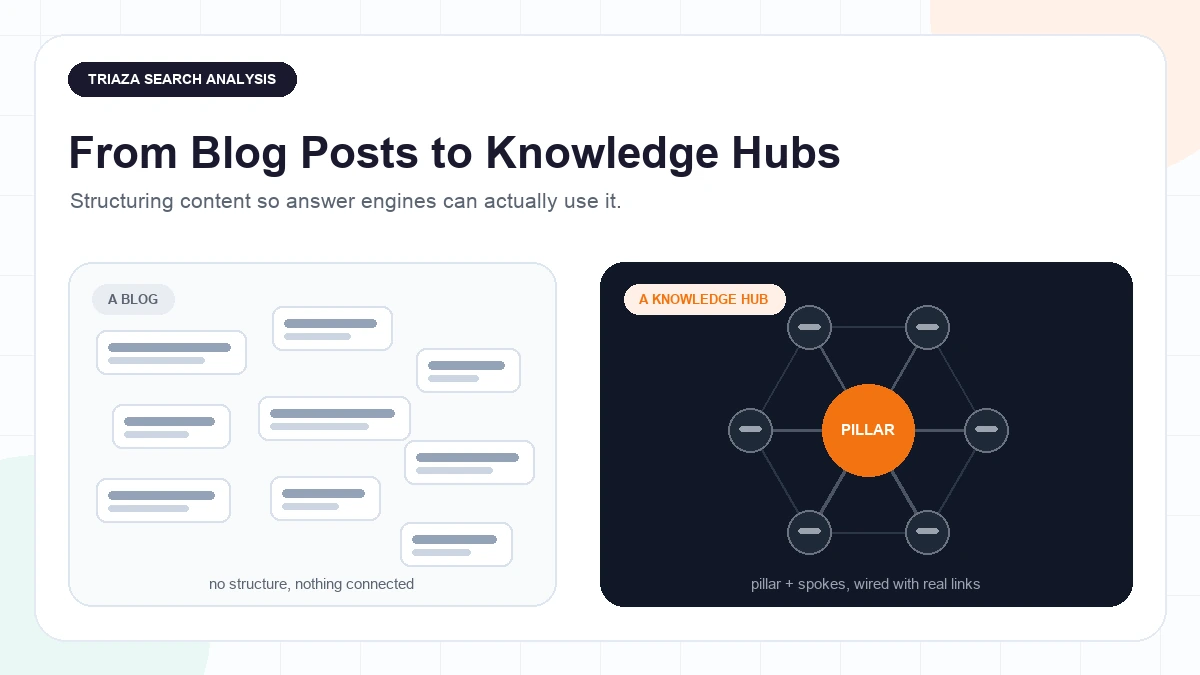
A knowledge hub is a blog restructured around topics instead of posts: one pillar page that covers a subject completely, supporting pages that go deep on each subtopic, and real internal links wiring them together. The structure matters because AI answer engines retrieve passages, not whole sites, and a well scoped passage is easier to retrieve.
Here’s the honest version of how to build one, including what has evidence behind it, what has only a hedged vendor study, and what’s just our reasoning.
Why “Publish More Posts” Stopped Working
The volume playbook assumed a click was the reward for ranking. That link between the two is weakening. Pew Research Center tracked the browsing of 900 U.S. adults across 68,879 Google searches in March 2025 and found that people clicked a traditional result on 8% of visits where an AI summary appeared, versus 15% of visits without one. They clicked a source cited inside the summary on just 1% of visits. Pew is careful about what this shows: it’s an opt-in browsing panel, it covers Google only, the result pages were captured in a single April 2025 window, and it’s observed correlation rather than proof that the summaries caused the drop. Directionally, though, the ground is moving.
Ranking First Doesn’t Get You Cited
The assumption worth killing early is that citations are a reward for ranking well. They aren’t, or at least not reliably.
Semrush studied AI Overviews across 200,000 keywords (100,000 US desktop and 100,000 US mobile) and found that more than half of desktop Overviews, and 60% on mobile, didn’t link the page ranking first organically. The average Overview ran 119 words on desktop and cited about 11 links. Two caveats belong with that number: Semrush’s keyword set skewed heavily informational (80% on desktop), and the underlying SERPs were collected in September 2024, so it’s a snapshot of a fast-moving surface rather than a current census.
BrightEdge, tracking 16 months of Overviews from May 2024 to September 2025, watched the overlap between AI Overview citations and organic rankings climb from 32.3% to 54.5%, while only 16.7% of citations came from the organic top 10. Most of the growth came from pages ranking 21 to 100. That’s BrightEdge’s own proprietary parser, it publishes no total sample size (a real gap worth naming), and BrightEdge itself notes individual industries “vary wildly”: B2B tech sat at 71% overlap while e-commerce barely moved.
And the citations churn. Authoritas sampled 11,203 keywords on three dates between August 2024 and January 2025 and found roughly 70% of the pages cited in Overviews changed over a two to three month window, with a very weak correlation (about 0.09) between AI Overview volatility and classic organic volatility. Their caveats: only 2,104 of those keywords actually triggered an Overview, it’s desktop-only, and they warn their volatility metrics can’t be compared directly to each other.
Put those together and the picture is consistent, if not conclusive: being cited is a related but separate contest from ranking. We covered how Overviews assemble an answer in our AI Overviews explainer, and the citation-earning discipline itself in our guide to answer engine optimization.
What a Knowledge Hub Actually Is
The model is older than AI search, which is a point in its favor. HubSpot Research published “Topic Clusters: The Next Evolution of SEO” in May 2017, and the shape has barely changed: a pillar page covering a broad topic comprehensively, cluster pages going deep on individual subtopics, and internal links running from each cluster page back to the pillar and across to each other.
HubSpot traced it to internal experiments run in 2016, reporting that as they added internal links between related pieces, those pages climbed and impressions rose with the number of links. Take that as what it is. It’s a vendor describing its own unpublished experiment on “a select group of topics,” with no sample size, no methodology, no significance testing, and no claim of causation. It’s the origin story for the model, not evidence that the model works.
Why it emerged is the more useful part. HubSpot pointed at Hummingbird (2013) and RankBrain (2015), when Google started parsing phrases and query context instead of matching exact keyword strings. Once the engine understands topics, organizing your site by keyword stops matching how the machine reads it. That argument aged well, and it applies with more force to systems that read passages.
Is “Topical Authority” Real? An Honest Answer
Mostly no, at least not as the thing it’s usually sold as.
There’s no documented Google ranking signal called topical authority. When a Reddit user argued the term was just repackaged “relevancy” and that it’s “a new fancy term used by SEO gurus to get clicks,” Google’s John Mueller replied “This” and has separately told people not to worry about it. That’s a brief comment on Reddit reported by Search Engine Journal rather than formal Google policy, but it’s the clearest thing a Google spokesperson has said on the term.
What Google has actually put on the record, with dates, is narrower and more useful. When it announced the Helpful Content Update in August 2022, Google described “a new site-wide signal that we consider among many other signals for ranking web pages,” and said that “any content, not just unhelpful content, on sites determined to have relatively high amounts of unhelpful content overall is less likely to perform well in Search.” It asked creators whether their content demonstrates first-hand expertise and depth of knowledge. That’s a statement about site-wide helpfulness, not about a topical authority score, and it describes what Google announced in 2022 rather than how its systems work today.
Google also added experience to E-A-T in December 2022, making E-E-A-T, so that quality raters weigh whether content was produced with real experience of the thing being described. Google is explicit that the rater guidelines “don’t directly influence ranking,” and it repeated that when it updated the guidelines again in November 2023, adding that “none of these involve any major or foundational shifts.” Anyone telling you E-E-A-T is a ranking factor is contradicting the source.
So here’s the synthesis, and it’s the reason this section exists. There’s no authority score to farm. What exists is a set of real, dated mechanisms: internal linking, a site-wide helpfulness signal, and raters assessing depth and first-hand experience. A well built cluster is a bet that those mechanisms reward comprehensive coverage. That’s a reasonable bet. It is not the same as optimizing for a metric Google computes.
Why Structure Matters for Retrieval (the Part That Isn’t Theory)
This is the firmest ground in the article, so it’s worth being precise about what it does and doesn’t establish.
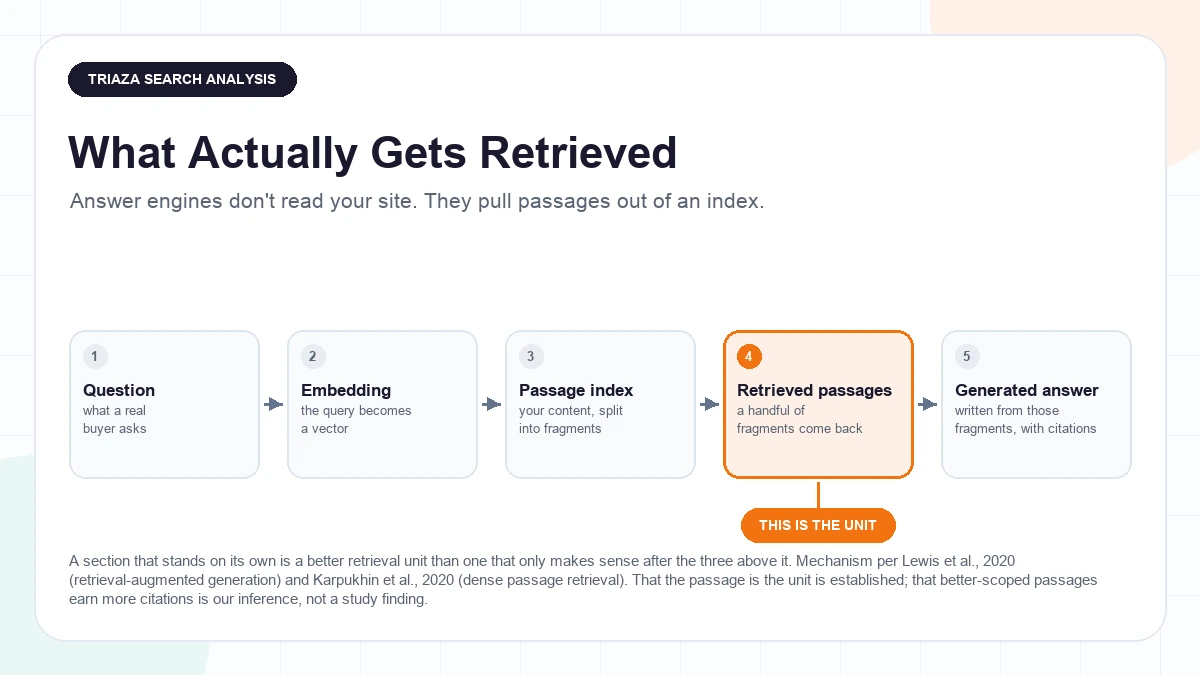
Answer engines don’t read your site. They query an index and pull fragments of it. The founding academic work here predates the whole AEO industry. The retrieval-augmented generation paper (Lewis et al., 2020) paired a language model with a dense vector index of Wikipedia reached through a neural retriever, and outperformed comparable parametric-only models on knowledge-intensive tasks, producing language the authors describe as more specific, diverse, and factual than a state-of-the-art parametric-only baseline. That’s a comparison against one baseline type, not a universal claim.
The retrieval half is more specific still. Dense Passage Retrieval (Karpukhin et al., 2020) showed that passage retrieval for open-domain question answering could be done with dense embeddings from a simple dual-encoder, beating a strong Lucene-BM25 baseline by 9 to 19 percentage points on top-20 retrieval accuracy. The paper says that held “largely” across a wide range of datasets, so don’t read the margin as identical everywhere.
Notice the word doing the work in both papers: passage. These systems retrieve passages, not pages and not sites.
Now the inference, and we’re labeling it as an inference rather than a finding: if the retrieval unit is a passage, then a section that stands on its own, states its scope, and answers its own question is a better retrieval unit than a section that only parses after you’ve read the three above it. That follows from how the mechanism works. It is not a study showing that better-chunked content gets cited more often. Nobody has run that study.
What We Can and Can’t Prove About Formatting
Be suspicious of anyone who tells you question-shaped H2s or bullets-over-prose lift citation rates. There’s no dated controlled study establishing that. The advice is reasonable inference from retrieval mechanics, which is exactly what we’re offering here, and it should be labeled that way rather than dressed up as a finding.
The nearest thing to evidence is the GEO paper (Aggarwal et al., 2023, later presented at KDD 2024), which built a benchmark of generative-engine responses and tested content-level changes. Its top methods, citing sources and adding quotations and statistics, produced a 30 to 40% relative improvement on the paper’s position-adjusted word count metric against a baseline visibility of roughly 19.3%, and 15 to 30% on its subjective impression metric, with the abstract claiming a boost of “up to 40%.” Keyword stuffing landed below the baseline. The caveats are load-bearing and belong right next to the numbers: it’s the authors’ own benchmark and their own visibility metric, it hasn’t been independently replicated, and it measures prompted model outputs on a constructed benchmark rather than live production answers. The paper says plainly that “the efficacy of these strategies varies across domains, underscoring the need for domain-specific optimization methods.” What survives all that is modest and still useful: substance that can be quoted travels; repetition doesn’t.
Entities and Schema: Plumbing, Not Switches
These two get sold as levers. They’re closer to wiring: worth doing correctly, incapable of carrying a strategy.
Entities: Real Mechanism, Thin Evidence
The mechanism is real and well documented. Google announced the Knowledge Graph in May 2012 with the phrase that still defines the idea, “things, not strings,” launching with more than 500 million objects and more than 3.5 billion facts about and relationships between them. An entity is a thing with a real-world identity, distinct from the words used to name it. Disambiguation is the whole job: telling a machine which Triaza, which product, which person.
Here’s the part the vendors skip. “Entity SEO” as a discipline is overwhelmingly practitioner theory extrapolated from Google’s public framing of the Knowledge Graph. It doesn’t have its own empirical literature. We went looking specifically for a study connecting entity clarity or brand-name consistency to AI citation behavior and found nothing dated and credible. The connection is plausible, since retrieval systems benefit from disambiguated entities for the same reasons search engines do, and it’s unproven. Treat sameAs, Wikidata, and Organization markup as how entity reconciliation works, not as a citation lever someone has measured.
Schema: Useful, Oversold
Start with the change most sites still haven’t absorbed. In August 2023 Google reduced FAQ rich results to “well-known, authoritative government and health websites,” and said that for everyone else they “will no longer be shown regularly.” HowTo was limited to desktop. Google said explicitly that this shouldn’t be considered a ranking change, and that there’s no need to rip the markup out, since unused structured data causes no problems. Which means “add FAQ schema for the rich snippet” has been dead advice for most B2B sites for two years.
On schema and AI citations specifically, the one dated study worth reading is AccuraCast’s, which pulled 9,000 citation sources from more than 2,000 prompts per platform across ChatGPT, AI Overviews, and Perplexity and found 81% of cited pages carried some schema versus 19% with none. Before anyone quotes that as proof, read what the authors say about it: “Looking at this data alone, one could jump to the conclusion that including schema is a requisite for getting cited in AI answers. But that wouldn’t be an accurate assumption.” They conclude schema “seems to matter to a very limited extent,” while noting it’s still worth using for traditional search, and that well-structured semantic HTML with proper list markup achieved comparable results. FAQPage markup appeared on 1.8% of cited sources.
There’s a counterpoint, and it’s an anecdote rather than a study. Search Engine Land ran three matched single-page test sites in September 2025; the well-implemented-schema page ranked for six keywords, peaked at position 3, and was the only one to appear in an AI Overview, while the page with no schema was crawled but never indexed. The authors are appropriately careful, writing that they “don’t consider these results to be absolute proof that well-implemented schema plays a role in AI Overview presence” and that “unseen variables could have muddied the waters.” Three pages and three keywords is a story, not a finding.
The defensible read: the evidence on schema and citation is thin and mixed, and nobody has shown schema earns citations. Mark up what your content actually is and move on. When Google walked through structured data at Search Central Live New York in March 2025, the types it pointed publishers at were Article, NewsArticle, BlogPosting, Paywall, and VideoObject, though that guidance was scoped to News and Top Stories rather than offered as a universal checklist. The principle generalizes even where the list doesn’t: describe the content, don’t decorate it. Mueller’s line from that same event is the right altitude: “If you’re doing the right thing for search, then you’re automatically doing the right things for AI.” There’s no separate AI schema checklist.
Internal Linking Is the Part Google Actually Confirmed
The least glamorous piece of the hub is the one with the strongest support.
Asked whether internal linking matters, Mueller didn’t hedge: “Yes, absolutely. It’s something where internal linking is super critical for SEO.” He called it “one of the biggest things that you can do on a website to kind of guide Google and guide visitors to the pages that you think are important.”
He also closed the door on the substitution most people are hoping for. Structured data doesn’t replace links: “just because there is structured data on a page somewhere, I wouldn’t see that as a replacement for normal internal linking. Even if in the structured data you also provide URLs, we don’t use those URLs in the same way as we would use normal internal links on a page.” His conclusion was blunt: “You should really have normal HTML links between the different parts of your website.”
That’s the house rule, stated by Google rather than by us. The links are the hub. Everything else is annotation.
The practical version, offered as practice rather than as Google-confirmed doctrine: keep important pages shallow in click depth, don’t strand pages with no inbound links, run links both from spokes to the pillar and between related spokes, and make anchor text describe the destination.
The Uncomfortable Data: Individual Blog Posts Rarely Get Cited
This is the number that should change your plan, and it cuts against our own interest in selling you content.
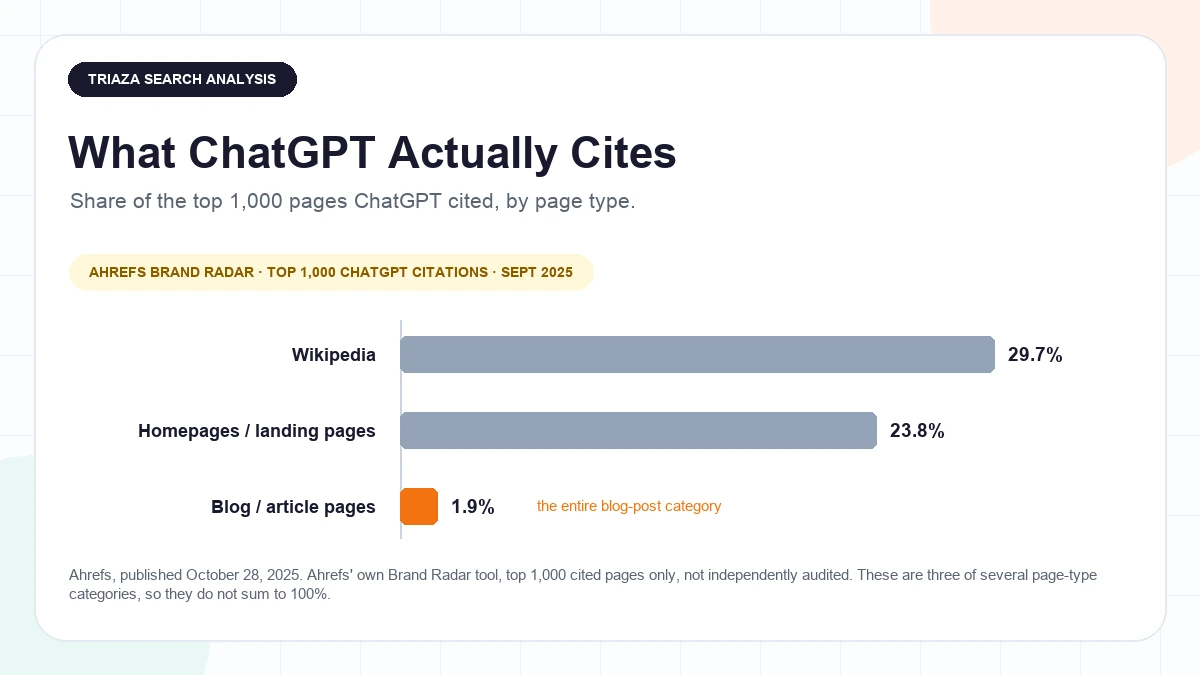
Ahrefs looked at the top 1,000 pages ChatGPT cited in September 2025. Wikipedia alone accounted for 29.7% of citations. Homepages and landing pages took 23.8%. Blog and article pages accounted for 1.9%. Ahrefs reckons about 32.3% of citation types are realistically influenceable by a marketer, meaning roughly two thirds are not. This is Ahrefs’ own Brand Radar data from its own tool, on the top 1,000 pages, and it isn’t independently audited.
Their freshness findings deserve more caution than they usually get when quoted. Publish dates were detectable on only 12.6% of those pages, and Ahrefs calls that “a very small pool of data, and other pages may follow a different pattern,” noting that “last modified” stamps can reflect crawl timing rather than real edits. This is exactly why we don’t tell clients to re-date their posts. The freshness data is directional at best, from a vendor’s own tool, on a tiny subsample, and the vendor says so.
Read the top-line honestly, though, and it makes the argument for hubs better than any vendor deck could. If reference-shaped pages and homepages take the citations while deep blog posts almost never do, the lesson isn’t “stop writing.” It’s that the asset worth building is the page that behaves structurally like reference content: comprehensive, stable, well organized, and clearly about one thing. The spokes still earn their keep, ranking for the long tail and giving the pillar something to be authoritative about. But the pillar is what gets cited. That’s the case for knowledge hubs, made by the least flattering data in this article.
How to Actually Build One
This is our approach rather than a study finding, and we’d rather label it than dress it up.
Start with an audit, not a plan. Find out what the engines currently say about you and where they source it before you restructure anything; our AI search visibility audit guide walks through the pre-work.
Consolidate before you add. Most blogs with 40 posts have maybe 12 topics and a lot of near-duplicates competing with each other. Merge the thin overlapping pieces into the pillar or prune them. Adding a spoke to a mess makes a bigger mess.
Pick topics you can own completely rather than topics you can add one post to. A cluster counts when someone with a real question about that subject can get it fully answered without leaving. That’s coverage, not a post count. Our companion strategy guide explains why topical authority beats isolated keyword volume and how to choose a buyer-relevant subject before building the hub.
Write passages that stand alone, answering the section’s question in its first two sentences before elaborating. Keep the caveat inside the paragraph that carries the claim, because a system that retrieves one passage will retrieve it without the qualification you parked three paragraphs later. That’s a genuine reason to write this way, and it’s why this article does.
Then wire it with real HTML links, mark up what the content actually is, and let it compound. If your constraint is capacity rather than knowing what to do, that’s the muscle our content marketing work builds: fewer pieces, each one dense enough to be worth citing, arranged so they add up to something.
What We’re Not Going to Tell You
We won’t tell you llms.txt earns citations, because no one has demonstrated that it does. We won’t tell you schema is a citation lever, because the best dated study on it explicitly warns against that reading. We won’t tell you to refresh your publish dates, because that advice rests on a 12.6% subsample from a vendor tool whose own authors call it a very small pool. And we won’t tell you there’s a topical authority score to optimize for, because Google’s own spokesperson says not to worry about the term.
What we will tell you is narrower and holds up: retrieval pulls passages, internal linking is the one piece Google has confirmed outright, and structure is the part of this you fully control. If you want help pointing that work at the answer engines specifically, that’s what our AI search optimization service is for. We’ve also written about pairing classic SEO with AI-era work in our guide to SEO and AI-driven search.
If you’re staring at 40 posts and no structure, that’s the conversation we have most weeks. Talk with us.
Questions Marketers Keep Asking About Content Hubs
How many posts does a cluster need before it counts? Nobody has a defensible number, and the published advice (anywhere from 5 to 20) has no study behind it. It isn’t a count, it’s coverage. A cluster counts when a reader with a real question about the topic can get it answered without leaving your site. Anyone who gives you a number is guessing.
Should we consolidate thin posts or just add more? Consolidate first. This is our standard practice rather than a sourced finding, but the logic is hard to argue with: overlapping thin posts compete with each other, split your internal links, and give a retrieval system several mediocre passages instead of one good one.
Does AI make blogging pointless? No, but the volume playbook is over. Ahrefs found blog and article pages made up just 1.9% of ChatGPT’s top 1,000 cited pages in September 2025, measured with its own Brand Radar tool on that top 1,000 sample and not independently audited. Read that as an argument for building hubs rather than an argument against writing, and as our interpretation of one vendor’s data rather than a settled conclusion.
How long until a content hub works? No dated number exists, and we won’t invent one. Mueller has described Google crawling more of a site over time as it recognizes the important pages, which supports “gradually, as trust is earned,” with his own caveats that it’s algorithmic, has no stated timeframe, and doesn’t work at all if the content isn’t good.
Do we still need FAQ schema now that the rich results are gone? It doesn’t hurt, and Google says there’s no need to remove it. But nothing in the record gives you a reason to prioritize it: FAQPage markup showed up on just 1.8% of cited sources in AccuraCast’s sample of 9,000 citations, whose authors warn against reading their own data as proof that schema drives citations and conclude it “seems to matter to a very limited extent,” and Google cut the rich result for most sites back in August 2023 while saying that change wasn’t a ranking one. Effort is better spent on Organization, Person, and Article clarity and on internal linking.
Is “topical authority” something we should optimize for? Optimize for the mechanisms the phrase is a nickname for. There’s no evidence of a topical authority score, and Google’s spokesperson has waved the term off. Comprehensive, well-linked coverage plausibly helps because of internal linking, a site-wide helpfulness signal, and raters assessing depth. Not because there’s a number being computed.