A founder can spend a year publishing articles that each look sensible in a keyword tool and still end up with a site that stands for nothing. One post targets a large search term. The next follows a trend. A third copies the structure of whatever currently ranks. Traffic may appear around the edges, but the collection never becomes a useful body of knowledge and never gives a buyer a reason to remember the company behind it.
That is the problem topical authority is meant to solve. It is not a score Google publishes. It is not a fixed number of cluster pages. It is an operating model for becoming unusually useful on a subject that matters to your customers and your business.
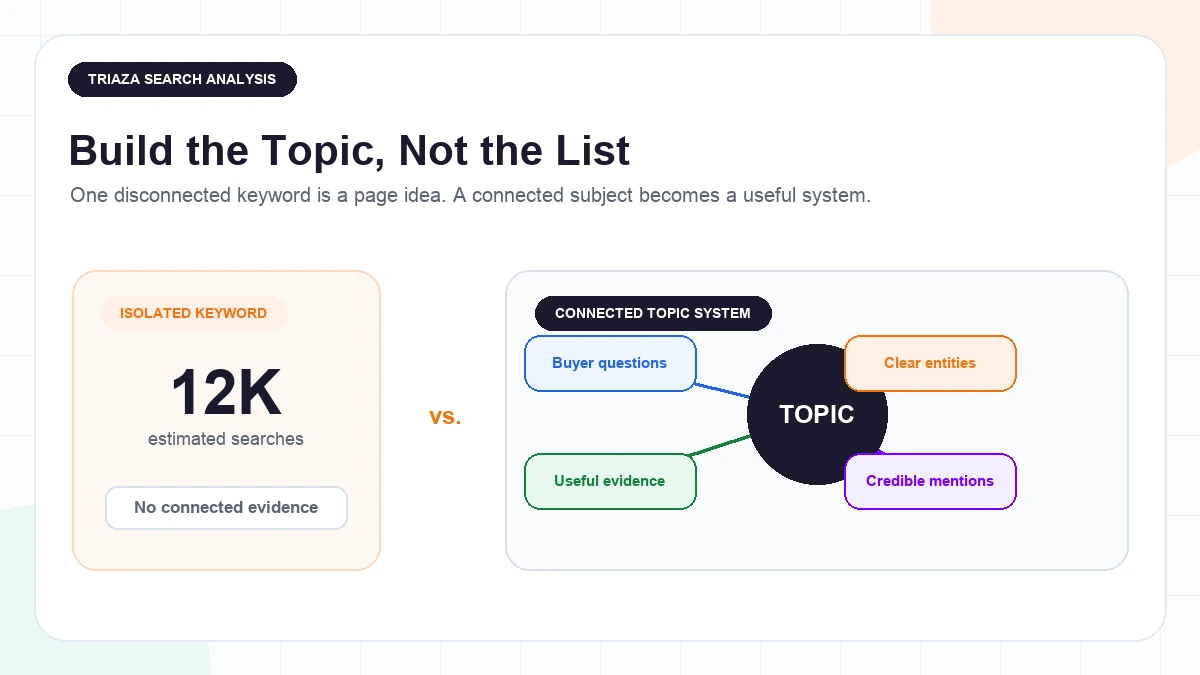
Topical authority beats isolated keyword-volume chasing because it helps a company build a connected body of useful evidence around questions it is qualified to answer. Keyword data still helps prioritize demand. The advantage comes from choosing a focused subject, covering it with real depth, connecting the pages, and earning credible recognition beyond your own site.
This distinction matters more in answer engine optimization (AEO) because query fan-out can explore the web more deeply to find relevant sites for a search, and an answer may synthesize material from several sources. A page still has to be accessible, relevant, and competitive. But publishing the next available keyword is a weak way to build the context, evidence, and recognition that make a source worth retrieving.
The Choice Is Not Keywords or Topics
Keyword volume is useful. It estimates how often people search for a phrase, helps compare demand, and gives a team a shared language for prioritization. The problem starts when that estimate becomes the editorial strategy.
A volume-first plan usually treats each keyword as a separate production order. A term clears a threshold, so the team commissions a page. The relationship to the company’s expertise, the buyer’s next question, and the surrounding content is considered later, if at all. The result is often a broad inventory of isolated pages that compete for attention but do not reinforce one another.
A topic-led plan starts with a different question: what subject does this company have a credible right to explain, and which decisions inside that subject matter to a buyer? Search demand still informs the answer. It just does not get the final vote.
That makes the real comparison less dramatic than the headline sounds:
- Isolated keyword chasing selects topics because demand exists.
- Topical planning selects a defined arena, then uses demand to decide which useful parts of that arena deserve attention first.
- A strong portfolio can still include a high-volume standalone page when the term fits the business and the company can offer something distinct.
- A weak portfolio can contain dozens of tightly related pages if each one repeats the same generic answer.
Google’s own language supports the distinction without endorsing a metric called topical authority. In an August 18, 2022 Search Central post, Google encouraged a clear site purpose or focus and firsthand depth, while calling publication across many topics in hopes that some content ranks a warning sign. Google also notes that parts of that historical post may be outdated, and it never presents the checklist as a guaranteed ranking formula.
The practical lesson is not “pick a niche and publish everything.” It is “pick a subject your audience already connects to your business, then earn the right to go deeper.”
What Keyword Volume Cannot Tell You
Volume estimates answer one planning question: how often might people search for this phrase in a typical month? They do not answer the questions that determine whether the page is a sensible investment.
They cannot tell you whether the people using the phrase resemble your buyers. A large informational audience may never need your product or service. A small technical audience may contain nearly every company you want to reach.
They cannot tell you where the phrase sits in a decision. Some searches help a buyer define a problem. Others compare approaches, expose a risk, or resolve an implementation obstacle. Two keywords with the same estimated demand can have very different value because they do different work.
They cannot tell you whether your company can improve the available answer. If the planned page merely combines what the first five results already say, the volume describes an audience you can reach only by becoming another commodity result. A lower-volume question can be more valuable when the company can bring a method, dataset, firsthand explanation, or point of view that does not already exist.
They cannot tell you what maintaining the answer will cost. A page about a stable operating principle may need light review. A page about changing product behavior, law, pricing, or platform policy may create a permanent research obligation. That maintenance burden belongs in the editorial decision.
They also cannot tell you whether the page strengthens the rest of the site. A useful supporting article can clarify a section of a pillar, give a service page evidence, answer a recurring sales question, and create a credible destination for external references. An isolated article may have more estimated searches and still contribute less to the portfolio.
Use a five-part filter before approving any topic:
- Buyer fit: Who asks this question, and what are they trying to decide?
- Business fit: Does the answer connect honestly to something the company does?
- Right to answer: What evidence, experience, or access makes this version worth publishing?
- Portfolio fit: Which existing page does it strengthen, and which distinct gap does it fill?
- Maintenance fit: Can the team keep the answer accurate for as long as it remains public?
Search volume helps order the opportunities that survive those tests. It should not rescue a topic that fails them.
Topical Authority Is a Useful Model, Not a Google Score
The phrase sounds more precise than it is. SEO tools may create their own authority scores, coverage scores, or content-gap percentages. Those can help a team compare its own work, but they are vendor models. Google does not expose a universal topical-authority score, a minimum cluster size, or a switch that turns authority on.
For this article, topical authority means four observable things working together:
- Coverage: The site answers the important questions inside a defined subject, with each page serving a real purpose.
- Evidence: The answers contain firsthand experience, original analysis, primary sources, clear methods, or specific examples that a generic summary cannot replace.
- Connection: Internal links, consistent terminology, and clear page roles show how the ideas relate.
- Recognition: Relevant people and publications mention, cite, review, or reference the company and its work outside the company’s own site.
This definition is intentionally operational. A team can audit it. It can see missing buyer questions, duplicated pages, unsupported assertions, contradictory company facts, orphaned articles, and a lack of credible third-party recognition. It does not need to pretend those inputs collapse into one reliable number.
The entity part is older than the current AI-search conversation. In its May 16, 2012 Knowledge Graph announcement, Google described a shift from matching strings toward understanding real-world entities and the relationships between them. That historical product explanation provides conceptual context for distinguishing entities and their relationships from keyword matching. It does not establish that entity consistency or markup improves rankings.
Entity clarity answers “who is this about?” Topic depth answers “what are they demonstrably useful for?” A strong content system needs both.
The simplest entity audit is a consistency table. Put the company, products, services, named methods, authors, industries, and locations in the first column. In the next columns, record the approved name, a plain definition, the relationships that matter, the primary page, and the credible external sources that corroborate the fact.
This catches problems that keyword research will not. A service may have three names across the site. A founder bio may describe expertise that no article demonstrates. A pillar may use an industry term differently from the supporting pages. A third-party profile may still carry an old product description. None of these issues is solved by repeating the target phrase more often.
Do not turn consistency into robotic repetition. People use synonyms, and clear writing needs them. The goal is to keep the identity stable while the prose stays natural. If the company calls the same offer a roadmap on one page, a software implementation on another, and a growth audit on a third, a buyer has a real clarity problem. If the article alternates between “company” and “business” in ordinary prose, it does not.
Entity work also sets a boundary on the topic. A marketing agency may have a legitimate relationship to AI search strategy, content systems, measurement, and brand positioning. It does not become authoritative on model architecture, data-center engineering, or AI safety policy simply because those subjects share the letters AI. The relationship map shows where the company has something coherent to contribute and where it is borrowing a trend.
Why AI Search Raises the Value of Connected Depth
Traditional keyword research often models one query and one results page. In AI search, query fan-out can explore the web more deeply to find relevant sites for a search.
In a May 6, 2026 product update, Google said it was improving how AI Mode and AI Overviews show and rank links, including through query fan-out that searches more deeply for relevant sites. Google described five link and source-discovery changes. It did not say comprehensive topic coverage guarantees a citation.
That caveat matters. Query fan-out is not evidence that Google counts cluster pages. It does mean a complicated buyer question can open several paths into the web. Consider a founder asking, “How should we change our marketing plan now that AI answers are reducing search clicks?” The answer may require material about:
- how AI Overviews affect click behavior
- which answer engines retrieve from which indexes
- what makes a claim citable
- how to measure referral and assisted conversion
- whether the company has enough expertise to publish on the subject
- how the plan changes for its budget and sales cycle
One generic page rarely answers all of that well. A well-designed knowledge hub can. The pillar orients the reader, while focused supporting pages supply evidence and depth for the parts that deserve their own treatment.
This is also why topic depth should not be confused with long articles. A 7,000-word page that mixes six intents can be harder to use than a 1,500-word page that resolves one difficult question precisely. The unit of quality is the decision the page helps someone make, not the word count.
Google reinforced the same direction in a May 15, 2026 Search Central announcement. Its generative-search guidance emphasizes valuable, unique, non-commodity content and says established SEO practices remain relevant and foundational. That is Google guidance for its own search features, not a promise that any page will be included.
The strategy follows from the combination. Keep the SEO foundation. Add material that deserves to be retrieved across the related questions a buyer will ask. Connect it clearly enough that a person and a system can understand the whole.
What the Current Evidence Supports
The cleanest evidence does not prove “topical authority wins.” It supports several narrower claims that add up to a useful strategy.
Publishing More Pages Is Not the Same as Building Authority
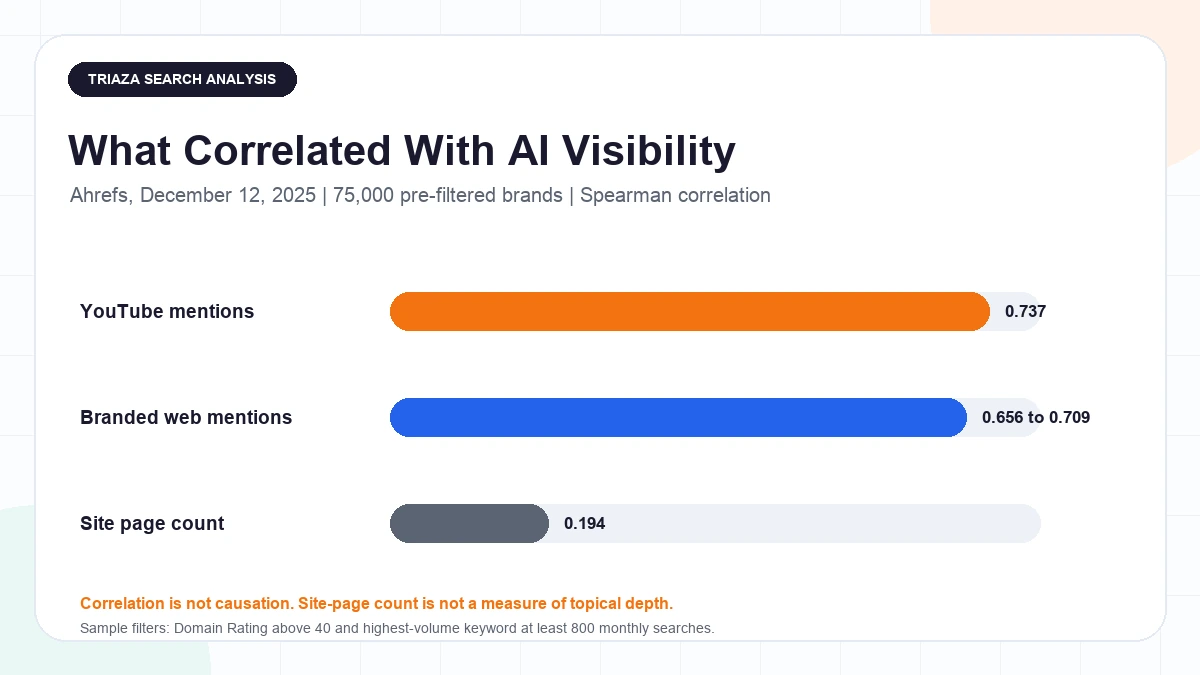
Ahrefs published an observational analysis on December 12, 2025 covering 75,000 pre-filtered brands. Branded web mentions had Spearman correlations from 0.656 to 0.709 with visibility across ChatGPT, Google AI Mode, and AI Overviews. YouTube mentions had the strongest reported aggregate correlation at about 0.737. Site-page count was weak at about 0.194.
Those figures do not mean mentions cause visibility or that deleting pages will improve it. Ahrefs filtered the sample to domains with Domain Rating above 40 and a highest-volume keyword of at least 800 monthly searches, used proprietary Brand Radar data, and explicitly cautioned that correlation does not establish causation. Page count is also not a direct measure of topical depth.
What the study can support is more modest: raw publication volume had a much weaker relationship with measured AI visibility than broad brand recognition did in that selected sample.
Search Visibility Still Supplies Much of the Retrieval Layer
A topic strategy does not replace ranking work. Ahrefs’ March 2, 2026 Brand Radar analysis examined 863,000 keyword results pages and 4 million URLs cited in AI Overviews. It found 37.9% of cited URLs within the first 10 results-page blocks, 31.2% in blocks 11 through 100, and 31.0% beyond the first 100 blocks.
Those are results-page blocks, not organic positions. Blocks can include ads, featured snippets, People Also Ask, video packs, and blue links. In Ahrefs’ separate organic-only cut, 37.10% ranked in the top 10, 26.20% ranked from 11 through 100, and 36.70% did not rank in the top 100. The study is one proprietary snapshot and does not explain why a specific page earned a citation.
The useful conclusion is that organic competitiveness remains an important input without being the whole mechanism. A page can be relevant to an AI answer without ranking in the top 10 for the exact surface query, especially when fan-out introduces related searches. It still has to be accessible, understandable, and competitive somewhere in the retrieval process.
Authority Is Built Off-Site as Well as On-Site
Muck Rack’s Generative Pulse team reported in a study last updated May 7, 2026 that it analyzed more than 25 million links cited across ChatGPT, Claude, and Gemini responses in 17 industries. It classified 84% of citations as earned media, 0.3% as paid or advertorial content, and 27% as journalism. The study covered unbranded, top-of-funnel queries and excluded branded and transactional prompts.
The accessible page does not expose the full methodology without a form download, and Muck Rack sells PR and large-language-model monitoring products. Treat the figures as vendor-sponsored research within that study’s sample, not as a universal law about what every answer engine cites.
Even with that limit, the study suggests that independent coverage, expert references, industry citations, reviews, and community discussion can provide third-party context that owned content cannot supply on its own.
What the Evidence Does Not Support
No credible controlled study surfaced in this research showing that a small site will beat a larger competitor because it published a complete topic cluster. The research found historical examples, agency cases, and correlations. None isolated topic depth from brand demand, backlinks, technical quality, promotion, domain history, or other work.
That should change how the headline is read. “Beats” describes a portfolio decision for a lean team. It does not describe a universal ranking result.
A historical example shows both the appeal and the limitation. In a Townsend Security-reported case cited by Content Marketing Institute on October 30, 2019, the company said its site organic-search traffic increased by more than 150% in the 10 months after publishing and promoting an encryption-key-management pillar page. It also reported that 63% of visitors provided their information to download the guide, and CMI said the page held Google’s top organic result for the target query in August 2017.
Those figures are company-reported. The source does not provide the analytics baseline, a causal method, seasonality, the contribution of promotion, or the other SEO work happening at the same time. It is a useful pattern, not proof that a pillar page caused the result or beat a larger site.
The absence of controlled proof does not make the strategy arbitrary. It means the argument should rest on economics and execution:
- A lean team cannot be credible on every subject.
- Every unrelated page consumes research, review, updating, internal linking, and measurement time.
- A connected topic gives each new asset a defined role and a set of relevant pages to support.
- Firsthand evidence becomes easier to accumulate when the team keeps working inside a subject it actually knows.
- Buyers are more likely to encounter a coherent explanation instead of a pile of disconnected articles.
Those are operational advantages a startup can act on without promising a ranking result.
How a Smaller Team Can Compete
Large competitors have real advantages. They may have more links, more brand searches, more contributors, more distribution, and more historical data. A useful strategy does not pretend those disappear in AI search.
The smaller team’s advantage is choice. It can choose a narrower arena where its operating knowledge is unusually specific, build the best evidence it can access, and connect the material around a buyer’s actual decision. It does not have to win the broad category to become the most useful source for a valuable slice of it.
For example, “marketing automation” may be too broad to own. “CRM handoff design for technical B2B startups with founder-led sales” is a clearer operating arena. It contains fewer viable pages, but each can answer a specific question the company encounters in real work: lifecycle stages, lead routing, sales acceptance, follow-up timing, field ownership, reporting, and failure diagnosis.
Narrowing works only when the smaller subject still connects to a business outcome. A tiny topic with no buyer relevance is not strategy. It is a hobby with a keyword report.
Use four tests before committing to an arena:
Buyer Relevance
Does the subject contain decisions, risks, objections, or implementation questions that appear in sales calls, support conversations, proposals, or customer work? Demand can come from search-volume data, paid-search terms, site search, community discussion, and direct conversations. No single source gets to define the topic.
Right to Answer
Can the company contribute experience, a method, original data, examples, a tool, a comparison, or access to credible experts? If the page would only summarize the existing results, the company has no durable advantage yet.
Coverage Potential
Are there several distinct questions that deserve separate answers, or is the idea really one article? A topic cluster is useful only when the supporting pages serve different reader needs.
Conversion Path
Can the content lead naturally to a product, service, assessment, implementation guide, demo, or next decision? Authority that never connects to what the business can help with may be educational, but it is not a complete growth strategy.
Build the Topic Map Around Decisions
A topical map is an editorial planning tool. It is not a machine-readable file and not a confirmed ranking factor. Its job is to show which questions belong together, which page should answer each one, what evidence is available, and how a reader moves through the subject.
Start with the buyer’s decisions rather than a keyword export.
Define the Core Decision
Write one sentence describing the decision the hub helps someone make. “Help a founder decide how to build visibility in AI search” is useful. “Rank for AI search keywords” is not a buyer decision.
Map the Question Chain
List what the buyer asks before, during, and after that decision. Early questions establish the problem. Middle questions compare approaches and constraints. Late questions cover implementation, measurement, cost, risk, and the next action.
Inventory Existing Evidence
For each question, record the evidence the company can bring: first-party data, internal methods, a technical demonstration, named sources, interviews, customer-safe patterns, or a transparent argument. Mark questions where the evidence is missing.
Assign One Page Role per Intent
The pillar should orient the reader across the decision. A supporting page should go deep on one part that deserves its own treatment. Avoid creating several pages that answer the same intent with slightly different phrases.
Add a Useful Internal-Link Path
Every supporting page should have a reason to link to the pillar, and the pillar should help readers reach the deeper pages at the right point. Supporting pages can link across the cluster when the next page advances the same task. The anchor text should describe what the reader will get.
Test the Map With a Concrete Example
Imagine a small B2B software company that helps manufacturers manage equipment maintenance. A volume export might tempt the team toward broad terms such as “maintenance software,” “AI in manufacturing,” and “predictive analytics.” Those phrases may describe real demand, but they do not yet define a useful content system.
The buyer decision is narrower: how should a plant manager move from reactive maintenance to a planned program without disrupting production?
That decision produces a coherent set of page roles:
- A pillar explains the transition, the operating choices, and the sequence.
- A planning guide covers asset inventory, failure criticality, ownership, and maintenance intervals.
- A comparison page distinguishes preventive, predictive, and condition-based approaches.
- An implementation page explains data requirements and the limits of sensor-driven predictions.
- A measurement page covers downtime, completion rate, backlog, and avoided-failure assumptions.
- A product page shows where the software supports the workflow and where human judgment remains necessary.
The team should not publish every page at once. It should start with the pillar and the two supporting questions buyers ask most often, using sales conversations and product usage to choose them. Each later page has to add evidence or resolve a distinct decision. If the team cannot explain predictive maintenance better than the existing sources, it should not publish that page merely because the keyword is large.
This example is hypothetical. It claims no traffic or ranking result. Its value is showing how a broad keyword list becomes a focused decision system.
Our guide to structuring content for AI citation covers the knowledge-hub architecture in detail. The companion pillar on how to get cited in AI search covers access, answer quality, evidence, and entity consistency across the major platforms.
Turn Coverage Into a Working Authority System
A map becomes useful only when it changes what the team publishes, improves, connects, and stops doing.
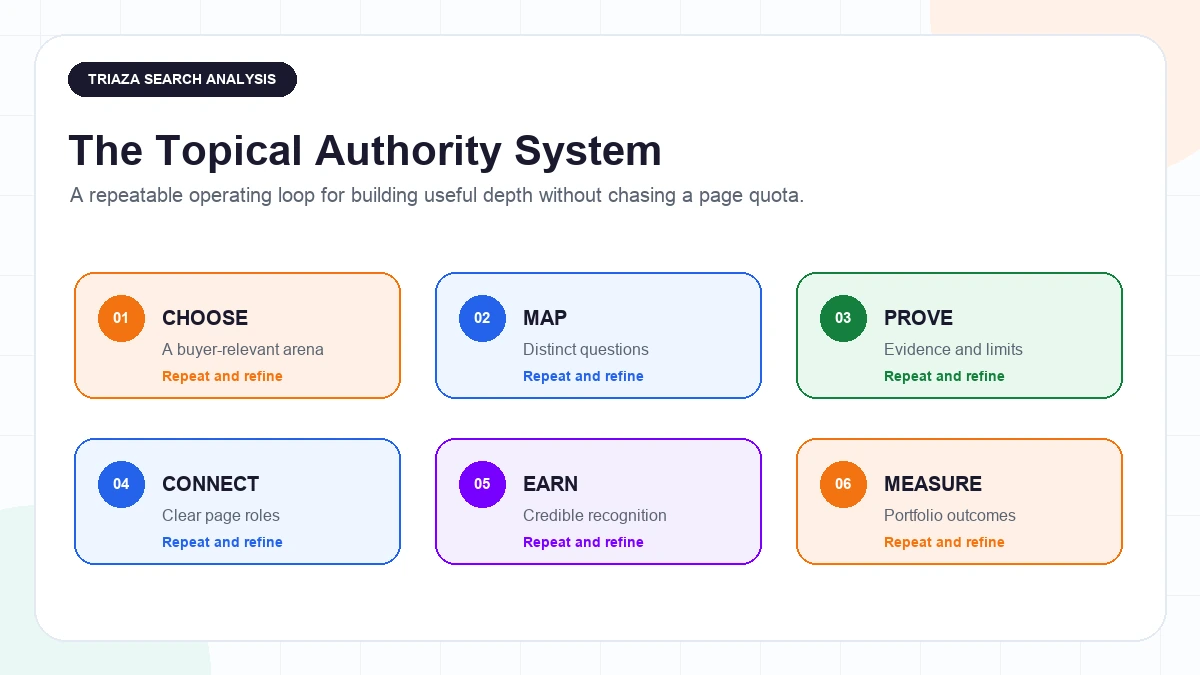
Consolidate Before You Multiply
Audit the existing content by intent. When two pages compete to answer the same question, decide which one is stronger. Merge useful material where the intents truly overlap, redirect when appropriate during implementation, or give each page a distinct job. Do not consolidate simply to make a chart look cleaner.
Thin content is not defined by length. A short page can solve a narrow problem completely. A long page can remain thin if it repeats generic advice without evidence.
Build an Evidence Ledger
For every important page, record which claims come from primary sources, which come from the company’s own experience, which are reasoned recommendations, and which remain assumptions. Add publication dates and source limits for anything time-sensitive.
This ledger makes updates faster and reduces a common failure in AI-search content: a statistic is repeated across several articles after its original scope and date have been forgotten.
Make the Entity Consistent
Use the same accurate company name, product names, author identities, category descriptions, URLs, and core facts across the site. Correct relevant third-party profiles when possible. Standard Organization and Article structured data can help machines read information that is already visible and accurate, but schema is not a citation switch.
Earn Relevant Recognition
Create material other people have a reason to reference. That can be a small original dataset, a field guide, a benchmark with a disclosed method, a useful calculator, a technical explanation, a clear expert opinion, or participation in a credible industry discussion.
The goal is not raw mention volume. Relevance and accuracy matter. A mention from a source your buyers and peers already trust is more useful than dozens of syndicated pages nobody reads.
Distribution belongs in the plan from the beginning. Before building an asset, list the people who would find it useful enough to challenge, quote, reference, or share. That may include practitioners, trade publications, researchers, customers who can review a general method without disclosing private information, partners, and communities where the question already appears.
This is not permission to manufacture mentions. Paid placements, low-quality syndication, and mass outreach can create URLs without creating trust. The better test is whether an informed third party would still reference the work if no SEO benefit existed.
Useful distribution also improves the asset. A practitioner can point out a missing constraint. A reporter can expose where the explanation depends on jargon. A customer-facing teammate can identify the question buyers actually ask after reading it. Authority grows when the work survives contact with people who know the subject, not when the team declares the hub complete.
Track the resulting mentions by relevance, source quality, accuracy, and whether the reference helps a buyer understand the company. A raw total removes the part that matters.
Maintain the Hub
Assign an owner and a review trigger. Update when the facts, product state, law, platform behavior, or recommended action materially changes. Do not change a date to simulate freshness. A current date without a substantive update is not new evidence.
Measure the Topic as a Portfolio
A keyword report encourages page-by-page thinking. A topic strategy needs a portfolio view.
Start with conventional outcomes:
- impressions, clicks, and click-through rate for the topic’s query set
- qualified organic sessions to the hub and supporting pages
- assisted and direct conversions tied to those pages
- branded searches that combine the company with the topic
- sales or support conversations that use the material
- relevant external mentions and links
- indexing, crawl, and internal-link health across the hub
Then add AI-search observations without turning them into the only score. Track whether the brand is mentioned accurately for a stable, commercially relevant question set. Record which sources appear and whether the answer points to the right page. Compare trends over several runs.
One snapshot is especially weak evidence. SISTRIX published an AI Citation Drift study on May 1, 2026, then modified it May 12, covering 82,619 prompts and 1,548,213 snapshots across six countries and 17 weekly reference dates from December 17, 2025 through April 8, 2026. Its domain-level churn-in measure was about 5% in Google AI Overviews, 56% in Google AI Mode, and 74% in its attribution-qualified ChatGPT Search sample.
Those are domain-level comparisons, not URL-level ones, and SISTRIX calls them conservative. The result means a weekly citation win can disappear without proving the page got worse, while a weekly loss can reverse without proving the team fixed anything.
Measure three layers instead:
- Inputs: coverage gaps closed, original evidence added, duplicated intent resolved, internal links repaired, entity facts aligned, and relevant outreach completed.
- Visibility: topic-level impressions, rankings, branded demand, qualified mentions, and AI-answer presence across a stable question set.
- Business outcomes: assisted conversions, sales use, pipeline influence, and whether the content reduces friction in an actual decision.
Our 2026 marketing playbook explains why current AI-search measurement is too unstable to support a separate program built around citation counts alone.
When Not to Build a Topic Cluster
Focus is valuable partly because it gives the team permission to decline work. Not every subject deserves a hub, even when several related keywords exist.
Do not build the cluster when the company lacks a right to answer. If every planned page depends on summarizing competitors, the missing input is expertise or evidence, not production capacity. Interview the people who do the work, run a useful analysis, or wait until the company has something worth adding.
Do not build it when the subject has no credible path to the business. A topic can attract the right industry and still sit too far from anything the company can help with. Write the conversion path before approving the pillar. If the only next action is a generic contact form, the subject may be editorially interesting but commercially misplaced.
Do not build it when one page resolves the need. Turning every subsection into a URL creates maintenance and navigation work without adding depth. A cluster exists to separate distinct reader jobs, not to make the site look comprehensive.
Do not build it when the team cannot maintain the facts. A current guide to a fast-changing platform may need frequent product-state checks, source re-verification, screenshots, and corrections. An abandoned hub can undermine the authority it was meant to build.
Do not build it when a stronger topic already needs attention. A half-finished second cluster usually contributes less than closing evidence gaps, consolidating overlap, and earning recognition for the first.
The decision to stop is part of topical authority. A site becomes clearer when its boundaries are deliberate.
A 90-Day Plan for a Lean Team
The goal of the first 90 days is not to publish a complete encyclopedia. It is to establish one credible topic system, improve the strongest existing pages, and learn whether the subject earns useful visibility and business attention.
Days 1 Through 30: Choose and Map
Pick one commercially relevant topic where the company already has experience. Define the core buyer decision. Review sales calls, support questions, paid-search terms, existing organic queries, community discussion, and competitor pages.
Inventory every current page connected to the topic. Give each one a role: pillar, supporting answer, evidence asset, conversion page, merge candidate, update candidate, or out of scope. Identify the three to five questions where better evidence would materially improve the hub.
Set a baseline before editing. Record topic-level search visibility, conversions, current AI-answer observations, internal-link gaps, and relevant off-site mentions.
Write down the competing explanations before work starts. Rankings could improve because a technical issue was fixed. Branded demand could rise because of an event or paid campaign. A conversion increase could come from a stronger offer rather than the content. Naming those possibilities in advance makes the later review more honest.
Days 31 Through 60: Strengthen What Already Exists
Improve the pillar so it orients the reader without swallowing every supporting intent. Consolidate genuine duplicates. Update the highest-opportunity supporting pages with clearer answers, current primary sources, firsthand examples, and explicit limits.
Connect the pages in the order a buyer would use them. Fix contradictory company and author facts. Confirm that the important pages are crawlable, indexable, and returning useful content.
Do not add llms.txt, extra schema, or a new publication date and call the hub optimized. Those may have separate technical uses. None replaces useful evidence or search eligibility.
Days 61 Through 90: Publish Proof and Earn Recognition
Publish the missing asset with the strongest right to exist. That may be a field guide, a comparison, a dataset, a teardown, a calculator, or a direct answer to a difficult implementation question.
Share it with the relevant people who can assess it, not a generic outreach list. Ask what is incomplete. Use the feedback to improve the evidence and language. Track whether the piece earns citations or references, but do not buy low-quality mentions to manufacture a signal.
At day 90, review the portfolio against the baseline. Keep the topic if it is producing stronger visibility, sales usefulness, or qualified engagement. Narrow it if the hub remains too broad. Stop if the company cannot sustain the evidence or the topic does not connect to the business.
Do not expect the full business effect to mature in 90 days. The period is a management checkpoint, not a promised SEO timetable. It is long enough to finish a small set of meaningful work, observe whether the pages are being found and used, and decide whether the next investment is justified.
If you need the topic decision, sequencing, and measurement plan built around your team and stage, that is the role of Triaza’s AI Strategy & Growth Roadmap. The broader Marketing Strategy service is the better fit when AI search is one part of a larger go-to-market decision.
Questions Founders and Marketing Leaders Ask
Is topical authority a Google ranking factor? Google does not publish a universal topical-authority score or a single ranking factor by that name. Its August 18, 2022 guidance encouraged a clear site focus, firsthand expertise, and depth, while warning against publishing across many topics only in hopes that some rank. Google notes that parts of the historical post may be outdated, and the guidance is not a ranking guarantee.
Should we stop targeting high-volume keywords? No. Keyword volume helps estimate demand. Use it as one input alongside buyer relevance, business fit, right to answer, competition, and conversion path. A high-volume page belongs in the plan when it serves a real customer decision and the company can make the answer meaningfully better.
How many pages does a topic cluster need? There is no defensible universal number. The cluster needs enough pages to answer the distinct questions a buyer genuinely has, with one clear role per page. If three pages cover the subject without repeating one another, three may be enough. If twelve are necessary, each should earn its place.
Can a small site outrank or out-cite a large competitor? It can happen, but this research did not find a controlled study proving that smaller sites win because of topic depth alone. Ahrefs’ March 2, 2026 analysis found that 36.70% of cited AI Overview URLs in its organic-only cut did not rank in the top 100 for the exact query, but the proprietary snapshot does not reveal why those URLs were selected. Narrow expertise creates an opportunity, not a guarantee.
Does AI search prefer topic clusters? No major platform publishes a rule that a cluster is required. Google said in a May 6, 2026 update that query fan-out helps it search more deeply for relevant sites, but it did not say broad coverage guarantees selection. Build a cluster because it helps people and supports distinct questions, not to satisfy an invented threshold.
Do we need llms.txt or special schema to build authority? No. For Google, established SEO practices remain the foundation, according to its May 15, 2026 Search Central announcement. Standard structured data can help machines interpret accurate visible information, but neither schema nor llms.txt is a citation switch. Other engines have their own access controls, which should be checked separately.
How long does topical authority take to build? No source supports a universal timetable. The historical Townsend Security case reported a 10-month window, but the October 30, 2019 CMI write-up says the company published and promoted the page and does not isolate causation. Set review periods around your sales cycle, crawl frequency, distribution, and evidence production rather than borrowing someone else’s clock.
How should we measure progress when citations keep changing? Use a stable question set and compare trends across several runs, then pair citation observations with conventional search visibility and business outcomes. In SISTRIX’s May 2026 study, the domain-level churn-in measure reached 56% in AI Mode and 74% in its attribution-qualified ChatGPT Search sample. The study called those comparisons conservative, so one weekly snapshot is not a reliable scorecard.
Choose a Subject You Can Keep Proving
Keyword volume answers a useful but narrow question: how much estimated demand exists for this phrase? It cannot tell you whether your company should be the one publishing the answer, whether the page will help a buyer, or whether the rest of your site gives that answer context.
Topical authority is the stronger strategy because it forces those decisions into the plan. Use the framework to choose a business-relevant subject, map real buyer questions, publish evidence rather than another summary, connect the material, earn recognition, and measure results at the portfolio level.
That will not make a small site large. It gives a small team a defined arena in which its work can become unusually useful, recognizable, and hard to replace.