If you’re sitting on the back half of a 2026 budget, you’ve read about eighteen months of contradictory headlines: search is dead in one telling, fine in the next, traffic collapsed by one measure, and Google insists clicks are stable. Every vendor has a number, most of the numbers are real, and they still don’t tell you what to do differently on Monday.
They conflict because four things are true at once. The platform shift is real, the click loss is real, the revenue shift is much smaller than the noise suggests, and the measurement layer isn’t trustworthy enough yet to referee any of it. Any playbook that picks one of those and ignores the other three is selling you something.
This one holds all four: where AI search stands in August 2026, what changed since late 2025, the five shifts worth making with the rest of this year’s money, and the specific conditions under which this advice turns out to be wrong.
AI search has changed how people find answers, not yet where most revenue comes from. For the rest of 2026, fund brand and entity authority, make your existing content machine-legible, plan for fewer clicks per ranking, spread paid testing beyond Google-only search, and fix your measurement before you optimize against it.
What Actually Changed Between Late 2025 And August 2026
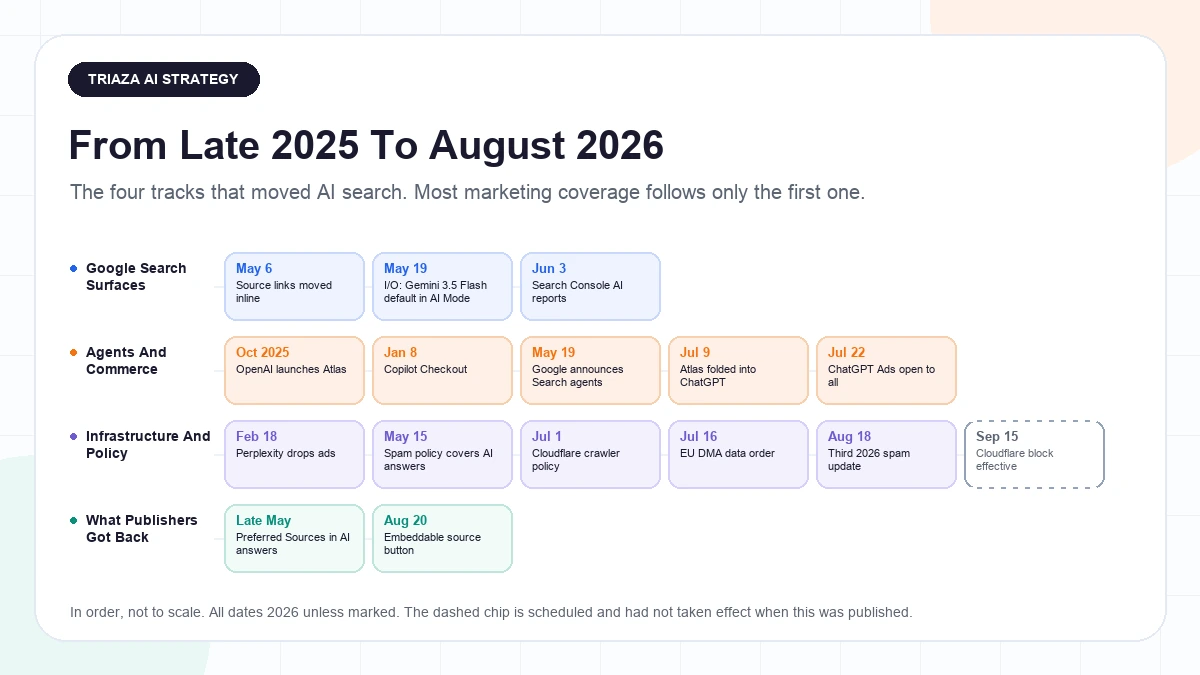
The developments that matter fall into four tracks. Marketing coverage almost always follows the first one and skips the other three, which is why the strategic picture looks thinner than it is.
Search Stopped Being A Link List And Became An Interface
At Google I/O on May 19, 2026, Google made Gemini 3.5 Flash the default model in AI Mode for everyone globally and began rolling out what it called the biggest upgrade to the Search box in over 25 years: a box that expands as you type, suggests queries beyond autocomplete, and accepts text, images, files, videos, and Chrome tabs as input. Google’s own language is that the new box “is starting to roll out today, in all countries and languages where AI Mode is available,” so it’s a staged rollout rather than a finished one.
The scale numbers came from the same stage. In his keynote post, Sundar Pichai said AI Overviews had passed 2.5 billion monthly active users and AI Mode had surpassed 1 billion, and Google’s Search post adds that AI Mode queries have more than doubled every quarter since launch. Those are Google’s internal figures, unauditable by anyone outside the company, and worth quoting as the company’s position rather than as settled fact. We took that first year apart in detail in our retrospective on what AI Mode did to organic traffic.
The Answer Engines Started Transacting, Not Just Answering
The more consequential change is that assistants are becoming places where a decision completes.
Microsoft got there first. On January 8, 2026 it launched Copilot Checkout and Brand Agents: shoppers can finish a purchase inside Copilot across Copilot.com, Bing, MSN, and Edge, and merchants can deploy an assistant trained on their own catalog. Read the rollout language carefully, because it’s narrower than the headline: Microsoft said Checkout was “beginning to roll out in the U.S. on Copilot.com.” That’s the state as of the January 2026 announcement, seven months old by now, so treat current availability as something to check rather than assume.
At I/O, Google announced plans for information agents that watch the web for changes matching your criteria, and for agentic booking of local services including home repair and pet care, up to the agent phoning the business on your behalf. Google’s language throughout is forward-looking, so these are announced plans rather than confirmed shipped features.
OpenAI went the other way on packaging. TechCrunch reported on July 9, 2026 that OpenAI is sunsetting its standalone Atlas browser less than a year after launching it, folding the capability into ChatGPT itself: a Chrome extension, a desktop app with a built-in browser that can log into accounts and download files, and a remote cloud browser for agent tasks. TechCrunch’s read, and it’s the publication’s read rather than an OpenAI admission, is that “the browser is a feature, not the destination.”
For a marketer, the through-line matters more than any single launch. If a booking or a purchase can finish inside the assistant, then some share of the funnel stops producing a session on your site at all. That’s a measurement problem before it’s a traffic problem.
The Plumbing Under The Web Got Repriced And Re-Regulated
TechCrunch reported on July 1, 2026 that Cloudflare will begin blocking mixed-use AI crawlers by default on any page hosting ads, starting September 15, 2026. Mixed-use means crawlers that combine search, agent, and training functions in one user agent. The default will apply to new Cloudflare customers, newly created sites on existing accounts, and all free-tier customers, and Cloudflare says site owners will be able to adjust settings to allow those crawlers, so it’s an opt-out default rather than a wall. Cloudflare is also turning its Pay Per Crawl marketplace into a Pay Per Use model that pays publishers when their content is actually used in an answer rather than merely fetched.
If your site sits behind Cloudflare and runs ads, put that date in a calendar. If it doesn’t, the significance is still directional: the economics of who gets to read the web are being renegotiated.
Regulation moved in the same window. On July 16, 2026 the European Commission adopted binding Digital Markets Act specification measures requiring Google to give competing search engines and AI chatbots access to anonymized Google Search data, including ranking, query, click, and view data, under a capped fair-price formula, with compliance required by January 2027. A separate requirement to open Android so rival assistants get parity with Gemini on features like voice activation lands in July 2027. Google President Kent Walker’s response was that “today’s decisions risk undermining vital privacy and security guardrails for millions of Europeans,” and Google has not confirmed whether it will appeal.
Nothing there changes a US company’s tactics this quarter. It changes who might be running a credible answer engine in 2027, which is exactly the horizon a playbook should care about.
Google Started Building Traffic Mitigations For Publishers
The fourth track is Google trying to hand some clicks back.
In late May 2026, Google brought Preferred Sources into AI Overviews and AI Mode, letting people mark publishers they want to see more of. Google said users are twice as likely to click through to a preferred source and that more than 345,000 unique sources had already been selected, both of which are Google’s own measurements.
A week earlier, on May 6, 2026, Google described five changes to how it surfaces and links sources inside AI responses, the most visible being inline links moved next to the relevant text instead of clustered at the end. Google calls this ongoing work, “continuing to enhance how we show and rank links,” using techniques like query fan-out, rather than a finished system.
Then, on August 20, 2026, TechCrunch reported that Google is letting publishers embed a favorite-source button on their own sites. Google’s framing is careful and yours should be too: becoming a preferred source “can” drive more traffic, and the twice-as-likely figure traces to Google’s own earlier studies rather than to independent measurement.
Google is aware the click economy is under strain and is shipping mitigations rather than reversals. None of these is a lever you pull for growth. All of them are worth ten minutes of setup.
The Click Math Got Worse, And Not For The Reason You Think
Most 2026 strategy decks get the next part backwards.
Zero-click is now the ordinary state of Google search rather than an emerging trend. SparkToro’s Rand Fishkin, working from Similarweb clickstream data, put US zero-click searches at 68.01% for January through April 2026, against 60.45% for calendar year 2024. Fishkin hedges that comparison himself, calling it “a bit of apples and oranges” because the two windows aren’t the same users or devices, and one further caveat matters more than the headline: the data covers browser searches and not the Google mobile app, which means the real zero-click rate is higher than 68%.
Alongside that, Ahrefs re-ran its click-through-rate study on December 2025 data and published the update on February 4, 2026: the presence of an AI Overview correlated with a 58% lower average click-through rate for the top-ranking page, up from 34.5% in its April 2025 original. Ahrefs measured that on one dataset over one window, so it isn’t a forecast for your site.
In the same SparkToro analysis, AI Mode accounted for just 0.34% of searches in that January to April 2026 window, on the same clickstream panel with the same mobile-app exclusion.
Together those two numbers make the planning conclusion uncomfortable for a lot of 2026 budgets. The click loss you’re already feeling is AI Overviews plus a decade of accumulated SERP features. It is not AI Mode. AI Mode is a forward risk that could compound the problem, not the thing that caused it. Neither source draws that conclusion; we do. It still changes what you’d fund, because you don’t fix an AI Overviews problem by building an AI Mode program.
Ranking Still Matters, It Just Yields Less
The other reflex worth killing is “rankings don’t matter now.”
Ahrefs analyzed 863,000 SERPs and 4 million AI Overview URLs in a study published March 2, 2026, and found that 37.9% of cited URLs appeared within the first 10 SERP blocks for the exact query, 31.2% ranked between positions 11 and 100, and 31% sat outside the top 100 entirely. One sample, one snapshot, and it doesn’t explain why any individual page was or wasn’t cited. Note what the first figure counts: blocks on the results page, which include ads and SERP features, not organic positions.
What it shows is a two-sided fact. Ranking well is still the single strongest thing correlated with being cited, and it’s no longer sufficient, because roughly six in ten citations in that sample came from outside the first 10 blocks of the results page. The practical version: keep doing the ranking work, and stop assuming the ranking work finishes the job.
AI Referral Traffic Is Small, High-Intent, And Growing Fast, And All Three Facts Change The Budget
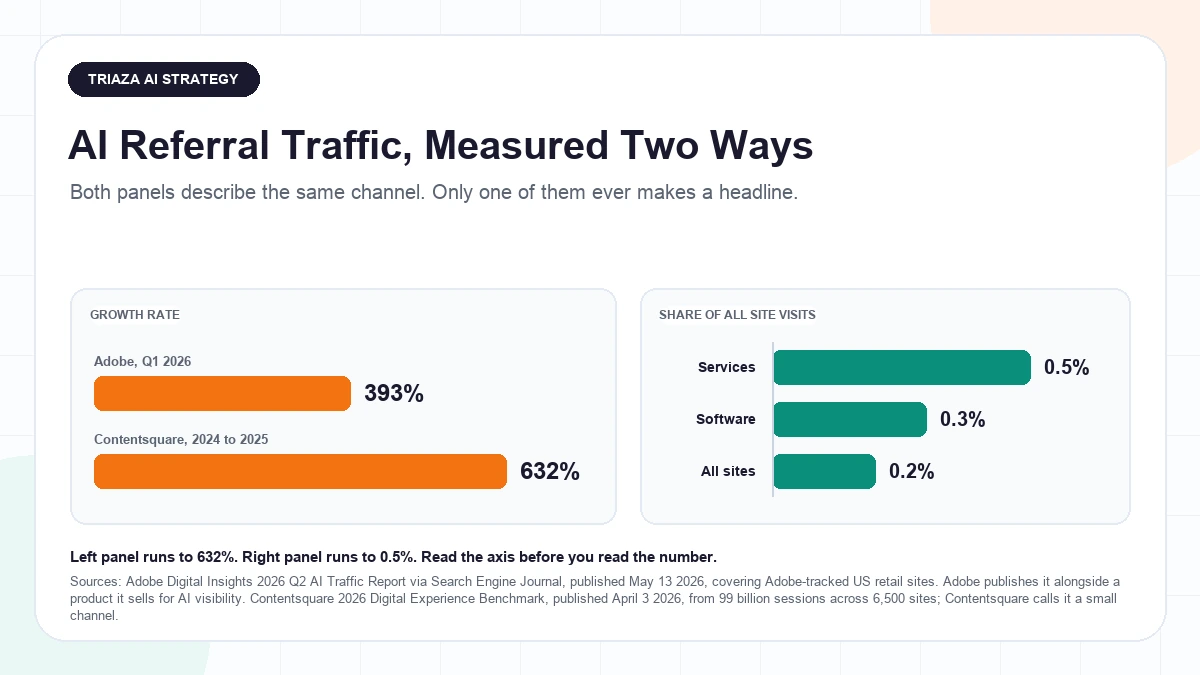
Two credible measurements of AI referral traffic look like they disagree. They don’t, and holding both is the whole point.
Adobe Digital Insights’ 2026 Q2 AI Traffic Report, covered by Search Engine Journal on May 13, 2026, found that AI-referred traffic to Adobe-tracked US retail sites grew 393% year over year in Q1 2026, with a single-month peak of 1,151% in December 2025, and that by March 2026 that traffic converted 42% better than non-AI traffic. A year earlier, in March 2025, it had converted at roughly half the non-AI rate, so the quality direction reversed inside twelve months. Adobe also reported 12% higher engagement, 48% more time on site, 13% more pages per visit, and 37% higher revenue per visit. Search Engine Journal’s own caveat belongs next to every one of those numbers: Adobe publishes this report alongside Adobe LLM Optimizer, a product it sells for making websites more visible to AI assistants.
Against that, Contentsquare’s 2026 Digital Experience Benchmark, published April 3, 2026 and drawn from 99 billion sessions across 6,500 sites, found AI-referred traffic grew 632% year over year from 2024 to 2025 and, across that 2025 data, still accounted for 0.2% of total site visits, reaching 0.5% in services and 0.3% in software. Its Q4 2025 conversion rate was 1.3%, up 55% from 0.8% a year earlier, and Contentsquare notes that’s still below mature channels like email at 1.9%. Contentsquare calls it “a small channel” and adds “for now,” and says adoption varies significantly by industry.
Both are right. AI referral is a small, high-intent channel whose value per visit is climbing much faster than its volume. Operationally, that argues for two things and against a third. A channel sitting at 0.2% of visits doesn’t justify dedicated headcount. A channel converting 42% better than average absolutely justifies making sure it isn’t broken: that the pages it lands on load, convert, and get attributed. And neither number justifies moving your budget’s center of gravity, which is the recommendation you’ll hear most often this year.
One Assistant Is No Longer The Whole Market
If your AI search plan was written in 2025, it was probably written for one assistant. That plan is stale.
Similarweb’s 2026 Generative AI Landscape, published July 29, 2026, found ChatGPT’s share of generative-AI web traffic fell from about 76% to about 53% between June 2025 and May 2026, while Gemini rose from under 9% into the roughly 27 to 28% range and Claude went from about 2% to nearly 9%. Similarweb notes that ChatGPT’s absolute visit count stayed roughly flat, so this is competitors gaining rather than ChatGPT shrinking, and all of it comes from Similarweb’s worldwide traffic panel, which means panel-based estimates rather than census data. The same report puts total category visits up 70% year over year to 9.5 billion monthly.
The consequence for a small team is that any tactic which only works on one assistant has a shrinking addressable market. That pushes you toward the inputs that carry across all of them, which is the argument in Shift Three.
Shift One: Fund Content That Survives Being Summarized
The content question for the rest of 2026 isn’t whether to publish. It’s what survives extraction.
If a machine is going to read your page, compress the answer, and restate it in three sentences, then everything that compresses cleanly is now a commodity. Definitions, overviews, and “what is X” answers all compress perfectly. What doesn’t compress is original data you collected, a specific implementation you actually ran, a named opinion with a defensible reason behind it, and the parts of an answer a model can’t generate from its own weights.
That’s the bar now, and it’s higher than “did we cover the topic.”
Cyrus Shepard’s May 2026 synthesis for Zyppy Signal is the most useful public map of what correlates with citation. He pulled together 54 prior experiments, patents, and case studies across ChatGPT, Gemini, and Perplexity into a 23-factor scoring model, weighting each factor on repeatability, evidence strength, and official platform support. The top scorers were unglamorous: URL accessibility at 9.5, traditional search rank at 9.4, fan-out rank at 9.3, preview control at 9.2, and query-to-answer match at 9.2. Shepard states plainly that correlation is not causation, that the scores reflect his own weighting from manual analysis rather than a peer-reviewed method, and that any errors are his. Read it as a prioritization aid from May 2026, not a checklist of requirements.
The pattern in that list is worth noticing: the things that scored highest are access, ranking, and answering the actual question. Not formatting tricks. Our guide to structuring content for AI citation goes into the editorial method, and building an AI content system that doesn’t sound like AI covers the production side.
Write For The Question, Not For The Prompt
There’s a tactic going around that deserves a direct answer: reverse-engineer the prompts people type, then build a page per prompt.
Eli Schwartz argued against it on April 9, 2026, and his case is the strongest version of the skeptical position. He warns against optimizing for common prompts and FAQs while the brand’s underlying authority is weak, points out that asking a model the same question twice in one session can produce a materially different answer, which undercuts the logic of rank tracking, and argues that short-term manipulation fails because models are designed to root it out and default instead to the most established and frequently cited entities. That piece is conceptual and cites no external studies, so it’s Schwartz’s analytical position rather than a finding. It’s still the argument to beat, and mostly it holds.
The Spam Line Moved, So Know Where It Is
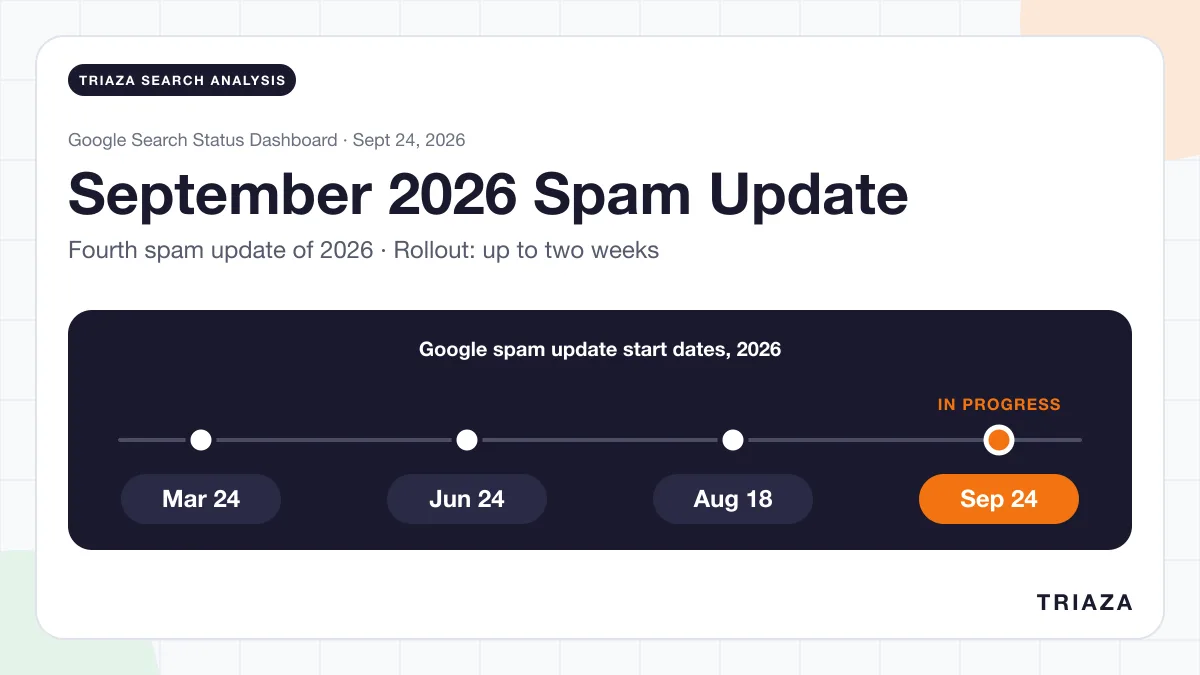
One more content constraint changed this year. On May 15, 2026, Google revised the opening of its spam policies so that spam explicitly includes attempting to manipulate generative AI responses in Google Search, not just classic rankings. Then Google shipped its third spam update of 2026 on August 18, 55 days after June’s.
Neither of those is a reason to stop using AI in content production. Google’s standing position is that appropriate use of AI isn’t a violation and that scaled content abuse applies no matter how content is created. What changed is that “we built 400 pages to get quoted by an assistant” is now inside the policy’s stated scope. If you were planning that, plan something else. If a core update moved your traffic instead, the May 2026 core update post covers how to tell those apart.
Shift Two: Treat Answer Engine Optimization As A Discipline Inside SEO, Not A New Budget Line
Answer engine optimization, or AEO, is the work of being visible inside AI-generated answers rather than only in ranked links. The mistake is treating it as a separate program with its own budget, tooling, and headcount.
The best evidence for that comes from Google itself. Its May 2026 explanation of how AI Overviews and AI Mode surface and link sources describes changes to link placement, hover previews, subscription labels, and community sources, and describes the retrieval side as ongoing work using techniques like query fan-out. What it doesn’t describe, anywhere, is a technical requirement. No file to publish. No markup to add. No format to adopt.
You don’t need llms.txt to be cited. It’s an unproven convention that some tools may choose to read. Publishing one is cheap and harmless. Treating it as a ranking factor is neither, because you’ll spend attention you needed elsewhere.
Schema markup is not a citation switch. It helps machines parse what’s already visible on the page, which is genuinely useful and worth doing correctly. It does not cause a citation, and no source in this article supports the claim that it does. We walk through the evidence and the limits in technical SEO for AI search.
A fresh publish date is not a lever. Updating a page because the substance changed is good practice. Updating the date because you want the page to look current is the kind of thing Google’s spam policy revision was written about.
What actually earns citations is closer to the old work than the vendors would like: crawlable pages, clear answers near the relevant heading, evidence a summary can’t reproduce, and a consistent story about who you are across the web. Our AEO checklist is the page-by-page version, and the AEO primer covers the fundamentals.
What A Reasonable AEO Line Item Looks Like In A Flat Budget
Budgets aren’t growing to accommodate any of this. Gartner’s 2026 CMO Spend Survey, covered by Sword and the Script on June 30, 2026, found marketing budgets averaging 7.8% of company revenue in 2026, essentially flat against 7.7% in 2025, with CMOs putting an average of 15.3% of the marketing budget into AI, rising to 21.3% among the AI-mature cohort Gartner calls AI strategists. The sample matters before the number does. Gartner polled 401 senior marketers in the US and Europe who work for businesses with more than $1 billion in revenue. If you’re a startup, that’s not your peer group, so take the shape and leave the percentage.
No 2026 survey we could find isolates AEO or AI-search-visibility spend as its own line. Every figure buckets it inside broader AI spend, which means any vendor quoting you a specific “companies spend X% on AEO” number is quoting an invention. We went through the same problem with percentage benchmarks generally in the 2026 startup marketing budget.
Our recommendation, and this is reasoning rather than evidence: fund AEO as a percentage of the SEO and content work you already do, not as a new program. The work overlaps by most of its surface area. If you want that done with help, it’s what AI Search & Answer Engine Optimization covers.
Shift Three: Brand And Entity Authority Is The Only Asset That Compounds Here
If you only change one thing in the back half of this year, change this one.
The most-cited correlation study on brand and AI visibility is Ahrefs’ May 2025 analysis of 75,000 brands, which filtered to domains with Domain Rating above 40 and each brand’s highest-volume keyword at 800 or more monthly searches. It found branded web mentions correlated with AI Overview brand visibility at a Spearman coefficient of 0.664, against 0.218 for backlinks, with branded anchors at 0.527 and Domain Rating at 0.326. Ahrefs itself says correlation does not equal causation, that all the factors studied showed moderate to very weak correlations, and that AI Overviews were still technically in an experimental phase when the study ran.
Two things about that study need saying out loud. It’s from May 2025, which makes the data about fifteen months old, and it gets recirculated constantly in 2026 posts as though it were new research, sometimes with extra correlation figures bolted on that don’t appear in the original. Check the date on any version of it you’re shown.
Pointing the same direction, Muck Rack analyzed more than 25 million cited links across 17 industries in May 2026 and found that sources it classified as earned media accounted for 84% of citations, with journalism at 27%. Muck Rack sells PR and media-monitoring software, so weigh a finding that favors earned media accordingly. It’s also one dataset with one classification scheme, and it doesn’t mean earned media will be 84% of citations in your industry.
This is the compounding asset, and the reasoning is ours rather than a finding. Branded mentions, consistent entity descriptions, and earned coverage are inputs that every assistant reads. They don’t expire when a model updates. They don’t have to be re-earned per platform. In a market where one assistant went from 76% to 53% of traffic in twelve months, the work that carries across all of them is worth more than the work tuned to any one of them.
Practically, that means three things. Make your company, product, and founder facts agree everywhere they appear, because conflicting facts give a model nothing stable to attach a citation to. Pursue accurate third-party coverage as a visibility channel, not just a PR vanity exercise. And write down your positioning so precisely that a summary of it is still recognizably you, which is most of what a message blueprint is for. Our companion pillar on how to get cited by every major answer engine is the tactical version of this section, and brand voice as a data asset covers keeping the voice consistent once machines are the ones reading it. If you’re explaining a category buyers don’t have a budget line for yet, startup positioning for a new category is the prerequisite.
Shift Four: Paid Media Is Fragmenting Away From Google-Only Search
Paid is where the fragmentation shows up in dollars.
eMarketer forecasts that Google will take 48.5% of US search ad spending in 2026, which analyst Nate Elliott’s May 14, 2026 report describes as the first time in more than 20 years the number has fallen below half, driven by AI and retail media, particularly Amazon. That’s a forecast for a year that hasn’t finished, published by a firm whose business is forecasts, so treat it as a modeled projection rather than a result.
The platforms are making opposite bets on how to monetize answers. OpenAI opened ChatGPT Ads to all advertisers on July 22, 2026, removing the minimum spend that had kept it a big-brand product, though ads serve only to adult accounts on the free and Go tiers, which means anyone on the higher paid tiers is unreachable there. Similarweb’s May 2026 analysis, measured from outside the platform, put overall click-through rate at 0.68%.
Perplexity went the other way. Search Engine Land reported on February 18, 2026 that Perplexity ended the sponsored-placement tests it had run since 2024, on the reasoning that even clearly labeled ads risk undermining trust in the answer, and is leaning on subscriptions instead, reporting about $200 million in annualized subscription revenue at tiers priced from $20 to $200 per month. That revenue figure comes from company executives rather than an audited financial statement, and Perplexity’s own position is explicitly non-permanent: it said it could revisit advertising or never need to.
Microsoft, meanwhile, is closing the loop inside the assistant with Copilot Checkout, which as of its January 2026 announcement was a US-only staged rollout.
The strategic read is a diversification argument, not a reallocation argument. Google is still the majority of search advertising even in a forecast where it drops below half. What’s changed is that the second-place options are now real enough to test with a small budget and a written success criterion. Protecting PPC ROI as the SERP shrinks covers the Google side, and if you run local services, the LSA to Performance Max migration is the more urgent item on your list. Paid advertising is where we do this work.
Shift Five: Fix Measurement Before You Optimize Against It
Practitioners will argue with this section, so the evidence goes first.
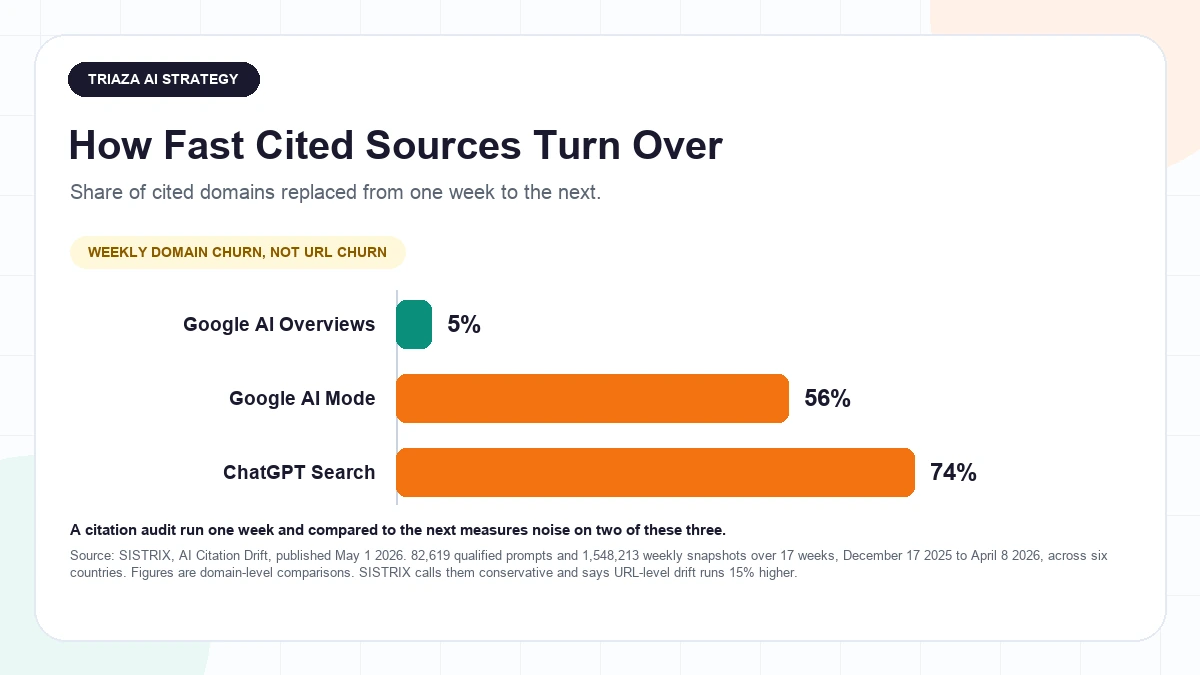
SISTRIX’s AI Citation Drift study, published May 1, 2026, tracked 82,619 qualified prompts and 1,548,213 snapshots collected weekly across Germany, the US, UK, Italy, Spain, and France over 17 weeks, from December 17, 2025 to April 8, 2026. Google AI Overviews replaced only about 5% of cited domains week to week. Google AI Mode churned roughly 56%. ChatGPT Search churned roughly 74%. SISTRIX is careful about what those numbers describe: all the drift figures are domain-level comparisons rather than URL-level, the rates are described as conservative because at the URL level they run 15% higher, and the ChatGPT data only includes prompts with consistent source attribution.
If more than half the cited domains in AI Mode turn over in a week, then a citation audit run on one Tuesday and compared to one from the previous Tuesday is measuring weather. Most AI visibility dashboards being sold right now report exactly that comparison, and the confident percentage they show you is, on two of three major platforms, mostly noise.
That doesn’t make measurement pointless. It makes single-snapshot measurement pointless. What holds up is direction over many observations, a fixed prompt set you re-run on a schedule, and recording the engine, date, prompt, and cited URL every time.
On the first-party side, Google began rolling out generative-AI performance reports in Search Console on June 3, 2026, covering AI Overviews and AI Mode. Two limits before you build a dashboard on it: the rollout started with a subset of properties, and the report shows impressions rather than clicks. And a live caveat as of this writing, from Google’s own August 2026 spam update window: a logging error began affecting that report’s impressions on August 13, 2026. Google says it is ongoing and affects data logging only. If your generative AI impressions fell last week, check that before you diagnose anything.
The board slide should show whether qualified pipeline from search-adjacent sources held up, not a citation count. We take that scorecard apart metric by metric in measuring content performance in a zero-click world, and the AI search visibility audit is the version you run before rewriting anything.
One more input belongs on the same slide, because it cuts against the whole category. A Fractl and Search Engine Land survey of 1,008 US consumers and 150 marketers, fielded in Q2 2026 and published June 17, 2026, found the share rating AI search as more helpful than traditional search fell from 82% in the 2025 wave to 54% in the 2026 wave, a 28-point drop, while 70% said they use AI tools for search more than they did a year earlier and self-described skeptics grew from 3% to 17%. It’s a self-reported panel compared year over year against the same questions, nationally representative on age, gender, and region, with no margin of error published.
Usage up and trust down is an unstable combination, and it’s the strongest reason not to bet the whole plan on this shift continuing in a straight line.
What Would Make This Playbook Wrong
Any strategy piece that can’t name its own failure conditions isn’t a strategy piece.
If AI Mode compounds the way Google says it’s growing. Fishkin, in the same June 9, 2026 analysis that reported 0.34%, speculated that AI Mode “could well be” the feature driving the next decade of zero-click growth, noting the number is almost certainly growing fast. Fishkin is speculating there, not projecting from a model. But if AI Mode goes from 0.34% to several percent of searches inside a year, the click loss stops being a 2025 story and becomes a 2027 one, and the case for building capability now gets much stronger than this article argues.
If agency gets gated faster than intelligence gets cheap. Kevin Indig forecast on July 27, 2026 that the back half of 2026 will separate intelligence from agency: model capability keeps getting cheaper and more abundant through open-weight models and price competition, while the authority to act, spend, access data, or deploy the most capable models gets more tightly controlled by platforms, governments, payment networks, and users. Indig’s read, with the detailed version behind a paywall. If he’s right, the constraint that matters is whether an agent acting for a buyer is permitted to transact with you at all, rather than whether you’re visible inside answers.
If the governance bill comes due. Forrester’s 2026 B2B predictions, published October 28, 2025, forecast that B2B companies will lose more than $10 billion in enterprise value in 2026 through falling stock prices, legal settlements, and fines tied to ungoverned generative AI use, and that 20% of B2B sellers will be compelled to respond to AI-powered buyer agents with AI-negotiated counteroffers. Those are Forrester’s numbers, stated in future tense, from a forecast now ten months old, and no individual analyst is credited with them.
And the counter-case, which is the one this article takes most seriously. If AI Mode’s share stays near 0.34%, and consumer trust keeps sliding from 54%, then a lot of what’s being spent on AI search visibility in 2026 will look in hindsight like an overcorrection to a real but slow-moving change. Watch whether your own AI referral sessions grow past a rounding error while still converting above your site average, rather than any vendor’s citation score. Give that ratio two quarters before you commit real money to a dedicated program.
How To Sequence The Rest Of 2026
Four months left in the year, one person, no new budget. The order below is what we’d run, with the disclaimer up front: no study proves that funding brand and entity authority beats funding a dedicated AI search program. This sequence is reasoning from the evidence above, not a tested result.
Weeks 1 to 4: baseline and cleanup. Confirm the crawlers you want can actually reach your pages, checking server responses rather than user-agent strings. Pull whatever generative AI impression data your Search Console property has, noting the August 13 logging error if the numbers look strange. Save a fixed set of 20 or so prompts a real buyer would ask, run them across at least two assistants, and record engine, date, prompt, and cited URL. Then fix conflicting company, product, and author facts across your site, schema, profiles, and any listing that ranks for your brand name.
Weeks 5 to 8: depth and evidence. Take the ten pages closest to revenue and ask what each one contains that a summary couldn’t reproduce. Add the original data, the specific example, the named opinion, or retire the page. In parallel, start one earned-media motion, whether that’s a data study, a technical comparison with stated criteria, or an expert contribution, and give it a real deadline.
Weeks 9 to 12: one test and one cadence. Run a single small paid test outside Google-only search with a written success criterion and a stop date. Re-run the prompt set from weeks 1 to 4 and compare direction, not scores. Then set a quarterly review that asks one question: whether qualified pipeline from search-adjacent sources held up.
If you’d rather have that built and run with you, that’s what our AI Strategy & Growth Roadmap does, and Marketing Strategy is the wider version when AI search is one input among several. If your content operation is the bottleneck, AI Content Systems is the piece that fixes production rather than distribution.
Frequently Asked Questions
Is AI Search Actually Costing Me Traffic Yet, Or Am I Reading Headlines? Some of both. SparkToro put US zero-click searches at 68.01% for January through April 2026, against 60.45% in 2024, on a Similarweb clickstream panel that excludes the Google mobile app, and against a 2024 baseline Rand Fishkin himself calls “a bit of apples and oranges” because the two windows aren’t the same users or devices. And Ahrefs’ February 4, 2026 update on December 2025 data found a 58% lower average click-through rate for the top-ranking page when an AI Overview is present, which is a correlation from one dataset. But AI Mode was only 0.34% of searches in that same SparkToro window, so the loss you’re feeling is AI Overviews and years of SERP features, not AI Mode.
How Much Of My Remaining 2026 Budget Should Go To AI Search? Less than you’re being told, and not as a separate line. Gartner’s 2026 CMO Spend Survey, via Sword and the Script, found budgets flat at 7.8% of revenue with 15.3% of the marketing budget going to AI overall, from 401 senior marketers in the US and Europe at businesses with more than $1 billion in revenue, which is not your peer group if you’re a startup. No 2026 survey we could find isolates AEO spend as its own line, so any specific AEO percentage you’re quoted is invented. Our recommendation, which is reasoning rather than evidence, is to fund it as a share of the SEO and content work you already do.
Do I Need llms.txt, Schema, Or Fresher Dates To Get Cited? No. Google’s May 2026 post on how AI Overviews and AI Mode surface and link sources describes link placement, previews, and community sources, and names no technical requirement at all, describing retrieval as ongoing work using techniques like query fan-out. Schema helps machines parse what’s visible on your page and is worth doing correctly, but it isn’t a citation switch. llms.txt is an unproven convention that costs almost nothing to publish and shouldn’t be treated as a ranking factor. Changing a date without changing the substance is closer to the behavior Google’s May 15, 2026 spam policy revision was written about.
Should I Optimize For ChatGPT Or For Google? Neither, in the way the question implies. Similarweb’s July 29, 2026 report found ChatGPT’s share of generative-AI web traffic fell from about 76% to about 53% between June 2025 and May 2026 while Gemini rose from under 9% into the roughly 27 to 28% range, all from a worldwide traffic panel rather than census data. Tuning for one assistant in a market that redistributed that fast is a poor use of a small team. Fund the inputs every assistant reads: accessible pages, clear answers, evidence, and consistent facts about your company.
Is AI Referral Traffic Worth Anything, Or Is It Just Vanity Volume? It’s small and improving. Contentsquare’s April 3, 2026 benchmark, from 99 billion sessions across 6,500 sites, put AI-referred traffic for 2025 at 0.2% of total visits, 0.5% in services and 0.3% in software, and calls it “a small channel” with a “for now” attached. Adobe’s Q2 2026 report, via Search Engine Journal, found it converting 42% better than non-AI traffic by March 2026 for US retail, and Adobe sells a product for AI visibility, so weigh it accordingly. Make sure the channel works. Don’t restructure the budget around it.
Should I Put Money Into ChatGPT Ads This Year? As a test with a stop date, yes. As a reallocation, no. Ads opened to all advertisers on July 22, 2026 but serve only to adult free and Go tier accounts, and Similarweb’s May 2026 outside analysis put click-through rate at 0.68%. eMarketer’s May 14, 2026 forecast has Google below half of US search ad spending at 48.5% for the first time in more than 20 years, which is a modeled projection for an unfinished year, and half is still most of the market. Meanwhile Perplexity dropped ads entirely in February 2026 on trust grounds, while saying it could revisit that. The category isn’t settled enough to bet on.
How Do I Report AI Search Performance To My Board When The Tools Disagree? Report direction and inputs, not a citation score. SISTRIX’s drift study, published May 1, 2026 across 82,619 prompts and 1,548,213 snapshots over 17 weeks, found weekly cited-domain churn of about 5% in AI Overviews, 56% in AI Mode, and 74% in ChatGPT Search, and notes those are conservative domain-level figures that run 15% higher at the URL level. A single-snapshot audit on two of three platforms is measuring noise. Use Search Console’s generative AI reports knowing they’re impressions only and rolled out to a subset of properties, and note the logging error that began August 13, 2026.
Is AEO A Real Discipline Or Just SEO With A New Name? It’s mostly SEO, and the parts that aren’t are worth naming. Eli Schwartz’s April 9, 2026 argument is that the differences are real and that the old metrics don’t map, since a model can answer the same question differently twice in one session, which breaks rank-tracking logic. His piece is conceptual and cites no studies, so it’s his analytical position. Our read is that the overlap is large enough that you should staff it inside your existing search work, and the genuine additions are crawler access for engines beyond Google, entity consistency, and measurement that survives the churn above.
The Smart Move Was Never A New AI Search Program
The teams that will look smart in January made their best pages worth citing, got their facts straight everywhere a machine might read them, tested one new paid surface with a stop date, and built a measurement habit that can tell a trend from a week of noise. None of that required standing up a separate AI search program this year.
If you want a second set of eyes on where your remaining 2026 budget should go, that conversation is what we do.