Google didn’t kill organic traffic this year. It repriced it.
That’s the short version of what happened in the year since AI Mode left Labs. Click value fell hardest on commodity informational content — the “what is X” pages that answer one narrow question — while citations inside AI answers, branded demand, and genuinely distinct expertise held up far better. If you run marketing for a startup or a technical B2B brand, the difference between those two groups is most of the story.
The “SEO is dead” version makes better headlines. It just doesn’t survive contact with the data. Here’s the year as it actually unfolded, what the credible studies show, and what to change if you still want Google to send you traffic.
Did Google’s AI Mode kill organic traffic?
No, but it repriced it. Independent studies found organic click-through rates fell by more than half on informational queries where AI Overviews appear, while Google maintains total organic clicks stayed “relatively stable.” Both can be true at once: clicks redistributed away from commodity informational pages and toward cited sources, branded searches, forums, video, and original analysis. The sites that lost least were cited inside AI answers, searched for by name, or publishing things a model can’t synthesize from everyone else.
The traffic drop wasn’t in your head
The moment Google Search changed at I/O 2025
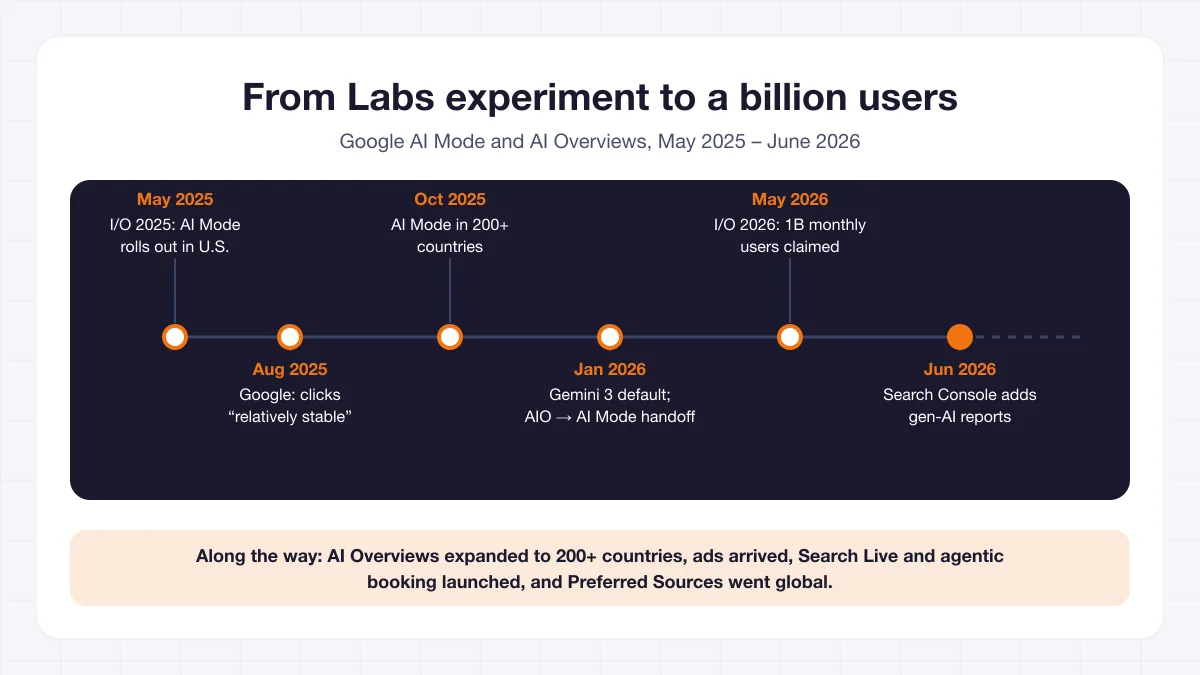
The turning point was Google I/O on May 20, 2025. Google rolled AI Mode out across the U.S. with no Labs sign-up required, added an AI Mode tab to Search and the Google app, and brought Gemini 2.5 into both AI Mode and AI Overviews. The same day, it announced AI Overviews were expanding to more than 200 countries and territories in over 40 languages, and claimed they were driving “over a 10% increase in usage” for the kinds of queries that show them.
The groundwork had been laid months earlier. Google introduced AI Mode as a Labs experiment in March 2025 and removed the waitlist on May 1. I/O just made the shift the default instead of the experiment.
From there, the product never stopped layering on capability. AI Mode reached India in June, picked up Canvas and image and PDF questions in July, and gained Search Live — real-time voice and camera search — by September. October brought 35+ new languages and 40+ new countries, pushing AI Mode past 200 countries and territories. In January 2026, Google made Gemini 3 the default model for AI Overviews globally and let users flow from an Overview straight into an AI Mode conversation. And at I/O 2026 on May 19, Google said AI Mode had passed one billion monthly users, with queries more than doubling every quarter since launch.
Whatever surface you were optimizing for in early 2025, your audience is using a different one now.
AI Overviews and AI Mode aren’t the same thing
The distinction matters more than most analytics conversations admit. AI Overviews are the AI-generated summaries at the top of an otherwise normal results page. AI Mode is a separate, conversational search experience — a chat-style tab where people ask longer, multi-part questions and follow up.
They hurt differently, too. An AI Overview compresses the answer into the results page, so the searcher may never scroll to your link. AI Mode moves the whole session into a conversation where blue links are even less central. Most marketers lump the two together because their analytics can’t tell them apart, and until very recently Search Console couldn’t either. When you read “AI Mode killed my traffic,” the number behind the headline is almost always an AI Overviews number standing in for the whole shift. Clean, AI-Mode-specific data barely exists yet.
What the past year actually did to organic traffic
CTR fell hardest on answerable informational pages
The most repeated finding across independent studies is that click-through rates dropped most on informational queries where an AI summary appears.
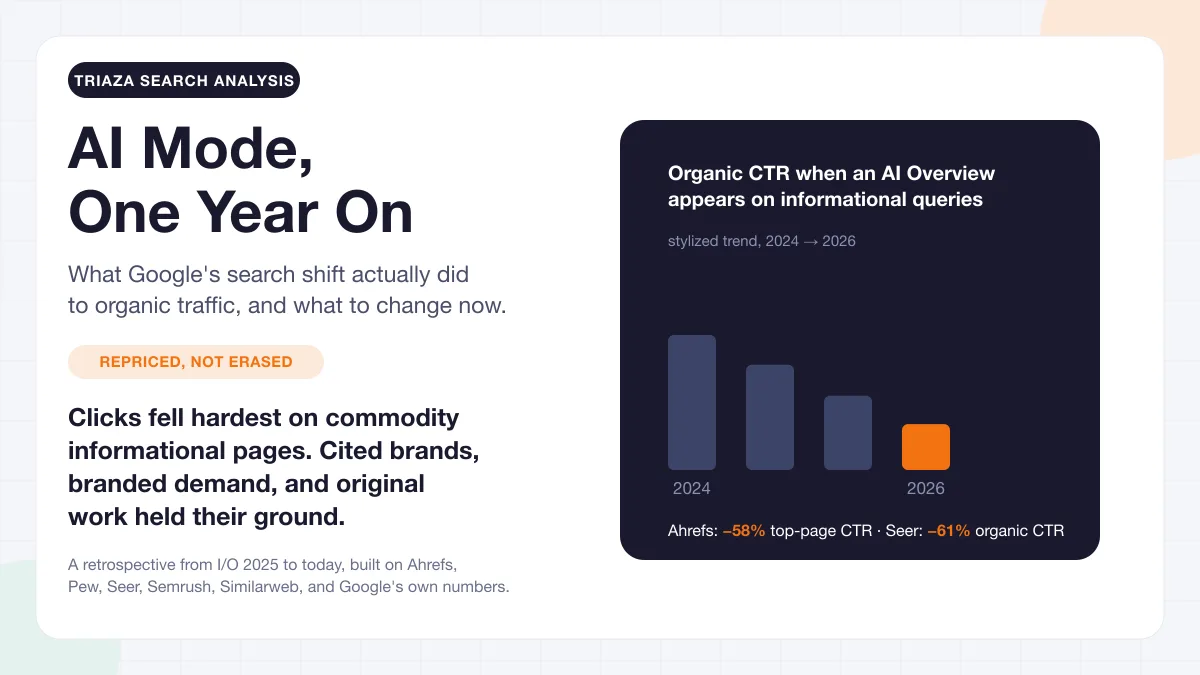
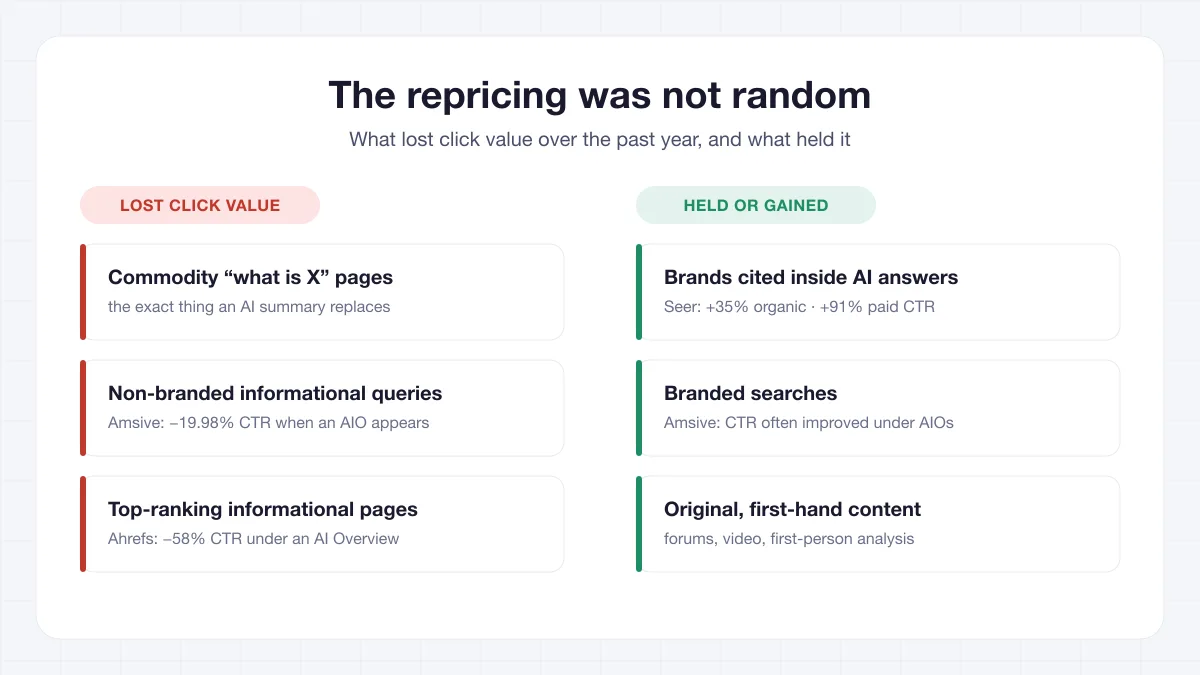
Ahrefs measured it first at scale in April 2025: across 300,000 keywords and aggregated Search Console data, the presence of an AI Overview correlated with a 34.5% lower CTR for the top-ranking page versus comparable informational keywords without one. When Ahrefs reran the study on December 2025 data, the gap had widened to 58%.
Pew Research Center came at it from real browsing behavior. Using U.S. data from March 2025, Pew found users clicked a traditional result on 8% of searches with an AI summary, against 15% without one. Links inside the summary itself got clicked on just 1% of visits, and sessions ended on Google more often when a summary appeared — 26% versus 16%.
Similarweb’s zero-click tracking found that nearly 80% of searches that trigger an AI Overview now end without a click. And Seer Interactive, tracking informational and educational queries from mid-2024 through September 2025, watched organic CTR on AI Overview queries fall from 1.76% to 0.61% — a 61% decline. Seer saw CTR fall on queries without AI Overviews too, which says something about how much search behavior in general has changed.
Different methods, different keyword sets, same direction: when the answer can be consumed on the results page, fewer people click through to get it.
Why Google says clicks are fine while marketers say they aren’t
Both sides are describing real numbers.
In August 2025, Google published a direct rebuttal to the traffic-loss narrative: total organic click volume from Search to websites was “relatively stable” year over year, average click quality had increased, and users were increasingly clicking into forums, videos, podcasts, original posts, and first-person analysis.
That can be true at the same time as a 58% CTR drop on informational queries with AI Overviews. Google is talking about aggregate clicks across all of Search. The third-party studies measure specific query classes — the informational, question-shaped searches most likely to trigger an AI summary in the first place. Aggregate stability can sit on top of sharp redistribution underneath: commodity informational pages lose, and other query types and content formats absorb the clicks.
One caveat belongs next to every Google number in this story. Stable click volume, rising “quality clicks,” a billion AI Mode users — all of it is internal Google data that nobody outside the company can audit. Quote it as Google’s position, not as settled industry fact.
The winners weren’t random
The strongest pattern is citation. Seer’s data showed that when a brand was cited inside an AI Overview, it saw 35% higher organic CTR and 91% higher paid CTR than comparable AI Overview results where it wasn’t cited. Visibility inside the answer has become its own performance layer, separate from ranking below it. BrightEdge’s one-year tracking adds a detail that matters for smaller sites: only about 17% of AI-Overview-cited sources in its dataset also ranked in the organic top 10. Citation isn’t reserved for the page-one incumbents.
The second pattern is originality. Google’s own August 2025 post said users were increasingly clicking forums, videos, podcasts, and first-person analysis, and its 2026 guidance on AI features in Search explicitly favors “non-commodity” content: unique viewpoints, first-hand reviews, strong original images and video.
The third is brand strength. Amsive’s CTR research found branded keywords rarely trigger AI Overviews — under 5% of them in its dataset — and when they did, CTR actually improved on average, while non-branded keywords fell nearly 20%. This is agency research rather than a neutral panel study, so treat it as directional. The direction is intuitive, though: demand for you is more resilient than demand for information you happen to publish.
The fourth is platform-native content. Semrush’s 10-million-keyword study found discussion blocks and video carousels are frequent neighbors of AI Overview results — the formats Google says people increasingly click are also the formats it keeps placing on the page.
What to do now if you still want traffic from Google
Stop publishing commodity pages like it’s 2023
The highest-leverage change is to stop spending your content budget on basic answer coverage. A page whose only job is to define a term or answer a narrow factual question is now the most exposed asset you own; it’s exactly what an AI summary replaces. Redirect that effort toward original analysis, expert comparisons, first-hand proof, tools, calculators, demos, and real editorial perspective. The bar is no longer “did we cover the topic.” It’s “did we add something a model can’t synthesize from everyone else’s pages.”
Optimize for citation-worthiness and click-worthiness separately
These are two different jobs now, and a strong page does both. Citation-worthiness means being clear, structured, and quotable enough that an AI answer pulls you in as a source: concise claims, clean formatting, specific data, unambiguous statements. Click-worthiness means giving the reader a reason to still choose you after the summary — a distinct point of view, proprietary data, a tool, or depth a three-paragraph answer can’t hold. Optimize for only one and you either get cited without traffic or rank below an answer nobody scrolls past.
None of it works without the foundations. AI systems still have to find, parse, and trust your pages before they can cite them, which is why technical SEO fundamentals still matter: crawlability, indexing, internal linking, site structure.
Make your brand easier to choose
Branded demand held up all year, which argues for investing in being a brand people search for by name and recognize inside an answer. That means consistent positioning, a homepage that plainly states who you help and how, and enough presence across the web that your name reads as a known entity. In practice, that’s most of what AI Search & AEO for B2B brands comes down to: becoming a recognizable, citable entity rather than a collection of ranking pages.
Use the surfaces Google is explicitly favoring
Google has been unusually direct about where it’s sending attention. Merchant Center for products. Business Profile for local. Strong images and video everywhere. And, where it fits, ask your audience to mark you as a Preferred Source: Google said in May 2026 that people are twice as likely to click through to a Preferred Source, and that users had already selected more than 345,000 unique sources. Most B2B teams haven’t pulled these levers yet.
How to measure AI-era search honestly
Search Console finally reports AI visibility — with limits
For the entire first year of this shift, Search Console folded AI-feature traffic into overall Web totals with no breakout, which is a big part of why the public conversation got so noisy. Anyone claiming a precise “AI Mode CTR” for a site was inferring it from query sets, overlays, or proprietary panels rather than reading a first-party label.
That began to change on June 3, 2026, when Google announced Search generative-AI performance reports covering visibility in AI Overviews and AI Mode. Two limits to know before you build a dashboard on top of them: the rollout started with a subset of sites, and the reports show impressions, not clicks. First-party visibility data is finally arriving. CTR-style analysis still requires inference.
Track beyond clicks
If raw clicks no longer tell the whole story, widen the lens. Watch branded search lift over time, assisted conversions, and on-site engagement from search landings rather than session counts alone. Track whether you’re cited in AI answers and whether you show up on the discussion and video surfaces Google keeps favoring. Google argues AI-originating clicks are higher quality; third-party data shows raw CTR is down. Measuring volume and quality together is the only way to see what’s happening to your pipeline instead of just your pageviews. We take that scorecard apart metric by metric, with the instrumentation for each, in our guide to measuring content performance in a zero-click world.
Questions founders keep asking
Did AI Mode cause my traffic drop, or was it something else?
It’s genuinely hard to isolate. Most public research measures AI Overviews rather than AI Mode, and Google shipped plenty of other ranking changes over the same year — the May 2026 core update moved traffic for reasons that had little to do with AI surfaces. Before blaming AI Mode, segment your losses by query type. If informational, question-shaped queries fell while branded queries held, the AI-summary explanation fits. If losses cut across everything, look at core updates first.
Which pages are most vulnerable?
Simple informational and educational pages whose whole job is answering a narrow question — that’s where every major study found the steepest declines. And the exposed category is widening: Semrush’s data shows AI Overviews expanding beyond informational queries into commercial and transactional ones through 2025.
Is AI referral traffic big enough to replace lost Google clicks?
Not yet, and not close. Similarweb estimated AI platforms generated 1.13 billion referral visits in June 2025, up 357% year over year — against roughly 191 billion referrals from Google Search in the same period. AI referrals are growing fast and tend to be higher intent, but as replacement volume they’re a rounding error for most sites.
Does brand strength really matter more now?
The data keeps pointing that way. Branded queries rarely trigger AI Overviews, branded CTR often held or improved when they did, and cited brands outperformed non-cited ones on the same results pages. A recognizable brand is the one asset that pays off across all of these surfaces at once.
The arc, one year in
Google didn’t erase organic opportunity evenly. It repriced it — hard — on the content that was easiest to replace, and left the most value with brands offering something distinct, citable, and worth choosing on purpose. The teams that struggled were mostly running a 2023 content playbook into a 2026 search surface. The teams that held up had earned citations, built a brand, or published things a model can’t regurgitate.
This piece is the look back. The playbook for what’s next — engine by engine, with the tactics that earn citations — is our companion pillar on how to get cited by every major answer engine.