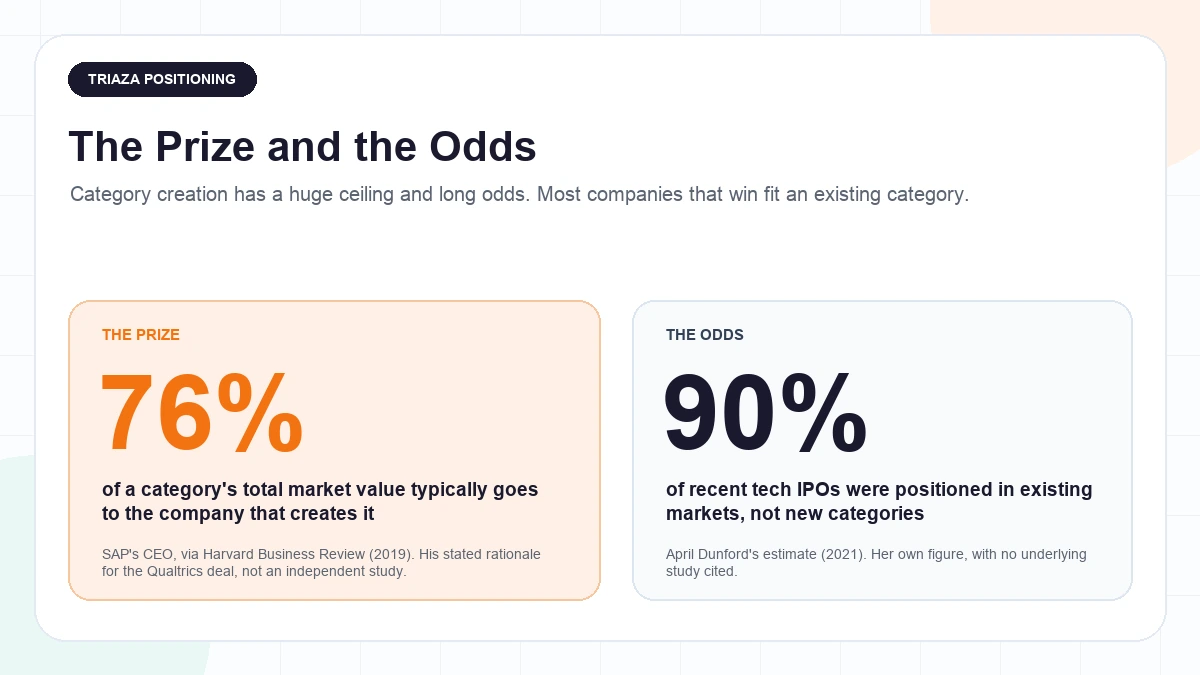
There’s a number that gets founders excited about creating a new category. Companies that create a new product category typically capture about 76% of that category’s total market value, a stat SAP’s then-CEO used to justify the company’s roughly $8 billion acquisition of Qualtrics (that was his rationale for the price, not an independent research finding). Own the category, own most of the economics. It’s a seductive pitch.
Here’s what the pitch leaves out. April Dunford, who has positioned dozens of B2B products, estimates that 90% of the tech companies that went public over the prior five years were positioned in existing markets, not brand-new categories (her own figure, with no underlying study cited). Most companies that win don’t invent a category. They win inside one buyers already understand.
Positioning a new category means anchoring your product to a frame of reference buyers already understand, naming the real alternative they’re using now (often a spreadsheet or doing nothing), and attaching the purchase to a budget line that already exists. You’re not teaching people a new word. You’re making your value obvious against something familiar.
So which is it, ride a category or build one? If you’ve made something genuinely new and prospects keep saying “interesting” and then never buy because they have no budget line for whatever-this-is, you’re stuck between those two facts. That gap is a positioning problem, and it’s the strategic work that decides whether the rest of your marketing lands or bounces off.
Positioning Is a Decision, Not a Headline
Most founders treat positioning as a copywriting problem. The homepage headline isn’t landing, so they rewrite it. Then they rewrite it again. Six versions later it’s still fuzzy, because the headline was never the problem.
Dunford draws a hard line here. “Positioning is not equivalent to messaging,” she writes. “It isn’t a tagline. It’s not your brand story, nor is it your vision or your ‘why.’” Positioning is the decision underneath all of those: what your product is, who it’s for, and what it competes against. Messaging is the language you use to express that decision. If the decision is unmade or wrong, no rewrite fixes the copy, because every version is just a new guess at a question you never actually answered.
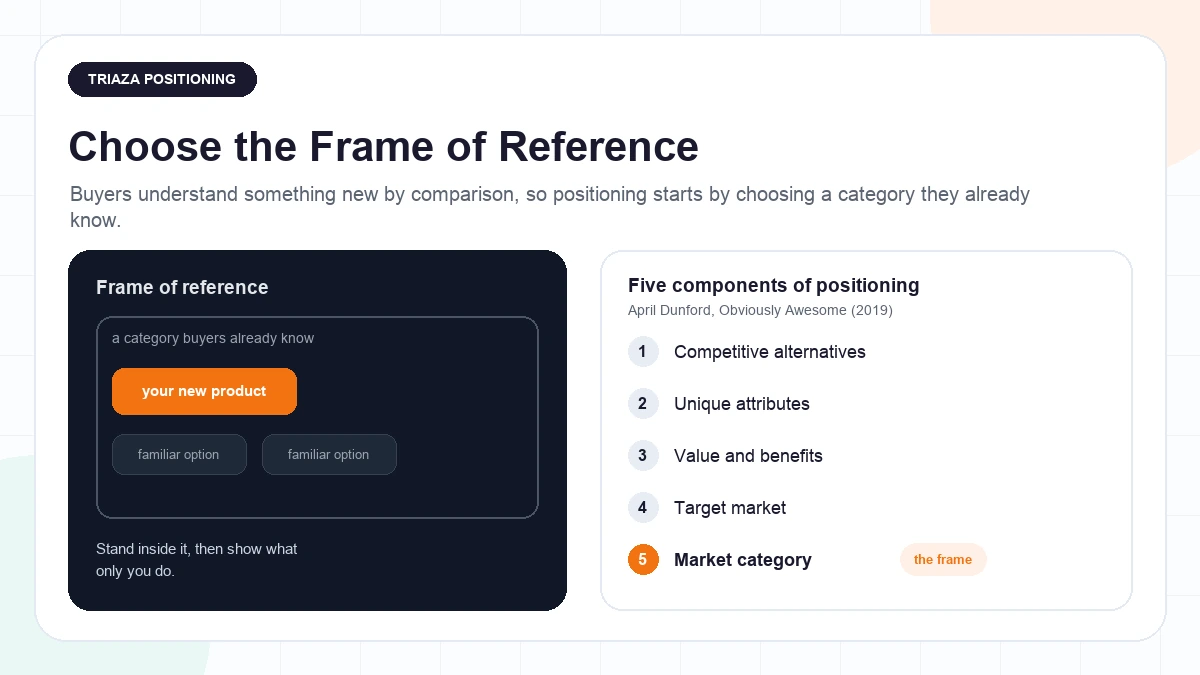
In her 2019 book Obviously Awesome, Dunford breaks positioning into five components: the competitive alternatives a customer would use instead of you, the unique attributes only you have, the value those attributes create, the target market that cares most about that value, and the market category you place yourself in so buyers know what you are. That last one does the heavy lifting for something new. Dunford defines market category as “the context we position our product in such that our value is obvious to our target customers.” The category is the frame. Get it right and the value explains itself. Get it wrong and even perfect copy reads as noise.
Your Real Competitor Is “Do Nothing”
When you’re selling something new, it’s tempting to fixate on rival vendors. But for a product buyers don’t have a budget line for, your toughest competitor usually isn’t a company. It’s inertia.
Jobs to Be Done, the framework from Clayton Christensen and his co-authors, reframes this well: customers don’t just buy products, they “hire” them to make progress on a job. Their well-known example is a fast-food chain that couldn’t work out why it sold so many milkshakes until it looked at the job people were hiring the shake to do, a long, boring commute that needed a thick, one-handed, filling companion. The real competition wasn’t other milkshakes. It was bananas, bagels, and boredom. For your product, the job the buyer needs done is already being handled by something: a spreadsheet, a manual process, an intern, or simply living with the problem.
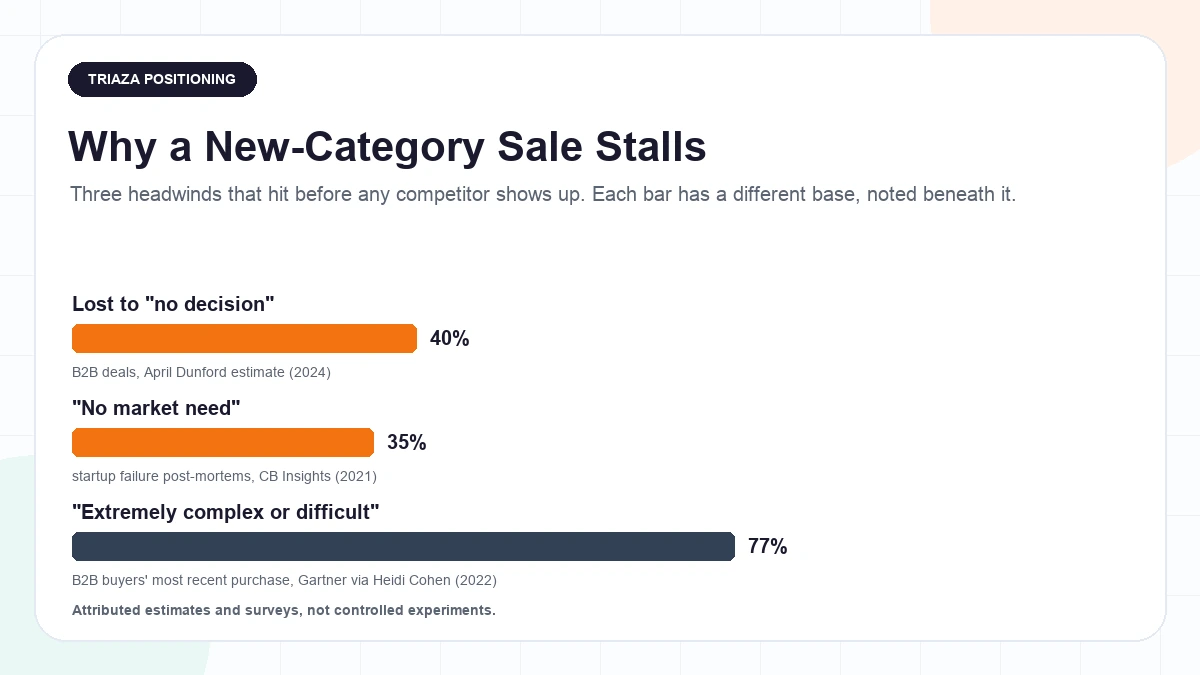
That “living with it” option is bigger than founders think. Dunford notes that in B2B, companies lose about 40% of deals to “no decision”, the prospect sticking with the status quo rather than choosing any vendor (she states that figure without citing an underlying study, so treat it as a practitioner’s estimate rather than a measured finding). And building for a need that turns out not to be real is one of the most common ways startups die: in CB Insights’ 2021 analysis of 111 startup failure post-mortems, “no market need” was the second-most-cited reason, appearing in 35% of cases (the listed reasons sum to well over 100%, because most failures had several causes). Even buyers who do want to move often find it genuinely hard: Gartner’s sales research found that 77% of B2B buyers rated a recent purchase “extremely complex or difficult”, a buyers’ self-assessment relayed through marketing writer Heidi Cohen’s recap of Gartner’s research rather than a primary Gartner release. Complexity plus a missing budget line is a recipe for stalling.
The practical takeaway is that your positioning has to beat “do nothing” before it beats any competitor. Name the workaround the buyer is using now, make its hidden costs visible, and show why your approach is worth the switch. If you can’t describe the status quo you’re replacing, you don’t have a position yet.
Explain It With a Frame of Reference, Not a New Vocabulary
The instinct with something new is to give it a new name and teach everyone the word. That’s almost always the hard way. Buyers understand new things by comparison to things they already know, so the fastest route to “obvious” is to borrow an existing frame of reference and then show how you differ inside it.
Geoffrey Moore’s positioning-statement template from his 1991 book Crossing the Chasm is a useful discipline device for exactly this, because it forces you to name the frame and the alternative: “For [target customer] who [need], [product] is a [category] that [benefit]. Unlike [alternative], [product] [differentiation].” The value isn’t in filling the blanks prettily. It’s that you can’t finish the sentence without deciding what category you’re in and what you’re replacing, even when the honest answer to “unlike” is “spreadsheets” or “doing it by hand.”
Use the template as a thinking tool, not a formula. Dunford cautions against treating the rote fill-in-the-blank version as if there’s one correct answer to drop into each slot; the category and the alternative are strategic choices you can get right or wrong, not obvious givens. And weigh the choice honestly. Anchoring to an existing category is usually the right default, because you’re borrowing a mental model, and often a budget line, the buyer already has. Inventing a category means teaching the market from scratch, which is slow and expensive, and most companies that win never take it on.
When (and Only When) to Create a New Category
Sometimes the existing frame genuinely hurts you. If buyers keep comparing you to a category you’re better than, or the nearest category anchors them to the wrong price or the wrong buyer, fitting in caps your value. That’s when category creation earns its keep.
The upside is real. Play Bigger, the 2016 book by Al Ramadan, Dave Peterson, Christopher Lochhead, and Kevin Maney, argued that the company which designs and dominates a new category becomes its “category king” and captures most of that category’s economics. The 76% figure from the intro is the headline version of that idea (again, that specific number was SAP’s CEO’s stated rationale for the Qualtrics price, not an independent finding). Category creators can also command real pricing power: Harvard Business Review’s 2013 look at Keurig reported that 2012 US sales of its coffeemakers and pods topped $3.8 billion with more than 40% dollar market share, and that K-Cups sold for about 50 cents each, roughly ten times the per-cup cost of ordinary brewed coffee (HBR’s 2013 single-company snapshot, not an ongoing or industry-wide measure).
Now the cost side, which the highlight reels skip. Creating a category means funding the education yourself: you’re not competing for a budget line, you’re trying to convince buyers one should exist. That means longer sales cycles, a higher cost to acquire each customer, and a multi-year investment in content, thought leadership, and market education before the spending shows up. Plenty of companies that tried to create a category ran out of money before the market caught up. The 76% belongs to the survivors.
So treat category creation as a deliberate, well-funded bet, not a growth hack. Default to an existing frame. Reach for a new category only when an existing one actively works against you and you have the runway to teach the market what you mean.
How Real Companies Named a Category Buyers Couldn’t Budget For
The playbook isn’t theoretical. A handful of companies built categories buyers had no budget line for, and their moves are worth studying.
Salesforce made the fight the message. Before “SaaS” or “the cloud” were line items any IT department recognized, Salesforce staged a 2000 launch event it called “The End of Software,” debuting its “No Software” logo and running an ad that pitted a fighter jet (Salesforce) against an obsolete biplane (the on-premise software industry). It didn’t so much explain a new category as declare the old one obsolete, which made the choice feel binary.
HubSpot wrote the category’s book. Brian Halligan and Dharmesh Shah gave a demand-generation approach a name and a manifesto in their 2009 book Inbound Marketing, positioning “inbound” explicitly against “outbound” interruption advertising. Naming the thing, then authoring the definitive text on it, is a repeatable way to own a category you’re trying to build.
Drift claimed the category out loud, then had to keep earning it. Drift named “conversational marketing,” repositioning live chat from a support widget into a buyer-led alternative to lead-capture forms. Its CEO put the claim on the record: “We launched Drift and created the Conversational Marketing category,” he said in a 2020 announcement that was itself about Drift expanding beyond that category. That’s the caution built into the example: naming a category isn’t a one-time act. Ownership takes ongoing narrative work, and categories can evolve out from under you.
Gainsight built the category where there was no title, tool, or budget for it. “Customer success” wasn’t a software segment until Gainsight made it one, educating the market and running an annual conference ahead of the demand. A 2017 Forbes piece caught the pre-category moment in an investor’s words: “There’s always been folks that have filled these roles. There’s never been great tools for it.” By then the bet was paying off, with Gainsight reporting 167% year-over-year revenue growth as budgets for the category started to appear.
Qualtrics named the gap, not just the product. When Qualtrics launched “Experience Management” in 2017, it didn’t lead with features. It named a problem: companies were “O-data rich, and X-data poor,” drowning in operational data but starved of the experience data that explains why customers and employees do what they do. Naming the gap lets buyers feel the problem before you sell them the fix, and it’s the most portable move in this list. You can run it on your own category tomorrow.
Selling Before There’s a Budget Line
Framework aside, founders still have to close deals this quarter, before anyone has budgeted for a category that doesn’t officially exist. A few practical moves help. These are practitioner tactics, not anything a study prescribes.
Attach to a budget line that already exists. Rather than asking a buyer to invent a new line item, reframe your product as a better way to spend money they already spend, or as the cost of a problem they’re already paying for in lost time or lost revenue. Budget is easier to find when it’s a reallocation, not a net-new request.
Sell to the person who owns the pain. The economic buyer of a problem often isn’t the obvious departmental owner. Whoever feels the cost of the status quo most sharply is who can find money for a fix, even with no pre-existing category.
Expect most of the market to be sitting out. Positioning that only speaks to people ready to buy today ignores how B2B purchasing actually works. Ehrenberg-Bass research, popularized as the “95:5 rule,” holds that only about 5% of B2B buyers are in-market to buy at any given time, an estimate derived from how often companies switch providers rather than a headcount of live buyers. The other 95% aren’t shopping yet, so clear, memorable positioning does double duty: it helps you win the few buying now, and it plants your frame in the minds of the many who will buy later.
None of this replaces the positioning decision itself. It’s what you do once you’ve made it. And that decision, what category you claim, who you’re for, and what you replace, is the strategic layer everything downstream depends on. Turning it into the actual words on your site and in your sales deck is the next job, and it goes much faster when the positioning underneath is settled. If you’re weighing that work against building a visual identity system, we cover which one to commission first in brand style guide vs. message blueprint.
Start With the Decision, Not the Homepage
If prospects keep saying “interesting” and then vanishing, resist the urge to rewrite the headline one more time. Go a level down and make the positioning call first: the category you’re claiming, the buyer you’re for, and the status-quo alternative you’re replacing. Write it as a plain sentence you can defend, test it against real buyers, and only then turn it into copy.
Positioning is hard to do on yourself, because you’re too close to the product to see which frame a buyer actually needs. An outside perspective, whether it’s an advisor, a peer founder, or a team that runs positioning exercises for a living, mostly earns its keep by asking the plain, clarifying questions you’ve stopped being able to ask yourself.
However you run it, the goal is the same: make your value obvious against something the buyer already understands, so “we don’t have budget for that” turns into “which line does this come out of.”
Questions Founders Keep Asking About Positioning
What’s the difference between positioning and messaging? Positioning is the strategic decision: what category you compete in, who you’re for, and what alternative you replace. Messaging is the language that communicates that decision. Founders often rewrite the homepage (messaging) without ever settling the frame (positioning), so every rewrite drifts back to the same fog. Decide the positioning first, then turn it into messaging.
Should we create a new category or fit into an existing one? It’s a tradeoff between speed and ceiling. Fitting an existing category borrows a budget line and a mental model, so sales cycles are shorter and education is cheaper, but you invite feature-by-feature comparison and cap your upside. Creating a category costs more time and money up front and can capture outsized value if you survive long enough. Default to fitting; create only when an existing frame actively hurts you.
How do I explain the product in one line when buyers don’t recognize the category? Anchor to something familiar, a known category, workflow, or job, instead of inventing a word buyers have to learn cold. Geoffrey Moore’s “for [target] who [need], [product] is a [category] that [benefit], unlike [alternative]” template forces you to state a comparison even when the honest alternative is “a spreadsheet.”
How do you sell something when the buyer has no budget line for it? Reframe it against a budget that already exists: attach it to an adjacent line item, or present it as the cost of a problem they’re already paying for, and sell to whoever owns that pain. Getting a brand-new category approved is far slower than redirecting spending that’s already flowing. (This is common practice, not a finding from any study.)
When should we actually name a new category? Usually only once you have evidence of repeat willingness to pay and enough runway to fund the education. Naming a category too early just adds a vocabulary tax to a sale that’s already hard.
What is Jobs to Be Done and how does it relate to positioning? Jobs to Be Done reframes a buyer’s need as the progress they’re trying to make, independent of any product category. It’s useful for positioning because it surfaces the real competitive set, which is often a manual process or the status quo rather than another vendor, and that becomes the “unlike” line in your positioning.
Do we even need a category name, or just clear positioning? A clear positioning statement (audience, problem, category, differentiation) works without coining a proprietary name. Naming is a later-stage move, not a prerequisite. Plenty of companies position sharply inside an existing category and never invent a word.