A LinkedIn carousel takes two weeks. It goes through three rounds of founder comments, a designer pass and a long thread about whether “operators” sounds more on-brand than “teams.” It goes out on a Tuesday at 11 a.m. because a benchmark said that was a strong window, and by Thursday it has a few dozen reactions, most of them from employees. Then the team is stuck on the usual questions: post more or polish harder, and can any of this be tested without paying for ads?
Both questions, and most guides to social media content testing, treat the post as the thing being judged. On YouTube, Instagram, TikTok and LinkedIn, a recommendation system decides who sees each post, often including people who don’t follow the account, and it decides partly by watching how those viewers respond. One polished post hands that system one version of one idea. If the angle is wrong for the people it reaches, two weeks of polish produces a very clean answer to a question nobody in the feed is asking.
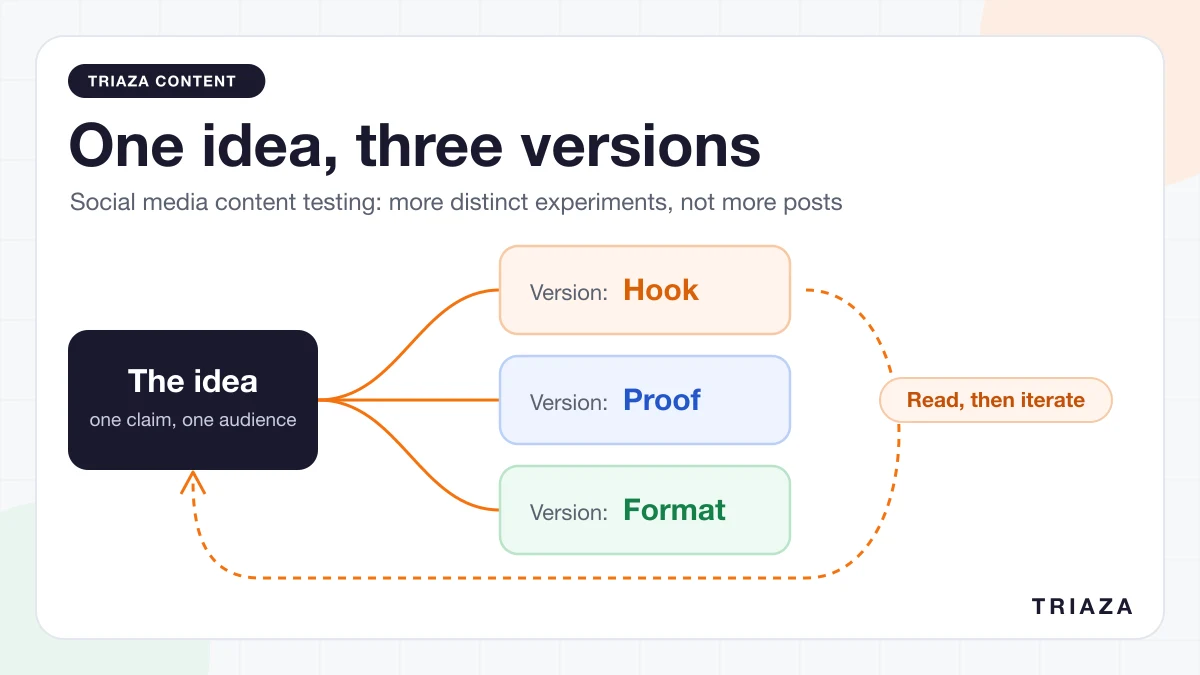
You can test social media content without paying for ads, and on feeds that pick an audience for every post, a few distinct, well-made versions of one idea teach you more than one polished post. Publish about three versions that differ in a way you can name (hook, frame, proof or format), use YouTube’s or Instagram’s built-in tests where they fit, and set the metric and decision rule before anything goes live. Keep the brand fixed, vary the execution, and aim for more distinct experiments, not more posts.
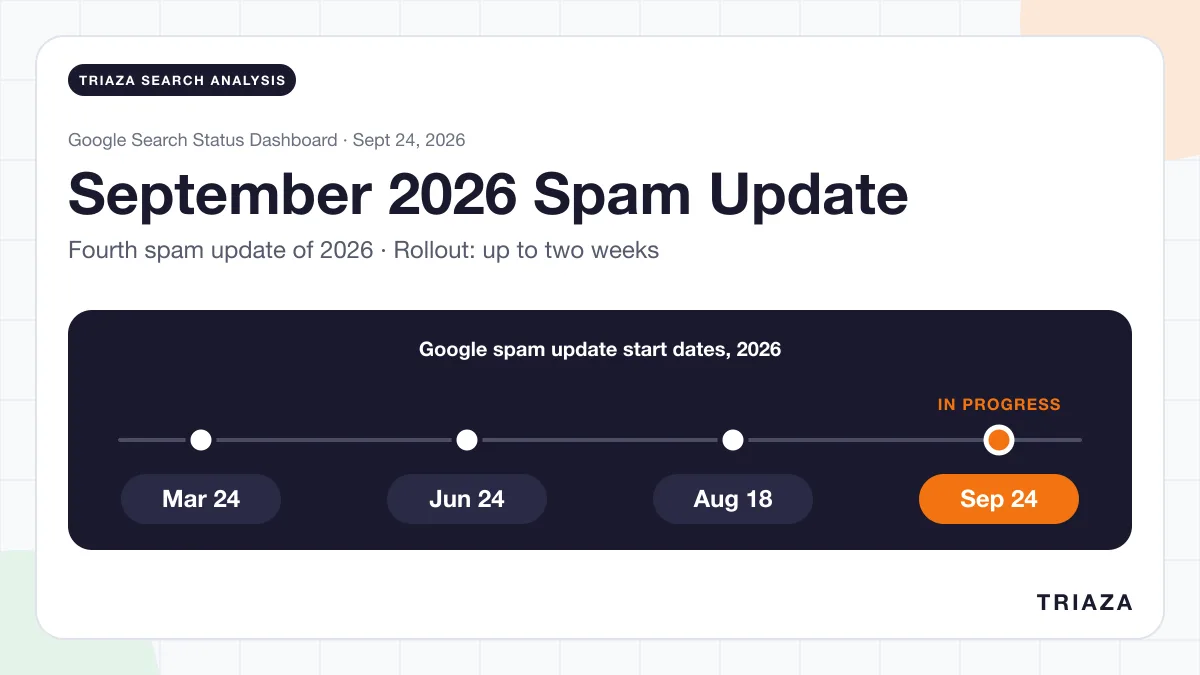
September brought news on both halves of that case. On September 23, 2026, YouTube said creators have run more than 40 million title and thumbnail experiments since the feature officially launched in 2024 (a usage count, not a result) and that testing up to three video cuts is “coming soon,” with no date (more on that timing below). On September 15, 2026, LinkedIn said its recent efforts have helped reduce views of content classified as AI slop by 40%, a category it defines as low-effort, likely AI-generated content that also includes content that feels “generic, repetitive, recycled” (self-reported, no method or time window). And TikTok’s Community Guidelines effective September 24, 2026 make “unoriginal or reused material without anything new” ineligible for the For You feed. The tools for social media content testing are getting better while recycling is getting riskier; that reading is ours.
A disclosure before the advice: Triaza sells social media services, so we have a stake in this argument. Throughout, we keep three things apart: what a platform says about its own system, what outside or vendor data found, and what we infer from both.
You Can Test Organic Posts Without Ads, Just Not Like an Ad Test
Many guides on how to A/B test social media posts borrow from paid ads, where the advertiser sets up the split. Organic posts don’t work that way: the platform picks who sees each post. YouTube’s performance FAQ (YouTube Help, accessed October 10, 2026) says its system “doesn’t promote videos to your audience but rather finds videos for your audience when they visit YouTube.” So organic social media testing has two routes: a built-in test where one exists, and rule-bound comparisons over time everywhere else.
YouTube Test & Compare Is the Closest Thing to a Clean Organic Test
YouTube Help now calls the feature “A/B test titles & thumbnails” (formerly Test & Compare). Creators test up to three titles, thumbnails or both on one video at once, in what YouTube calls “true, concurrent A/B/C tests” with no promised equal split. It optimizes “for overall watch time over other metrics, like click-through-rate,” reports results as watch time share and shows the option with the highest watch time to all viewers. A test ends as Winner, Performed Same or Inconclusive, and YouTube Help says “it’s normal not to receive a ‘Winner’ test result.”
Tests run only in YouTube Studio on a computer, on channels with advanced features, which YouTube’s feature-access page says unlock through channel history or ID or video verification. Shorts and private videos are excluded, and changing a title or thumbnail mid-test stops it. Creator Insider confirmed on July 24, 2026 that Shorts thumbnails can’t be tested; title testing went global on December 4, 2025. Two cautions on the September 23, 2026 news: the 40 million figure counts experiments run, not won (the YouTube pages we read give no Winner rate or lift), and the video-cut test is “coming soon” in that post with no date, though a same-day post from CEO Neal Mohan says creators “can now” use it, so treat its availability as unconfirmed.
Instagram Trial Reels Give You a Non-Follower Readout, Not a Verdict
Instagram announced Trial Reels on December 10, 2024. A Trial Reel goes to non-followers first, and followers won’t see it in Feed or the Reels tab. About 24 hours later the creator sees views, likes, comments and shares, plus a comparison with previous trials, and can “share with everyone.” That is an engagement readout; the page mentions no significance test or minimum sample. The one outcome figure we found from Meta, in Adam Mosseri’s June 12, 2025 post, says 40% of creators posted reels more often after trying Trial Reels and 80% of those saw more non-follower reach. That is Meta’s before-and-after analysis of more than 400,000 adopters, not proof of cause, and the same post says “performance is not guaranteed.” The post also said Trial Reels were available to everyone, but we couldn’t verify current eligibility rules, so if the Trial toggle doesn’t appear when you create a reel, check Instagram’s Help Center before assuming the feature is broken.
Where There Is No Built-In Test, Run Paired Repeats
LinkedIn’s undated Page posting one-pager says to “Post a variety of content and use ‘Update analytics’ to see what is resonating.” Our method, reasoning rather than a platform rule, is paired repeats: run each version at least twice in comparable slots (same account, weekday and hour), alternate which goes first, and judge across both rounds. One comparison is a hint. The same result twice is a decision. Even a paid split is less clean than it looks: an August 28, 2025 preprint by mostly Meta-affiliated authors studied 181,890 Meta A/B tests and 3,204 Lift tests and found clear audience imbalance in the A/B tests but no meaningful imbalance in the Lift tests, so a Meta A/B winner can partly reflect who saw it. If you later boost an organic winner with paid spend, remember how little a small paid test can prove.
How Many Versions to Post: Three That Differ in a Way You Can Name
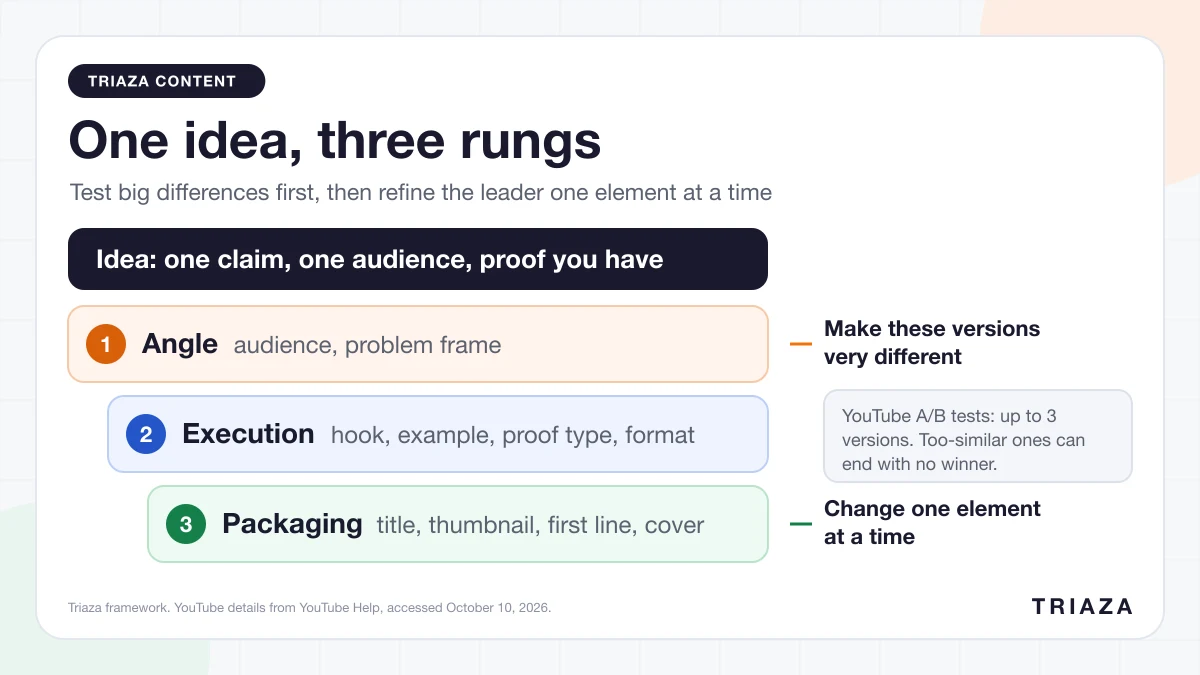
Start with three. YouTube’s test caps at three variants; three gives one baseline and two challengers, and is small enough for a lean team to make well (our reasoning, not YouTube’s). Then make them different. YouTube Help says to “Run diverse A/B tests,” because too-similar variants can run longer, and “Minimal difference in titles or thumbnails” is a listed reason for no Winner. Three is a default, not a quota; our startup content playbook already says don’t force an arbitrary number of derivatives.
Change the Angle First, Then Fine-Tune the Winner
The idea comes first, and it should be one you could lose: one sentence a reader could disagree with, plus the audience it is for and the proof you have. “Thought leadership on fleet maintenance” is a topic; “missed maintenance windows are usually a scheduling problem” is an idea. Then climb a ladder. Rung one is the angle (audience, problem frame); rung two the execution (hook, example, proof type, format); rung three the packaging (title, thumbnail, first line, cover). Make rung-one versions very different, and isolate single elements once a version leads; “change one variable at a time” is rung-three advice. Build versions from different source material or from a variable you chose on purpose, and have a person review each one. Our AI content systems guide covers studies where AI-assisted writing came out more alike across writers, so we would expect one prompt asked for ten rewrites to return near-copies (our inference). If you can’t name the variable that changed, you have a duplicate.
Your Favorite Draft Is a Hypothesis
The case for testing rather than choosing rests on how often confident people are wrong. Kohavi and Thomke wrote in Harvard Business Review, September-October 2017 that at Microsoft one-third of experiments proved effective, one-third neutral and one-third negative, and that at Google and Bing only about 10% to 20% produced positive results (website and product tests at very large companies). In a megastudy in PNAS on February 1, 2022, Milkman and colleagues tested 22 text-message interventions on 689,693 pharmacy patients. Neither the 24 scientists who designed them nor 406 lay raters anticipated the best performer, and the scientists’ predictions didn’t correlate with results (r = 0.03) while the lay raters’ did (r = 0.60), though the paper calls the difference between the two correlations only marginally significant. That is health messaging, and it says credentials didn’t help, not that experts can’t predict.
This is where MrBeast belongs, as an example rather than the foundation. Chucky Appleby, who makes MrBeast’s thumbnails, said on Creator Insider on March 7, 2024 that the team probably comes up with “like 50 concepts per video, which is excessive,” is trying to get to about three for YouTube’s A/B test, and that testing is “kind of killing my personal biases”; a strong idea, he said, comes first. MrBeast wrote on X on September 6, 2023 that since he can now A/B test thumbnails, “I don’t have to guess and I just test and see what people want.” Mark Cuban said at WIRED’s Big Interview on December 3, 2024 (video posted December 4, 2024) that MrBeast “basically said” he spends millions reverse engineering each platform’s algorithm: Cuban’s paraphrase of a private conversation, with no MrBeast confirmation found, recapped by Barchart on October 9, 2026. And the limit: MrBeast is quoted in TIME on January 23, 2024 saying “My videos cost millions to make.” He is evidence for testing the packaging of a strong idea, not for cheap volume.
Our inference: use the team’s judgment to generate and shortlist, then let audience response pick among the finalists.
How Long to Run a Social Media Test: A Day for a Readout, Weeks for a Decision
The platforms give different clocks. YouTube Help says a test “can take a few days or up to 2 weeks to complete,” “should be completed within two weeks,” and is less likely to produce a Winner on low-impression videos. Trial Reels read out at about 24 hours. TikTok’s Creator Academy (last updated August 18, 2026) says that when you try new formats or topics, you should review performance over a few weeks rather than after one or two posts, and that a shift in engagement “doesn’t always mean your content is failing.” YouTube also says results for the same video can differ between tests, “similar to flipping a coin,” and as the audience changes. That variability is why paired repeats ask for the same result twice before you call it a decision.
Write the Test Card Before Anything Goes Live
One card per idea, filled in before the first version ships. It is a Triaza template.
- Idea: one claim you could lose, and who it’s for.
- Fixed: the claim, voice and distinctive assets every version keeps.
- Variable: the rung being tested, in a word or two.
- Versions: A, B and C in one line each.
- Where and how: YouTube’s A/B test, a Trial Reel or paired repeats, with the slots.
- Primary metric: one per platform, chosen before posting.
- Window and rule: the read date, the bar to graduate and the floor to kill.
- Learning: one dated sentence you would reuse, written at review.
Graduate, Iterate or Kill on Rules You Set in Advance
- Graduate: the leader clears its bar in both rounds, or wins the native test. It goes to followers (Instagram’s “share with everyone”) and becomes next month’s base.
- Iterate: a clear leader on angle earns execution-level versions, for example three hooks on the winning angle.
- Kill: below the floor in both rounds. No clear winner is normal (YouTube names two kinds of no-Winner result, Performed Same and Inconclusive), so one weak post never kills an idea.
Quality vs. Quantity on Social Media Is the Wrong Debate
Our reading: quality is the price of entry, extra posts mostly buy more chances at an outlier, and extra copies buy nothing. The sources come first, and the platforms’ own advice cuts both ways.
YouTube’s performance FAQ (accessed October 10, 2026) answers “Do I need to upload daily or at least once a week?” with the finding that “growth in views across uploads is not correlated with time between uploads,” adding that many creators built audience connections through “quality over quantity” (a description of creators, not a directive). The same page lists “Uploading less frequently than usual” among reasons for drops in recommended traffic and says to “always keep experimenting with new topics and formats.” TikTok’s Creator Academy (last updated September 10, 2026) says a steady stream of high-quality content beats rushing out daily updates and that “your exact posting cadence is totally up to you,” though the same page also says posting frequently and optimizing on your top videos is the best way to keep growth going, and another page (last updated August 18, 2026) calls posting across too many topics, hoping one sticks, a mistake. Variation belongs inside one topic.
The frequency data points two ways inside one vendor. Buffer’s October 8, 2025 TikTok study of 11.4 million posts from more than 150,000 accounts found median views roughly flat across posting tiers (489, 506, 487 and 459 for 1, 2 to 5, 6 to 10 and 11 or more posts a week) while 90th-percentile views rose from 3,722 to 14,401: more posting “doesn’t necessarily raise the floor, but it does raise the ceiling.” Its within-account analysis found views per post up to 17%, 29% and 34% higher at the three higher tiers than at one post a week. It is observational data with no calendar dates on the page, and its “isolates the effect” wording leans causal. Buffer’s March 5, 2026 report then said its 15.7 million-post analysis “suggests that reach per post tends to decline at higher frequencies,” and that it cannot say posting more causes higher engagement.
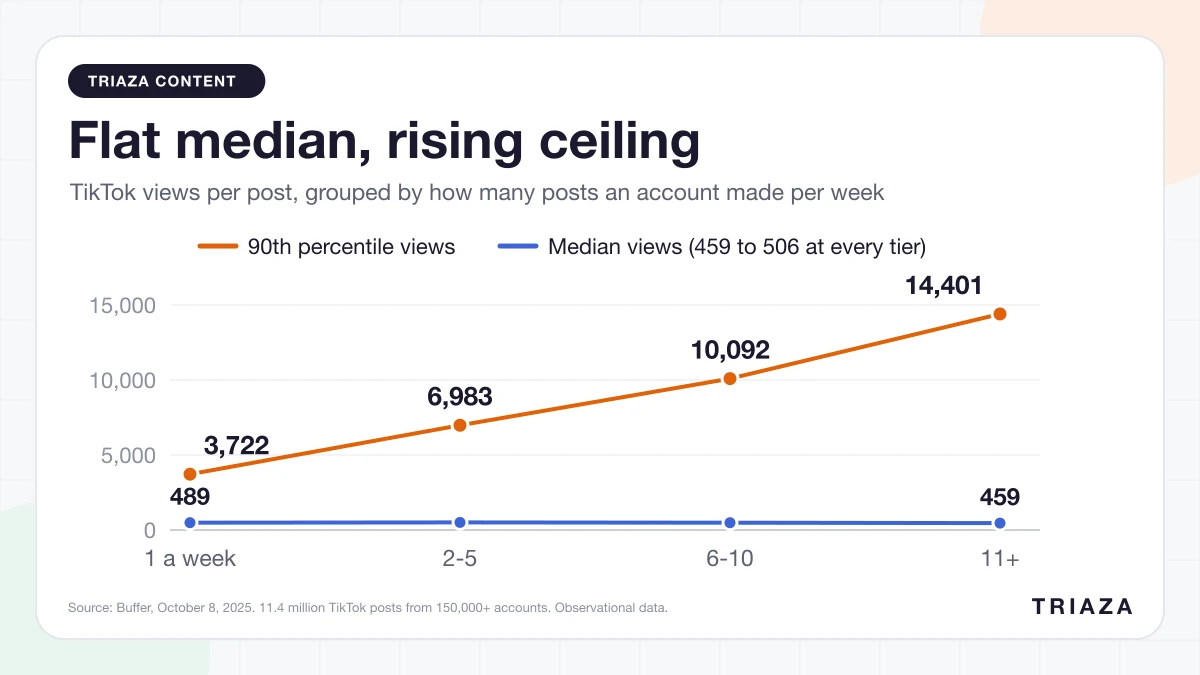
Our inference: each distinct version is a new draw at that ceiling, and a near-copy isn’t. YouTube says testing too-similar variants can make a test run longer, and TikTok’s Safety Center (undated) says its For You ranking ends with a “similarity check” that swaps out top-ranked videos too alike to each other in a viewer’s feed. Neither source draws that conclusion; we do.
How Often Should a Business Post on Social Media? Treat Benchmarks as Test Bands
No platform page we read gives one agreed number, vendor guides can disagree by a multiple (LinkedIn shows the widest gap), and a lean team should pick a band it can sustain on one or two platforms with every post still distinct. LinkedIn’s own pages disagree: its Pages best practices tie weekly posting to a 2x engagement lift, its posting one-pager says “Work toward posting at least once a day,” and its small-business plan recommends “1-2 times per day,” all undated, none with a method.
The figures below come from Hootsuite (August 7, 2026), Buffer (January 13, 2026) and Quid’s benchmark report (March 5, 2026), which reports the median posting of 150 randomly selected companies in each of 18 industries. The first two are guidance and the third is observed behavior; none is evidence of what maximizes reach. Hootsuite’s page also carries a unit conflict of its own: its text says “minimum posts per week” while its table gives per-day figures for Facebook and LinkedIn.
| Platform | Hootsuite minimum / Buffer | Brands’ median (Quid) |
|---|---|---|
| 3 to 5 a week / 3 to 5 a week | 3.69 a week | |
| TikTok | 3 to 5 a week / 2 to 5 a week | 1.98 a week |
| 1 to 2 a day / 2 to 5 a week | Not covered | |
| 1 to 2 a day / 1 to 2 a day | About 3 a week |
Timing is the same story, which brings back the Tuesday carousel. Sprout Social (March 31, 2026) lists Tuesday 11 a.m. to 5 p.m. among its LinkedIn windows, in each audience’s local time; Buffer’s 4.8 million-post study (September 9, 2026) puts Wednesday 4 p.m. on top and Tuesday near the bottom. Different datasets, and neither tested why. Hold timing constant inside a pair instead of chasing a slot.
Posting steadily has better support than posting more. Willow, a LinkedIn content vendor, reported on March 16, 2026 from 488 B2B company pages that pages posting twice a week nearly every week got slightly fewer impressions per post than pages posting once a week nearly every week (237 versus 250) but 59% more per year; correlational, no controls. Our recommendation: start at the low end of the bands on one or two platforms, run one idea a month through the test card, and test one step up only if every post can still be distinct. A five-channel launch usually gives a small team five neglected accounts, and our 2026 startup marketing budget guide argues for funding one demand engine deep.
Run One Idea a Month Inside That Band
This is the routine a two-person team can keep, and it is ours rather than a platform’s. It fits TikTok’s advice to judge over a few weeks and YouTube’s two-week test window.
- Week 1: pick the idea, fill in the test card and make three versions. Start the YouTube test, post the Trial Reels (read them at about 24 hours) and run the first round of paired repeats everywhere else.
- Week 2: run the second round of repeats with the order reversed. Share the leading Trial Reel with everyone.
- Week 3: read the YouTube result, since YouTube says tests should finish within two weeks, and draft execution-level versions of the leading angle.
- Week 4: hold the monthly review (graduate, iterate or kill), write the one-sentence learning on the test card and choose next month’s idea.
Will Testing Hurt Your Brand? Not if the Brand Platform Stays Fixed
Two fears hide inside this question. One is looking spammy, which is about duplication. The other is looking scattered, which is about the brand’s fixed layer.
Variation Is Not Duplication: What the Originality Rules Target
On April 30, 2026, Instagram extended its Reels originality protections to photos and carousels: accounts that mostly post unoriginal content are no longer shown where Instagram recommends content, and adding only a border, watermark, subtitles or a credit to someone else’s post doesn’t make it original. On March 13, 2026, Meta said Facebook deprioritizes content duplicative of, or minimally edited from, another creator’s post. TikTok’s guidelines, effective September 24, 2026, make “unoriginal or reused material without anything new” ineligible for For You. LinkedIn’s September 15, 2026 post defines AI slop to include content that feels “generic, repetitive, recycled” (its 40% cut in views of content classified as AI slop is self-reported), and its Help Center says the tip an author may see in Post analytics after enough member feedback “does not mean that your post was taken down.”
| Platform | What it targets |
|---|---|
| TikTok (effective September 24, 2026) | Reused material “without anything new.” Each version should add something. |
| LinkedIn (September 15, 2026) | Content it calls AI slop, including generic, repetitive, recycled posts. Each version should say something new. |
| Instagram (April 30, 2026) | Accounts that mostly post other people’s work, so it is aimed at aggregators. |
| Facebook (March 13, 2026) | Duplicates or minor edits of another creator’s post, so it is aimed at reposters. |
| YouTube (Help, accessed October 10, 2026) | Test variants too similar to pick a winner, which makes tests run longer. Keep variants diverse. |
Our inference: none of these rules addresses a brand posting several distinct versions of its own idea. They target other people’s content, reused material and generic repetition. Silence is not endorsement. The safe test follows: every version must add something you can name.
Brand Consistency on Social Media Means a Fixed Brand Platform, Not Identical Posts
The fear of looking scattered is the one the brand literature takes seriously. In Brands of Distinction (Ehrenberg-Bass Institute, undated, around 2013), Jenni Romaniuk writes that a distinctive asset must be unique and famous, that each exposure builds it only when the identity is consistent, and that inconsistency in colors, fonts and logos is the enemy; Ehrenberg-Bass colleagues Phua and Hartnett say to be “creative (but consistent)” with assets. Both were written about packaging, retail and advertising, not social feeds. Romaniuk adds a complication: in a summary of her May 2018 Admap article, she argues the more attention-grabbing the creative, the harder the branding has to work. Our reading is that every novel hook raises the branding burden on that version. TikTok’s Creator Academy (last updated August 18, 2026) tells creators changing direction to keep one or two recognizable elements, like an intro line or on-camera energy, while experimenting.
Our split is in the figure below. It borrows the claims-versus-look distinction from style guide vs. message blueprint, and our brand voice post treats voice as a constant and tone as a variable.
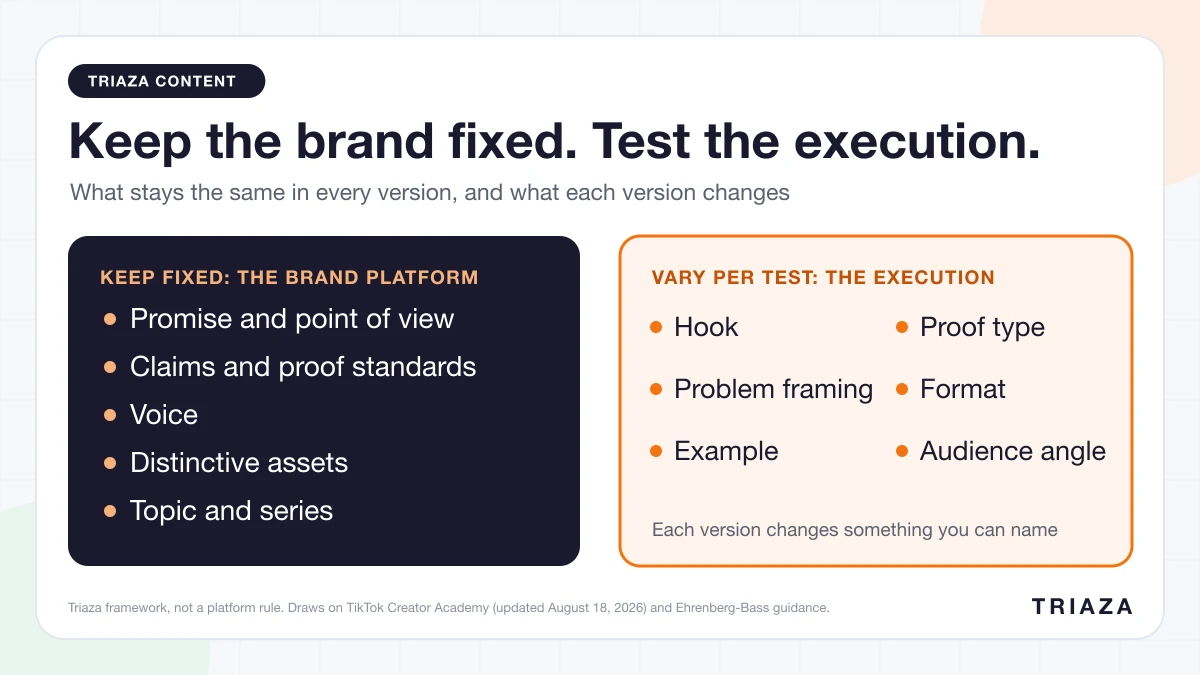
If your team can’t agree on what belongs in the fixed layer, settle that before anyone writes a version. A message blueprint pins down what you claim, to whom and with what proof, and a style guide sets the visual and verbal rules, so everything else is free to change.
How Social Media Algorithms Work in 2026: Each Post Has to Find Its Own Audience
Every major feed we checked now includes recommended posts from accounts you don’t follow, and each platform says it ranks by predicted or observed response from the people shown a post. Apart from X, none we checked publishes numeric weights. That is the mechanism behind everything above: a different version of the same idea can reach a different set of people. Instagram’s “Your Algorithm” topic controls went live across Feed, Reels and Explore on June 10, 2026: evidence that interests are user-steerable, not that variation wins. In Mosseri’s September 2026 ranking series, the Part 2 caption (September 9, 2026) says Instagram tries to value originality, recency and “breaking content.” Social Media Today (September 24, 2026) describes breaking content as showing small creators’ posts to non-followers to gauge response, and relays his advice to experiment, including with Trial Reels; both are its paraphrase, since we read the captions, not the videos. X publishes default ranking weights in its repository (added August 13, 2026), and a README note added August 14 warns that they multiply predicted probabilities and are not count equivalences.
Our inference: no platform promises that every follower sees every post, so each version has to earn its own audience.
What the LinkedIn Algorithm Means for B2B Posts
LinkedIn’s engineering post of March 12, 2026 says the Feed balances network, followed and suggested content, including posts from “professionals you’ve never connected with before,” and ranks “millions of posts at any given time.” Its retrieval research (arXiv, October 16, 2025; AAAI-26, March 14, 2026) describes a language-model retriever that represents members and posts from text alone, narrowing a pool in the millions to roughly a thousand or two candidates; gains were small, largest for members with fewer connections, and self-reported. Its ranking paper (Feed SR, version 3, September 16, 2026) describes a model that has served most Feed traffic and optimizes for actions including “Long Dwell” and “Contribution” (a like, comment or share). Ignore two pieces of lore: 360Brew is a withdrawn paper about a pre-production model, and we found no “golden hour” in LinkedIn’s own publications, only a May 12, 2020 post defining dwell time.
Our inference: because retrieval matches post text to member interests, the same expertise framed for an operations manager and for a CFO gives the system two texts to match. State the problem, role and specialty plainly, and test frames per buyer. Our post on marketing AI companies makes a related case for naming the job and writing separate reading paths for technical evaluators and economic buyers.
Judge the Set of Versions, Not the Single Best Post
Pick one primary metric per platform before you post, and make it a rate where you can.
- YouTube: watch time share inside the A/B test. Elsewhere compare engaged views and retention, and don’t compare raw view counts across the August 24, 2026 counting change.
- Instagram: average watch time, likes per reach and sends per reach, the three Mosseri named on January 21, 2025, with no multiplier given; for Trial Reels, the comparison against your previous trials.
- LinkedIn: the ranker optimizes dwell and contributions, so read comments from the roles you sell to above raw reactions (our inference, not LinkedIn’s).
- TikTok: its Help Center (undated) says that for most users, user interactions, which may include time spent watching, are generally weighted more heavily than other factors; we found no completion-rate threshold in TikTok’s own pages.
Then score the month rather than any one post. This is Triaza’s scorecard, not an industry standard:
- Decision rate: the share of idea tests that end in a graduate or kill decision you act on.
- Non-follower share: where the platform reports it.
- Qualified actions per idea: site visits and quote or demo requests logged in your CRM and tagged to the idea.
- Hours per tested idea: our version of a cost per creative discovery.
Expect neutral results: YouTube calls no Winner “normal,” and the Kohavi and Thomke base rates above suggest most confident ideas don’t win. Reasoning, not a sourced fact: reach from separate posts overlaps, so adding it up overstates how many people you reached. Our guide to measuring content performance covers the habits that keep this honest: show the denominator, and treat weekly flags, monthly trends and quarterly decisions as different things.
What a Test Looks Like for a B2B Startup and a Local Service Business
Hypothetical B2B Example: A Fleet-Maintenance Software Startup
This example is hypothetical. It describes a test design and claims no reach, engagement or pipeline result.
A small startup sells maintenance-scheduling software to regional trucking fleets on LinkedIn and a YouTube channel of recorded webinars. Its idea, a claim it could lose: missed preventive-maintenance windows are usually a scheduling problem, not a shop problem. Fixed: the claim, the founder’s voice and one visual template. Version A is the operator angle, a founder post about a Monday dispatch scramble when a service window collides with a load. Version B is the owner angle, the cost of an unplanned out-of-service day, using the company’s own average. Version C changes proof and format: a document post walking through an anonymized before-and-after maintenance calendar.
On YouTube, the webinar on the same idea gets three titles, one per angle, in YouTube’s A/B test, judged by watch time share. On LinkedIn, the founder runs paired repeats over weeks 1 and 2, same weekday slot, order alternated, and each version states the role and the problem plainly because suggested content reaches strangers. The read-out, set in advance: comments from people in fleet operations or ownership roles as primary, with profile visits and demo requests in the CRM as secondary. One conditional decision: if C draws fewer reactions than A but most of its comments come from fleet managers asking how the calendar works, C graduates and next month tests three opening lines on C.
Hypothetical Local Example: A Pest Control Company
This example is also hypothetical. It claims no views, calls or revenue.
A two-truck pest control company posts phone-shot Instagram Reels and TikToks. Its idea, from its own observation: most spring ant problems start at an entry point outside the house. Fixed, following TikTok’s advice to keep recognizable elements: the same technician on camera, uniform and truck visible early, an opening line naming the company and a sign-off naming the service area. Version A is a demo hook: the technician walks the foundation and points out the trail in the first seconds. Version B pitches the same inspection to landlords and property managers. Version C is a carousel checklist of entry points.
On Instagram, A and B go out as Trial Reels. The owner reads them at about 24 hours and shares the leader with everyone; the primary metric is sends per reach and average watch time. On TikTok, A and B run as paired repeats over two to three weeks in the same slot, with original footage only. The business read-out is calls and quote requests from the service area, logged in the CRM with the source noted. If A wins on Instagram sends but B wins on TikTok watch time, both graduate on their own platform, and next month tests three hooks on each. The same structure fits a home contractor’s seasonal offer.
What the Evidence Does Not Support
No study in this research tests three versions against one polished post, and every frequency and timing dataset above is observational vendor data.
Nothing here shows that posting more causes higher reach per post. Buffer’s March 2026 report says its analysis suggests reach per post tends to decline at higher frequencies, Willow saw a small per-post dip at twice a week, and YouTube found no correlation between upload gaps and view growth.
No platform has been shown to reward, or punish, distinct versions of your own idea. The originality and slop rules target other people’s content and generic, recycled output. Their silence on a brand’s own distinct versions is what we build on.
Testing itself has not been shown to lift results, and nothing shows the native tests are lab-grade. YouTube reports usage, not lift, and Meta’s Trial Reels figures come from a before-and-after analysis of adopters. Trial Reels run no significance test, YouTube’s results shift with the audience, and paid Meta tests can show each version to a different mix of people.
The popular statistics do not hold up either. The “brand consistency raises revenue 23%” figure comes from a 2016 vendor-sponsored survey of hypothetical estimates from respondents who already had inconsistent branding, not a measured effect. We found no golden hour in LinkedIn’s own publications, its Feed engineering post and ranking paper never name 360Brew, no Instagram source we found gives a numeric multiplier for sends over likes, and X’s repo warns against reading its weights as count equivalences, such as one report cancelling out 468 likes.
And MrBeast does not prove cheap volume works. His documented volume is in thumbnail concepts for videos that cost millions.
What would change our view: platform data showing similar variants separate as often as distinct ones, or lift data showing channels that test grow no faster than channels that don’t.
When One Polished Post Is Still the Right Call
When the post must say one exact thing (a regulated claim, an incident update, a launch), write it once and carefully. When reach is too thin for a difference to show, YouTube’s note applies: low-impression videos are less likely to get a Winner. And when the idea itself is the bet, remember that Appleby put the idea ahead of the packaging, and that variants which drift far from the brand raise the branding burden on each.
If you’d rather hand the day-to-day to a team, our social media work covers strategy, content creation, platform-specific marketing, community management, and the analytics and reporting that guide what comes next. The broader marketing strategy service fits better when the real question is which platforms deserve the budget at all.
Frequently Asked Questions About Social Media Content Testing
Is it better to post every day or focus on quality on social media? Quality first, then distinct versions at a cadence you can sustain. YouTube Help (accessed October 10, 2026) says growth in views across uploads is not correlated with time between uploads, and TikTok’s Creator Academy (last updated September 10, 2026) says a steady stream of high-quality content beats rushing out daily updates. Buffer’s October 8, 2025 study of 11.4 million TikTok posts found median views roughly flat across posting tiers while 90th-percentile views rose; it is observational.
Can you A/B test organic social media posts without paying for ads? Yes, within limits. YouTube’s built-in test compares up to three titles, thumbnails or both on eligible videos in desktop YouTube Studio and picks by watch time share; Shorts are excluded as of October 10, 2026. Instagram’s Trial Reels, announced December 10, 2024, show a reel to non-followers first and report after about 24 hours, an engagement readout rather than a statistical test. Elsewhere, post versions in comparable slots, repeat each comparison and judge over a few weeks.
How many versions of the same post should I test? About three, each differing in one way you can name, such as the audience angle, the hook or the proof. YouTube’s A/B tool caps tests at three, and YouTube Help says too-similar variants can run longer and are a listed reason a test ends without a Winner. Chucky Appleby, who makes MrBeast’s thumbnails, said in March 2024 that his team narrows about 50 concepts to about three for YouTube’s test, a big-budget operation. Three is our default, not a platform rule.
How long should a social media A/B test run? It depends on the tool. YouTube Help (accessed October 10, 2026) says a title or thumbnail test can take a few days or up to two weeks, and low-impression videos are less likely to get a Winner. Instagram’s Trial Reels report after about 24 hours. TikTok’s Creator Academy (last updated August 18, 2026) says to review performance over a few weeks rather than after one or two posts when you try a new format or topic. YouTube also says results for the same video can differ between tests, similar to flipping a coin, so set the read date before posting and repeat a win before you scale it.
Can you post the same content multiple times on social media? Near-identical reposts are the risky case. TikTok’s guidelines, effective September 24, 2026, make reused material without anything new ineligible for For You, and LinkedIn said on September 15, 2026 that it limits distribution of content it classifies as AI slop, a category of low-effort, likely AI-generated content that it says includes content that feels generic, repetitive or recycled. Instagram’s April 30, 2026 and Facebook’s March 13, 2026 originality rules target reposting other people’s work. None of these rules addresses a brand’s distinct versions of its own idea, which is our reading.
How often should a small business post on social media? No platform page we read gives one agreed number. TikTok says the cadence is up to you, and LinkedIn’s own pages say weekly, daily and one to two times a day in different places. Hootsuite (August 7, 2026) lists three to five Instagram posts a week as a minimum, and Buffer (January 13, 2026) suggests the same range, but they disagree on LinkedIn (Hootsuite’s table says one to two a day, though its own text calls the figures weekly minimums; Buffer says two to five a week). Pick a band you can sustain on one or two platforms and keep every post distinct.
Does brand consistency still matter if you keep testing new hooks and formats? Yes, at the brand level rather than the post level. The Ehrenberg-Bass Institute’s Brands of Distinction (undated, around 2013) says an asset builds only when its identity stays consistent, and a summary of Jenni Romaniuk’s 2018 Admap article says the more attention-grabbing the creative, the harder the branding has to work. Both were written about packaging, retail and advertising, not social feeds. So keep the promise, voice and distinctive assets fixed, and vary the hook, frame, proof and format. TikTok’s Creator Academy (last updated August 18, 2026) gives creators changing direction a similar tip: keep one or two recognizable elements, such as an intro line.
How does the LinkedIn algorithm work for B2B posts? LinkedIn’s March 12, 2026 engineering post says the Feed balances network, followed and suggested content, including posts from professionals you have never connected with. Its retrieval research matches text about members with post text, and its Feed SR paper (revised September 16, 2026) says the Feed’s optimized actions include long dwell and contribution, meaning a like, comment or share. We found no golden-hour rule in LinkedIn’s own engineering posts or papers. State the problem and the buyer plainly, and test frames per buyer.
Polish the Idea, Then Test the Execution
The two-week carousel’s problem isn’t the polish. All of that effort goes into one guess about how strangers will respond, and the feed answers with a few dozen reactions, most of them from inside the company.
Put the polish into the idea and the fixed brand layer. Then write three versions that disagree about how to say it, let the people each platform shows them to settle it, and repeat next month with a sharper question. Social media content testing, done that way, is a monthly habit rather than a project.
That won’t make every post land. It does mean each month ends with something you know that you didn’t know before.