AI companies often have plenty to say about models, infrastructure, agents, evaluation, and safety. Buyers still have a more basic question: can this product do a specific job under the conditions that matter to us?
The gap appears when a product claim asks the buyer to make too many translations. A claim such as “advanced reasoning” may be meaningful to the product team, but an engineering evaluator needs to know which tasks were tested. A security reviewer needs to know where data goes. An economic buyer needs to know what changes in the workflow, what remains uncertain, and what the organization must supply.
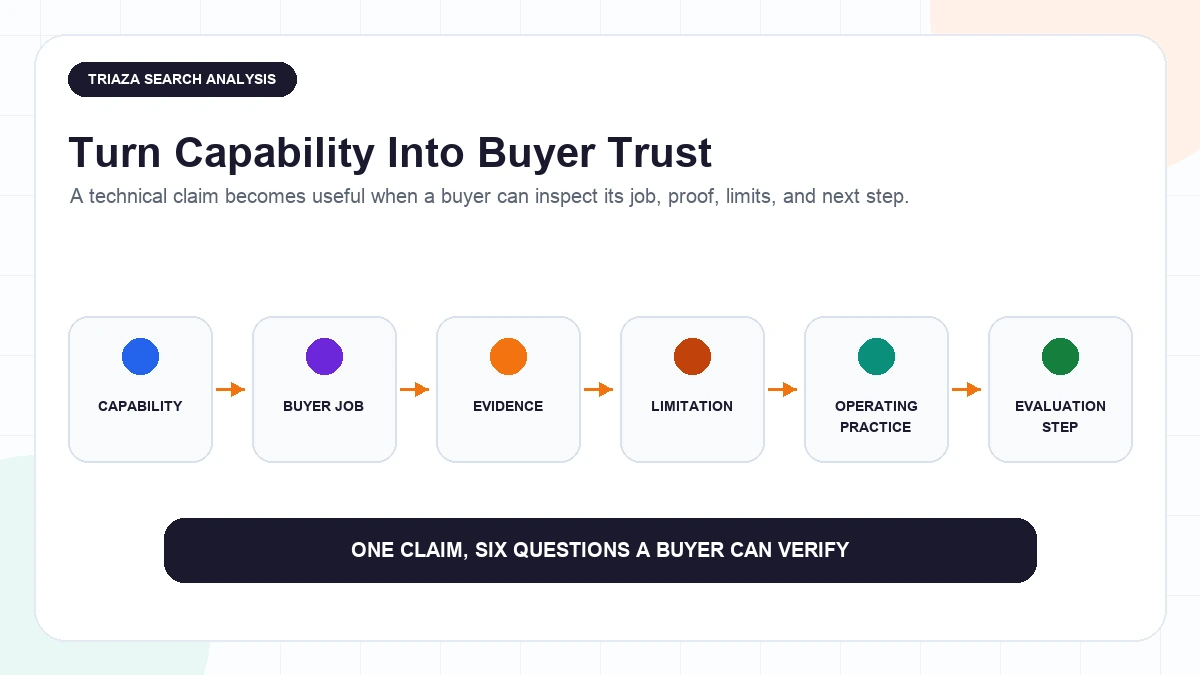
Marketing for AI companies builds buyer trust by connecting a technical capability to a specific job, relevant evidence, material limitations, operating safeguards, and a clear evaluation step. Each claim should help technical evaluators and economic buyers understand what was tested, where it applies, what remains uncertain, and how to verify fit.
That standard does not require exposing proprietary methods or publishing every internal document. It does require deciding which information a buyer needs in order to judge the claim being made. A polished capability statement without that support creates more evaluation work. A precise claim with bounded evidence gives the buying group something it can inspect, question, and share.
The Trust Problem Is A Translation Problem
AI product teams tend to organize knowledge around the system. They think about model choice, context handling, retrieval, tools, orchestration, evaluations, latency, security controls, and release changes. Buyers organize the same purchase around a job and its consequences. They think about whether the product fits the workflow, which data it touches, what failure looks like, who monitors it, and how a decision can be defended internally.
Both views are legitimate. Marketing has to connect them without flattening either one.
When the connection is missing, technical language starts carrying more weight than it can support. “Enterprise grade” substitutes for named controls. “Accurate” appears without a task, test set, comparison, or error definition. “Secure” is presented as a product property even though the buyer also needs to understand deployment, access, retention, and operational responsibilities. “Autonomous” hides where human review still belongs.
Technical detail needs a job. A model name matters when it affects inputs, constraints, evaluation, or implementation. An architecture diagram matters when it clarifies data flow, controls, or dependencies. A benchmark matters when its task resembles the claim and its limits are clear.
A useful first edit puts the buyer’s job before the mechanism:
- “Classifies inbound support requests into the team’s existing categories” gives the reader a task to evaluate.
- “Uses retrieval to draft an answer from approved policy documents” defines both the action and the source boundary.
- “Flags contract clauses for a reviewer” identifies the human decision point.
- “Generates code changes for a developer to inspect and merge” makes review part of the workflow instead of hiding it.
The mechanism can follow. The buyer can then judge whether it fits that job.
If a system performs well on a narrow task, say so. If performance changes with language, document quality, request complexity, or connected tools, put those conditions near the claim.
Buyers Build A Position Before The Sales Call
Many AI companies write as if the website has one purpose: earn a demo. The site also supports internal research before anyone agrees to a meeting. A product page, technical guide, evaluation note, security overview, and customer example may circulate among people who never visit the site together.
The 6sense 2024 Buyer Experience Report release summarizes a vendor-authored survey of 2,509 recent B2B buyers. Respondents reported an average 11.3-month buying cycle and an 11-person buying group. The report says respondents were nearly 70% through the process before seller engagement, initiated contact more than 80% of the time, had a preferred vendor in 81% of cases, and had largely set requirements in 85%. The public methodology omits field dates, sampling, weighting, question wording, and margin of error, so these findings should not be treated as universal buyer behavior or evidence that any content tactic causes a purchase.
The useful point is narrower. A buyer may form requirements and preferences before the vendor can explain a vague claim in conversation. Marketing therefore has to survive independent reading.
That changes what a page needs to do. A visitor who sees “best in class reasoning” cannot tell whether the claim matters to their workflow or which evidence supports it. A visitor who sees the target task, relevant evaluation conditions, known limits, and a way to test the product can carry a more useful summary to the rest of the group.
Forrester reported that in its 2023 survey of more than 18,000 global business buyers, 89% cited one or more reasons a purchase had stalled. Its public summary says price topped information priorities, product experts were the most influential people in the buying cycle, and vendor presentations topped content influence for complex purchases. These are survey findings, not causal or universal claims, and the public page omits sampling, weighting, field dates, margin of error, and question wording.
An AI company should read those findings as a prompt to examine the buyer’s information path, not as a formula for closing deals. Can someone find price structure or the variables that affect price, if the company has approved that information for public use? Can a product expert answer a precise evaluation question without turning the exchange into a generic demo? Can a presentation preserve the limitations that matter? Can the internal champion show the economic buyer what will change operationally?
Technical Evaluators And Economic Buyers Need Different Views
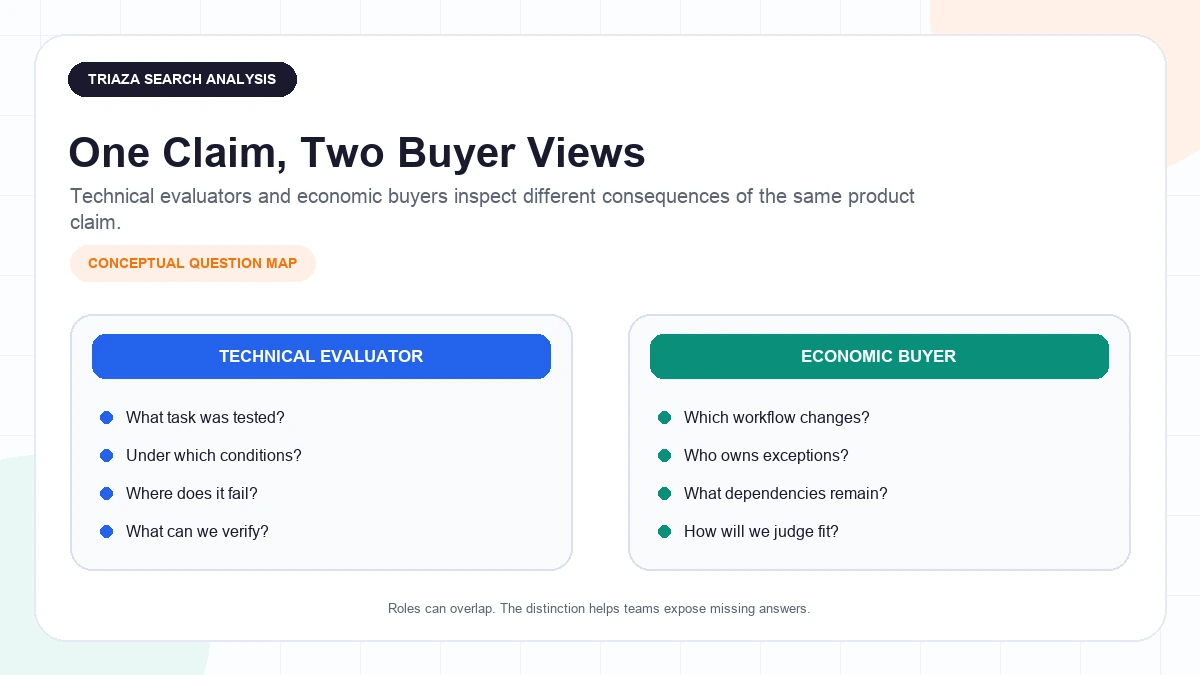
One narrative can serve the whole buying group, but one page rarely answers every question at the same depth. Technical evaluators and economic buyers usually inspect different consequences of the same claim.
A technical evaluator may ask:
- What task does the system perform, and what input does it require?
- Which model or system configuration produced the reported result?
- What evaluation procedure was used?
- How representative were the test conditions?
- What happens on ambiguous, adversarial, unsupported, or out-of-scope inputs?
- How are data, permissions, tools, and logs handled?
- Where is human review required?
- What can the buyer test in its own environment?
An economic buyer may ask:
- Which workflow changes if the product works as described?
- Which team owns setup, review, and exception handling?
- What business cost or risk is the company trying to reduce?
- Which dependencies could delay adoption?
- How will the organization decide whether the product is good enough?
- What happens when the system is wrong?
- Which ongoing costs and responsibilities remain with the buyer?
These are not fixed roles. A founder may ask both sets. A security reviewer may care about operational cost. A finance leader may ask how error rates were measured. The distinction is useful because it catches a common messaging failure: giving the economic buyer a model lecture while giving the technical evaluator an outcome promise with no inspectable evidence.
Start from one shared claim, then create two reading paths. Suppose the product drafts answers for a support team from an approved knowledge base.
The technical path might explain retrieval boundaries, citation behavior, evaluation categories, unsupported-question handling, access controls, and the handoff to a human. The economic path might explain which support queue is in scope, which work remains with agents, which quality threshold governs rollout, how exceptions are reviewed, and which inputs the buyer must maintain.
Both paths should use the same nouns and scope. If one page says the product “resolves support requests” while another says it “drafts suggested responses,” the buying group has to decide which description is true. Message consistency matters because the claim itself defines the evaluation.
An Ipsos online survey fielded August 29 and 30, 2023, and published in April 2024 asked 586 US adults who used or purchased software at work about AI in workplace software. In that US English-language online sample, 69% said they wanted to know whether software used at work contained AI. This reports a stated transparency preference in one sample, not a current population estimate, observed buying behavior, or proof that disclosure changes purchase decisions.
The marketing implication is not that an AI label creates trust. The product description should tell the buyer where AI is involved when that fact affects evaluation, risk, workflow, or expectations. The useful disclosure names the role the system performs and the decision boundary around it. A badge that says “AI powered” adds little by itself.
Use A Six-Part Capability-To-Trust Chain
The following framework is Triaza’s editorial synthesis. It is not an industry standard, a regulatory requirement, or a source-proven conversion formula.
- Capability
- Buyer job
- Relevant evidence
- Material limitation
- Operating practice
- Next evaluation step
Run every important product claim through all six parts before it becomes a headline, sales slide, campaign, case study, or launch post.
1. Name The Capability Precisely
Describe what the system does in observable terms. Avoid starting with an adjective.
“Understands complex documents” is difficult to inspect. “Extracts named fields from uploaded insurance forms” is narrower and gives the buyer something to test. “Reasons across company data” could mean retrieval, calculation, classification, summarization, or tool use. Name the action, input, and output.
Capability language should also distinguish the product from the underlying model. If the product adds retrieval, permissions, business rules, review queues, and monitoring, describe that system. Do not imply that a model announcement automatically establishes the finished product’s performance. Conversely, do not take credit for a model capability as if it were proprietary product evidence.
Useful capability statements often include:
- The input the system receives
- The action it takes
- The output it produces
- The user or system that receives the output
- The conditions required for the action
- The point where a human or another control intervenes
The statement does not need to contain every detail. It needs enough scope that the next five parts have a stable subject.
2. Connect The Capability To A Buyer Job
A capability becomes relevant when it changes work. Name the task, user, and decision.
“Summarizes calls” describes an output. “Creates a reviewable call summary in the account record for the sales representative” gives the output a destination and owner. The buyer can now ask which fields are included, how consent and retention are handled, how corrections work, and whether the summary fits the team’s process.
Lead with the workflow when the model detail does not change the buyer’s decision. Lead with the model or infrastructure detail when it materially affects compatibility, control, performance, data handling, or evaluation. This prevents two opposite errors: hiding an important technical dependency and making the buyer decode technical novelty that has no stated operational consequence.
The buyer job should be real enough to exclude something. A product for code review may support one repository language, change type, or review stage before it supports another. A document system may work with particular file formats or document structures. A workflow agent may require tool permissions that a company is unwilling to grant. Those boundaries help the right buyer identify fit.
3. Attach Evidence That Matches The Claim
Evidence should answer the claim at the same level of specificity. A benchmark can support performance on that benchmark. A product evaluation can support performance under its stated configuration and test conditions. A selected customer example can show what happened in that selected setting. A system card can explain methods, findings, and limitations. None automatically substitutes for the others.
For each proof point, state:
- Who produced it
- What was evaluated or observed
- Which configuration and conditions applied
- Which measure was used
- Which important details are unavailable
- What the evidence supports
- What it does not support
This does not weaken the proof. It stops the reader from extending it past its source.
The 2019 Model Cards paper summarized by Google Research recommends documenting intended-use context, evaluation procedures, and performance across application-relevant conditions and subgroups. The arXiv record was first submitted in 2018 and revised in 2019. Model Cards are a proposed reporting framework, not a universal documentation standard, but the underlying questions are useful for marketing: intended for what, evaluated how, and under which relevant conditions?
A company does not have to copy the format. A concise evaluation page may be easier for its buyers. The discipline is more important than the template.
4. State The Material Limitation Beside The Claim
A material limitation is a condition that could change the buyer’s interpretation, evaluation, implementation, or risk decision. It belongs close to the claim, not hidden in a generic disclaimer.
Examples include:
- Performance is lower for a relevant language, document type, or input length.
- The reported evaluation used curated inputs rather than live workflow data.
- The system requires human approval before an external action.
- A feature supports selected integrations or regions.
- The system can cite provided sources but cannot establish that every source is correct.
- A customer example reflects one selected implementation.
- A test used one model version or configuration.
Do not turn the limitation section into a list of every hypothetical failure. Prioritize what would change a serious buyer’s decision. If the same limitation affects several claims, explain it once in a prominent place and link back to it from the claims it qualifies.
Good limitation language is plain. “Results vary” tells the buyer almost nothing. “The evaluation used English customer emails from two support categories and did not test voice or multilingual requests” defines the boundary.
5. Explain The Operating Practice
An AI system is used inside an operating process. Marketing should explain the controls and responsibilities that make the claim usable.
Depending on the product, that may include access control, data handling, logging, monitoring, human review, escalation, fallback behavior, change management, evaluation before release, or a way to correct output. Name only practices that are actually true and approved for public use. Do not transform an internal intention into a deployed control.
The NIST AI Risk Management Framework is voluntary guidance, not a mandate. It identifies validity and reliability, safety, security and resilience, accountability and transparency, explainability and interpretability, privacy enhancement, and fairness with harmful bias managed as trustworthiness characteristics that organizations balance for context. NIST’s fixed 2024 Generative AI Profile publication says robust testing, evaluation, validation, and verification can be applied iteratively and documented in early lifecycle stages. That early-stage wording should not be expanded into a claim about every stage of a product lifecycle.
NIST is useful here because it resists reducing trust to one property. A highly accurate result on a narrow task does not settle privacy, resilience, fairness, or accountability questions. A transparent explanation does not compensate for an invalid evaluation. Marketing should avoid implying that one document or control proves the whole system trustworthy.
6. Give The Buyer A Next Evaluation Step
A trust claim should end with a buyer action.
The next step might be:
- Review an evaluation note and its test conditions.
- Submit representative inputs to a controlled product test.
- Map data flow and permissions with a technical reviewer.
- Compare product output against an existing human process.
- Define pass, fail, and escalation criteria for a limited pilot.
- Inspect a redacted system card, security document, or implementation guide.
- Bring a product expert into a focused question session.
Avoid a generic demo when the buyer has a specific uncertainty. If the concern is multilingual extraction, test representative multilingual documents. If the concern is tool permissions, map tool access and failure handling. If the concern is economic value, define the workflow baseline and the decision rule before presenting an outcome estimate.
The evaluation step should identify what the buyer must provide. Representative data, subject-matter review, workflow owners, access decisions, and baseline measures are shared responsibilities.
Match The Proof Format To The Claim
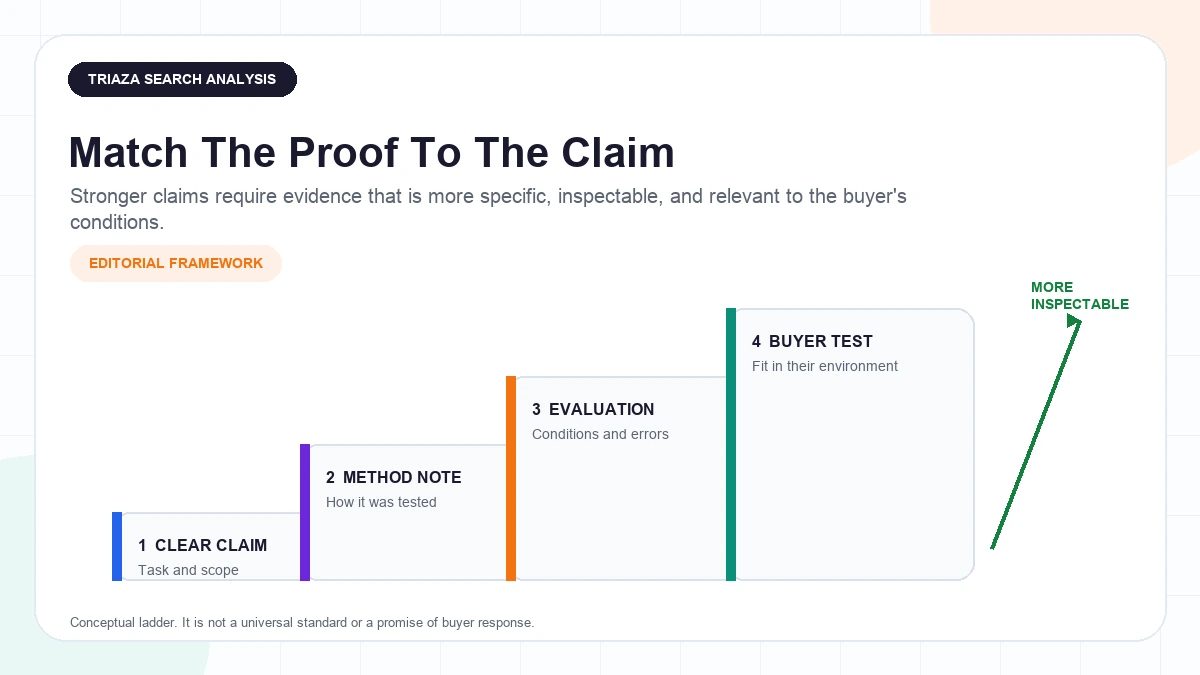
AI marketing often collects proof into one undifferentiated block: benchmark logos, customer quotes, compliance badges, product screenshots, and a broad statement about innovation. Buyers need to know what each item establishes.
Use a simple evidence ladder:
Assertion
The company states what the product can do. It should be precise enough to evaluate.
Demonstration
A demonstration shows a designed example. It helps explain the workflow and interface, but does not establish representative performance without a defined evaluation method.
Benchmark Or Controlled Evaluation
A benchmark reports a result on a named task, dataset, or procedure. A product evaluation can address the actual workflow. Both need configuration, measure, scope, and exclusions.
Vendor-Selected Customer Example
A customer example can show implementation context. Label vendor authorship or selection, and explain the starting workflow, product role, customer contribution, observed result, and limits. One example does not prove the same result elsewhere.
Buyer-Run Evaluation
A buyer-run evaluation uses representative inputs, agreed measures, and a decision rule. It still reflects the scope of that test. Marketing can make the protocol and responsibilities clear before testing begins.
This ladder is an editorial tool, not a universal hierarchy. Independent evidence may be stronger than vendor-authored evidence, but relevance and method still matter. A poorly matched independent benchmark may answer less of the buyer’s question than a transparent product evaluation on representative tasks.
Treat Benchmarks As Bounded Evidence
Benchmarks help teams compare performance on a defined task. Problems begin when a benchmark result is used as a general description of a product or a promise about an untested workflow.
Before publishing a result, answer these questions:
- What task and dataset does the benchmark represent?
- Does the product use the same model and configuration as the tested system?
- Which metric is reported, and what does it miss?
- Was the result reproduced internally, supplied by a vendor, or reported by an independent party?
- Is the test relevant to the buyer job in the claim?
- Are there known concerns about the evaluation method?
- Which product conditions, tools, or review steps are absent from the benchmark?
A 2023 position paper titled NLP Evaluation in Trouble argues that exposure to benchmark test data can overstate performance on that benchmark. The authors also say contamination is difficult to measure and its extent is unknown. The paper does not prove that any named model or benchmark is contaminated, and it does not quantify universal performance inflation.
That distinction matters. Marketing can describe a leaderboard result as benchmark-specific evidence without accusing a model of contamination. If the company has not investigated contamination, do not imply that it has. If the product claim concerns a live workflow, add a product-level evaluation that reflects the actual system and representative conditions.
Avoid benchmark soup. A row of scores from unrelated tasks asks the reader to infer a general intelligence or product advantage that the tests may not establish. Select the evidence that answers the buyer’s job, then explain the remaining uncertainty.
Publish Limits And Operating Safeguards Together
Limitations without operating context can sound like a warning label detached from the product. Safeguards without limitations can sound like a list of reassuring controls with no defined risk. Pair them.
If a document extraction system struggles with handwritten fields, explain how it identifies low-confidence output and routes it for review, if that is actually how the product operates. If an agent can call external tools, explain the permission boundary, confirmation step, logging, and fallback that apply. If a support assistant is limited to approved sources, explain what happens when those sources do not answer the question.
The goal is to show the buyer how a known limitation is handled in practice. Marketing should work with product, security, legal, and customer teams to collect approved facts, then keep those facts consistent across public pages and sales material.
The importance of operating detail is visible in incident reporting, although broad incident data should not be turned into a product accusation. The Stanford AI Index 2025 reports an Accenture and Stanford survey conducted from January to February 2025 among 1,500 organizations with at least $500 million in revenue across 20 countries and 19 industries. Respondents reported AI-related incident types from the prior two years, most frequently adversarial attacks at 56%, privacy violations at 55%, unintended decision making at 51%, model bias at 47%, and performance failures at 46%. These are reported incident types among large organizations, not population incident rates or evidence about all firms or any specific product.
That survey does not tell an AI company which controls to claim. It does show why a serious buyer may ask about failure, privacy, attack resistance, bias, and decision boundaries. Answer with the product’s actual practices and scope. If a control is planned, label it as planned or leave it out of public claims until it exists.
Keep these distinctions visible:
- A policy says what an organization intends or requires.
- A control describes a mechanism or practice.
- An evaluation tests behavior under stated conditions.
- Monitoring observes the operating system after deployment.
- An incident process defines how the team responds when something goes wrong.
One cannot stand in for all the others. A policy is not proof that a control operated. A control description is not evidence of effectiveness. An evaluation does not guarantee future behavior. Monitoring does not prevent every failure.
Turn Technical Work Into Buyer-Ready Assets
The product team may already have much of the material marketing needs. The problem is usually translation, ownership, and audience fit.
Build a proof inventory before creating new content. Look for evaluation reports, model or system cards, release notes, architecture diagrams, threat models, security responses, data flow maps, limitation lists, pilot protocols, error taxonomies, support logs, and implementation checklists. Confirm which version is current, who owns it, and which details are approved for public use.
Then convert the material into a small set of linked assets.
Product Page
State the buyer job, core capability, important conditions, and next evaluation step. Link to deeper proof rather than compressing every technical detail into the main narrative.
Evaluation Note
Explain the task, dataset or input source, test procedure, configuration, measures, results, exclusions, and limitations. Separate product evaluation from underlying model benchmarks. Include the date and version because they help the reader identify which system was evaluated, not because a fresh date creates trust or ranking value.
Limitations And Safeguards Page
Group limits by the buyer decisions they affect. Connect each material limit to the relevant operating practice or review step. Avoid a generic wall of caveats that no one can apply.
Technical Guide
Show data flow, permissions, integrations, review points, logging, and failure handling at the depth the buyer needs. Use diagrams when they clarify the system. Do not publish sensitive details merely to look transparent.
Customer Example
Label who authored and selected the example. Describe the customer’s starting context, the product’s exact role, customer contributions, observed result, and what the example cannot establish. Use approved customer facts only.
Buyer Evaluation Guide
Give the evaluator representative tasks, setup requirements, pass criteria, expected failure cases, and a place to record findings. A useful guide helps the buyer run a fair test rather than steering the buyer toward a polished demonstration.
Internal Champion Brief
Create a short document that preserves the claim, evidence, limitation, operating practice, and evaluation step for engineering, security, finance, and leadership.
Product Expert Session
Offer a focused path for unresolved questions. Follow the buyer’s evaluation gap and record the approved answer for reuse.
This asset system supports content marketing because one verified source can feed several buyer formats without changing the claim. It also depends on a stable message blueprint so product pages, technical documents, presentations, and sales conversations do not describe different products.
Clear source ownership matters as the asset set grows. A brand voice system can help teams preserve approved language across channels, but it does not replace factual review. The guide to treating brand voice as a data asset explains the consistency problem. For technical claims, add an evidence owner, product version, approval state, and review trigger.
Schema, llms.txt, publication dates, disclosure labels, and documentation formats are not trust or ranking switches. Use structured fields and dates when they help maintain accurate information. Use disclosure when it is material and appropriate. Judge the assets by whether they answer buyer questions with supported claims.
Learn From Vendor Examples Without Copying Their Claims
Public model launches and system cards offer useful examples of how vendors frame capability, evidence, and limits. They remain vendor-authored materials, and selected examples do not prove general product performance.
Claude 4 Shows A Job And A Selected Example
Anthropic’s May 22, 2025 introduction to Claude 4 described Claude Opus 4 for sustained work on complex coding and agent tasks. Anthropic also reported that Rakuten had validated one demanding open-source refactor that ran independently for seven hours with sustained performance. This is a vendor-authored launch and vendor-selected customer example, not independent validation, proof across codebases, or a general seven-hour capability claim.
The useful marketing pattern is the move from a broad capability to a recognizable job and a bounded example. The qualification matters as much as the example. A buyer still needs to know the repository conditions, task definition, review process, success criteria, and how those conditions compare with its own work.
An AI company using a selected customer example should preserve that same boundary. Say who selected it, what the product did, what the customer supplied, what was observed, and why the setting may differ elsewhere. Do not turn one demanding run into a general autonomy promise.
Gemini 2.5 Connects Product Language To Operational Terms
Google introduced Gemini 2.5 Pro Experimental in its March 25, 2025 launch post. Google described model reasoning in operational terms such as analyzing information, drawing logical conclusions, incorporating context and nuance, and making informed decisions, and connected the model to complex tasks and advanced coding work. Those are Google’s capability descriptions, not proof of reliable performance in every case.
By the date of this article, the product state had changed. Google’s June 17, 2025 model update released stable Gemini 2.5 Pro for general availability. Present-tense copy should therefore describe the stable generally available model, while reserving the experimental label for its March launch history.
The editorial lesson is to maintain product-state language. Launch copy becomes stale. A page can preserve the history while keeping the current status accurate. That is ordinary information maintenance, not a claim that updating the date itself improves trust or search visibility.
The GPT-4o System Card Shows Evidence And Limits In One Asset
OpenAI’s vendor-authored August 8, 2024 GPT-4o System Card describes methods, results, external red teaming, third-party assessments, and limitations. OpenAI reported working with more than 100 external red teamers who spoke 45 languages and represented geographic backgrounds from 29 countries. These figures come from OpenAI. Many Preparedness and third-party assessments focused on text and vision, while some voice testing used text-to-speech conversions with stated coverage and representativeness limits.
The card is useful as a content pattern because it puts methods and limitations near results. Its existence does not prove that every reader will trust the product, that every risk was covered, or that another company should copy its structure. An AI company can take the narrower lesson: publish enough method and scope for the reader to understand what an evaluation covered.
Stop Claims That Outrun The Evidence
The fastest way to damage a technical message is to let a claim grow as it moves from product notes to marketing copy.
Watch for these expansions:
- “Performed well on this benchmark” becomes “best performing.”
- “Completed this selected task” becomes “works autonomously.”
- “Supports this workflow with review” becomes “replaces the role.”
- “Uses encryption and access controls” becomes “completely secure.”
- “Reduced errors in a selected evaluation” becomes “eliminates errors.”
- “Can explain its output in this interface” becomes “fully transparent.”
- “Available in this configuration” becomes “ready for every enterprise.”
Create a claim review record with the exact sentence, source, evidence type, scope, owner, approval state, and material limitation. Review the record when the product, model, dataset, workflow, or source changes.
Legal review may be necessary when a claim compares the product with a profession or promises a level of service. In a September 25, 2024 release about Operation AI Comply, the FTC said its complaint alleged that DoNotPay had not tested whether chatbot output matched the level of a human lawyer. The Commission later approved a final order on January 16, 2025 barring unsupported claims that the service could substitute for professional services. The complaint’s assertions remain allegations rather than adjudicated findings. The order itself was final by the article date.
This is general educational information, not legal advice. A company making professional-substitution, performance, comparative, safety, compliance, or outcome claims should obtain review based on the actual claim, evidence, audience, and applicable law.
Marketing can still write clearly while review is pending. Narrow the claim to what the approved evidence supports. Mark unavailable details internally. Do not fill the gap with a broad adjective.
Build The Message And Proof System In 30 Days
This 30-day plan sequences the work. It is not a promise about how long every organization needs.
Week 1: Inventory Claims And Buyer Questions
Collect the claims currently used on the website, in presentations, in product demonstrations, and in sales material. Include model language, benchmark statements, customer examples, security descriptions, outcome claims, and calls to action.
For each claim, record:
- The exact sentence
- The buyer job it refers to
- The source and owner
- The product version or configuration
- The evidence type
- The material limitation
- The next evaluation step
- The approval state
Do not rewrite yet. First find where the company tells different stories about the same capability.
Interview product, engineering, security, customer, and sales owners about recurring buyer questions. Identify which answers are public, which require controlled review, and which are not yet known. Map each question to a technical evaluator, economic buyer, or both as a planning tool, not a fixed role assignment.
Week 2: Rebuild The Core Narrative
Choose the small set of capabilities that matter most to the buyer jobs in scope. Run each through the six-part framework.
Rewrite the product page so the job and capability are clear before secondary technical detail. Add only the limitations and operating practices that are confirmed and approved. Link each major proof point to a deeper source.
Build two reading paths from the same claims. The technical path should make evaluation conditions, architecture, controls, and test options easy to find. The economic path should make workflow change, ownership, dependencies, and decision criteria clear.
Use one name for the same action, user, and output across the site and sales material. Preserve old product terms only when they clarify an older evaluation or release.
Week 3: Produce The Missing Proof Assets
Choose the asset that closes the most important evaluation gap. It may be an evaluation note, limitations and safeguards page, data flow guide, selected customer example, or buyer-run test protocol.
Write from confirmed source material. Keep the method, result, scope, and limitation together. Check technical accuracy and whether the asset answers the buyer’s question.
Create an internal champion brief after the source assets are stable. Compressing the story first tends to remove the qualification. The short brief should inherit the exact claim boundaries from the full material.
Update presentations and product demonstrations so they link to the same source. A slide should not use a stronger claim merely because space is limited.
Week 4: Test The Buyer Path
Give the material to reviewers who did not write it. Ask them to identify:
- What job the product performs
- Which conditions appear necessary
- Which evidence supports the main claim
- Which limitation could change a decision
- Which operating responsibility remains with the buyer
- What they would evaluate next
Compare their answers with the intended message. If reviewers cannot name the product’s job, fix the opening. If they overgeneralize a benchmark, tighten its scope. If they cannot find the next step, make the evaluation path explicit.
Run the same check across marketing strategy, product marketing, sales material, and technical documentation owners. The goal is a shared source of claims, not identical copy on every surface.
Then decide what needs ongoing review. Tie the review trigger to a real change such as a new product version, model, evaluation, workflow, control, or approved customer example. Do not use a fresh publication date as a substitute for revisiting the facts.
Make The Buyer Able To Verify The Story
The strongest AI company message is one a buyer can restate without making it broader. It names the job, shows evidence that fits the claim, keeps the important limitation attached, explains how the system is operated, and offers a sensible way to test fit.
That discipline supports useful thought leadership for startups because the company can teach from real product decisions instead of publishing generic opinions. It also gives AI company marketing a practical center: help the buyer understand what the product does, where the proof applies, and what to evaluate next.
If your product pages, technical proof, and buyer conversations describe the same capability three different ways, Triaza can help organize the claims into one reviewable message and evidence system. Start with content marketing or the message blueprint based on the gap you need to solve.
Questions AI Companies Ask About Buyer Trust
What evidence helps when a buyer cannot evaluate an AI model directly?
Use evidence that matches the product claim: a defined product evaluation, a clear method, representative conditions, known limits, and a buyer-run test when feasible. The 2019 Model Cards proposal recommends intended-use context, evaluation procedures, and performance across application-relevant conditions and subgroups, but it is a proposed reporting framework rather than a universal standard. The buyer still needs to understand how the underlying model becomes the product system.
How should marketing distinguish a benchmark, a customer example, and a product claim?
A product claim states what the company says the system can do. A benchmark supports a result on its named task and conditions. A customer example describes one selected implementation and should identify who authored or selected it. A 2023 benchmark contamination position paper argues that test-data exposure can overstate performance on a benchmark while saying contamination is difficult to measure and its extent is unknown. It does not prove a named model or benchmark is contaminated.
Which limitations belong in marketing?
Include limitations that could change the buyer’s interpretation, evaluation, implementation, or risk decision. Put them near the affected claim and explain the related operating practice when one exists. The voluntary NIST AI Risk Management Framework treats several trustworthiness characteristics as contextual and interrelated, so one limitation page or control should not be presented as proof that the entire system is trustworthy.
How can one narrative serve technical evaluators and economic buyers?
Use one claim and two reading paths. Technical evaluators need the task, configuration, method, conditions, controls, failures, and test path. Economic buyers need the workflow change, ownership, dependencies, decision criteria, and cost or risk question. A Forrester survey of more than 18,000 global business buyers reported that product experts were the most influential people in the buying cycle, but the public summary omits sampling, weighting, field dates, margin of error, and question wording, and the finding is neither causal nor universal.
What should an AI company avoid saying when proof is incomplete?
Avoid universal, comparative, professional-substitution, safety, or outcome claims that the available evidence cannot support. In a September 2024 FTC release, the agency said its complaint alleged that DoNotPay had not tested whether its chatbot output matched the level of a human lawyer. The Commission later approved a final order on January 16, 2025 barring unsupported substitution claims. The complaint assertions remain allegations rather than adjudicated findings. This is general educational information, not legal advice.
When should a model detail lead the message?
Lead with the model or infrastructure detail when it changes compatibility, control, performance, data handling, or the buyer’s evaluation. Lead with the workflow when the mechanism does not change the decision. Google’s June 17, 2025 update made stable Gemini 2.5 Pro generally available after Google’s experimental March launch. That product-state detail matters when a buyer is evaluating availability, but Google’s capability descriptions remain vendor-authored and do not prove reliable performance in every case.