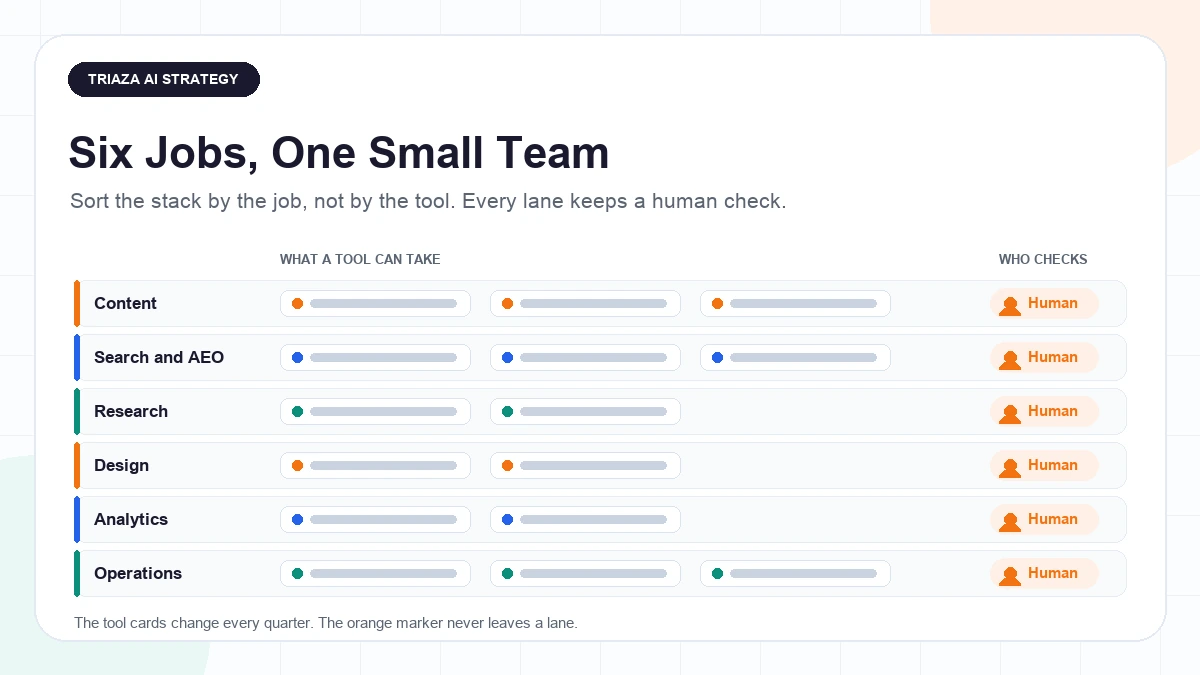
You have six jobs and somewhere between one and three people. Content needs writing. Search needs tending. Somebody has to research the market, make the graphics, read the numbers, and keep the plumbing connected between your site, your CRM, and your email tool. There is no specialist to hand any of it to, which also means there is nobody to hand tool evaluation to.
So the pitches land on you. A new AI product every week, each one promising to replace a function you cannot afford to staff. Some of them are real. Several are a text box in front of a model you already pay for. Telling the difference costs hours you do not have.
Here is a way to cut that down, and it is how we build an AI marketing stack for a lean team. Sort the decision by job rather than by tool, decide what each job actually costs you today, and only then ask whether software can take a piece of it.
A lean marketing team should build its AI stack around six jobs: content, search visibility, research, design, analytics, and operations. Start with three tools, not twelve. Switch on the AI already bundled in software you pay for. Keep a human on any output where a mistake is expensive and hard to spot.
Sort Your AI Marketing Stack by the Job, Not by the Tool
Tool categories are drawn by vendors, and vendors draw them around what they sell. Jobs are drawn by what your week actually contains. When you sort by job you notice something useful: AI is not evenly good across your week. It compresses one specific slice of most jobs, usually the mechanical middle, and leaves the parts on either side untouched.
The six jobs below are our split, not an industry standard. We use it because it maps to how the work arrives rather than to how software is packaged.
Three Questions Before Anything Joins the Stack
Before you trial anything, run it past three questions. These are ours, not research findings, and they exist to save you the trial.
Does it replace something you are already doing badly? A tool that improves a job you are doing well is a rounding error. A tool that covers a job you are currently skipping is worth real money.
Would a bad output show up quickly? If the tool writes a first draft, you will notice the problem in ten minutes. If it silently mis-segments your email list, you may notice in a quarter. That difference should drive how much supervision you build in, and whether you adopt at all.
Can you turn it off without breaking something else? Anything that becomes load-bearing inside another system is a much bigger commitment than its monthly price suggests.
What “AI-Powered” Means Now, Which Is Almost Nothing
The label has stopped carrying information. Ahrefs ran its in-house detector against 900,000 newly created English-language pages in April 2025, one page per domain, and reported that 74.2% contained at least some AI-generated content, with 71.7% mixed human and AI rather than purely machine-written. Ahrefs is clear that this is its own detector on its own crawl sample and that no AI content detector is fully accurate, that partial AI use is the hardest case to call, and that rewriting tools can evade detection. Treat the number as a rough read on saturation rather than a census.
Saturation is the point. When most new pages have some machine assistance behind them, “we use AI” tells a buyer nothing, and it tells you nothing when a vendor says it either. Ask what job the software does instead.
Job 1: Content and Writing
The job is turning what your company knows into things people can read. Not producing volume. Producing the specific pieces that answer the questions your buyers actually ask.
What Controlled Research Actually Measured
Two studies are worth knowing because they are among the few with control groups rather than survey responses.
In a preregistered experiment published in Science in July 2023, 453 college-educated professionals given access to ChatGPT completed occupation-specific writing tasks 40% faster with output rated 18% higher in quality. The authors are specific about the limits: the gains concentrated among lower-ability writers rather than raising everyone equally, and the tasks were short, incentivized assignments such as press releases, emails and reports, not open-ended campaign work.
A field study of a customer support deployment found the same shape. Across 5,179 agents, average productivity rose 14%, with a 34% gain for novice agents and effectively no gain for experienced high performers. That is one company’s rollout of one proprietary assistant, not a general knowledge-work result, and the authors describe their explanation for the pattern as interpretive rather than proven.
Read those together and the honest expectation for a lean team is narrower than the pitch. If you are the strongest writer in your company, the measured gain for someone like you was close to zero.
Brand Voice Is the Feature Every Tool Now Sells
Almost every writing product has some version of it. Jasper introduced Brand Voice in April 2023, describing a memory layer for company facts and a separate tone and style layer, in its own product announcement. Grammarly Business launched custom style guides in 2020 so organizations could enforce terminology and stylistic rules across a team automatically. Writer, an enterprise content platform founded in 2020, raised a $200M Series C at a $1.9B valuation in November 2024 with customers including Accenture, Uber and Intuit.
The general assistants got there by a different route. ChatGPT added memory in February 2024, letting it carry user-supplied details between conversations, though that rolled out to a small portion of users first rather than everyone at once.
None of that solves the actual problem, which is that most companies have never written their voice down in a form a model can use. The feature is a container. You still have to fill it, and that work is the subject of our piece on treating your brand voice as a documented asset.
Which Generation of Model You Are Working With
Worth knowing, mostly so you can tell whether a tool is running something current. Anthropic released Claude Opus 4 and Sonnet 4 on May 22, and Google DeepMind shipped Gemini 2.5 in late March as its first generation of models that reason before answering, initially through AI Studio and the Gemini app for Advanced subscribers rather than everywhere at once. Both companies published benchmark scores for their own models, which is the usual caveat: those are vendor-run coding and reasoning benchmarks, and none of them predicts whether the output sounds like your company.
What the Writing Job Still Costs You
The draft got cheaper. Deciding what to write, checking whether it is true, and making it sound like you did not. If your content is not working, a faster drafting tool will produce more of the thing that is not working. The fix is the process around the tool, which we laid out in detail in building an AI content system, and it is the same discipline our content marketing work is built on.
Job 2: Search and AEO Visibility
The job is being findable when someone goes looking, whether that ends in a click or a citation inside a generated answer. The second half of that is what the industry has settled on calling answer engine optimization, or AEO.
AI Mode Is a Shipped Product Now
This is the part of the landscape that moved most recently. Google began rolling AI Mode out to all US Search users on May 20, announced at I/O, running on a custom version of Gemini 2.5. It had launched in March as a limited Search Labs preview and expanded through the spring, but that phase is over. Anyone searching from the US can use it today, and planning around it as a future experiment is planning around last quarter.
What the Click Data Shows, and What It Does Not
Two independent studies published within a week of each other in April point the same direction and disagree on size, which is worth carrying honestly rather than picking the scarier one.
Ahrefs compared aggregated Search Console data from March 2024 to March 2025 across 300,000 keywords and reported that pages ranking first saw 34.5% lower average desktop click-through rate when an AI Overview was present, a figure restricted almost entirely to informational-intent keywords, and one Ahrefs presents as a forecast comparison rather than an isolated measurement, because Search Console gives no way to separate AI Overview clicks from standard organic ones. Amsive’s study of 700,000 keywords across 10 sites, its own proprietary data, covered by Search Engine Land on April 21, found a smaller average drop of 15.49%, an average that hides an 18.68% CTR increase on branded keywords and a 37.04% decline in the worst combination, where an AI Overview and a featured snippet appear together.
Same direction, different magnitudes, one vendor data set each. The safe reading is that unaided informational rankings are losing click value and branded demand is not, which is a strategy conclusion rather than a panic one. We covered the surface itself in our AI Overviews explainer.
Tools That Claim to Track Your Brand Inside AI Answers
The category exists now. Semrush announced an AI Toolkit in March, describing tracking for how often a brand appears in AI-generated answers across ChatGPT, Gemini and Perplexity compared with competitors. Ahrefs added Brand Radar on all paid plans, in beta, tracking brand presence across AI platforms.
Both of those descriptions come from the vendors, about their own products. Nobody has published independent accuracy data on this category yet, which is what you would expect of something this new. Useful as a directional signal, not yet as a number you would put in a board deck.
For the underlying discipline, our guide to answer engine optimization is the full treatment. One thing worth repeating here because vendors keep selling it: llms.txt, extra schema markup and refreshed publish dates are not switches that make AI search find you. They are, at best, small supporting details. If a tool’s pitch rests on any of them, that is a signal about the tool. For the ordinary search fundamentals underneath all of this, our roundup of SEO tools for small businesses still covers the ground.
Job 3: Research and Competitive Intel
The job is knowing what your market is doing without spending your week on it. Much of it never needed AI. The tools we covered in our marketing research tools roundup solve a good part of the job with ordinary software.
What is new is agentic research: you ask a question, the assistant browses for several minutes on its own, and returns a report with sources. OpenAI rolled deep research out to paying ChatGPT users in late February after an initial launch for its top tier. Several assistants now offer some version of this.
It is genuinely useful and it fails in a specific way you should plan for. A study of language models answering legal research questions found hallucination rates that varied sharply by how obscure the material was, worse on lower-profile and lower-court cases than on famous precedent. That is a legal-domain study, its authors explicitly caution against generalizing it, and no number in it transfers to marketing research. What transfers is the shape: these systems are least reliable exactly where the source material is thin and specialized. For you, that is the long tail of your own niche, which is also the material you most wanted help with and are least able to spot-check.
Use it to find things. Verify anything you plan to repeat.
Job 4: Design and Creative
The job is producing the visual assets that go with everything else, on a budget that does not include a designer.
Image and video generation reached a usable place this spring, within limits worth stating precisely. Adobe announced Firefly Image Model 4 and 4 Ultra in April alongside a text to vector capability, and took its video model out of beta at clips of up to five seconds and resolutions up to 1080p. At I/O, Google announced Imagen 4 at up to 2K resolution and Veo 3, its first video model that generates matching audio, available at announcement to Ultra subscribers in the United States through the Gemini app and Flow, with enterprise access through Vertex AI.
Read those specs before you plan around them. Five-second clips and single images fill a real gap in social and ad creative. They do not replace a shoot, and a paid US-only tier is not a capability your whole team has.
On the design side, Figma announced four products at Config in May: Make for prompt to prototype, Sites for AI-assisted site building, Buzz for bulk marketing asset generation, and Draw for vector work. Sites and Buzz were in beta at announcement and Make and Draw were described as rolling out over the following weeks, so none of it is something to build a June plan around. Buzz is the one aimed at a marketing team, and it is worth watching for exactly that reason.
The Rights Question Nobody Can Outsource for You
This is unsettled and it matters more than the feature list. The US Copyright Office released the third report in its Copyright and Artificial Intelligence series in May, and as summarized by Skadden, it concluded that using copyrighted works to train generative models that produce competing expressive content, particularly from pirated sources, likely exceeds fair use, while non-competing research uses are more likely to qualify. That went out as a pre-publication version, so exact wording could still shift before formal release.
None of that is legal advice and none of it predicts how any case resolves. The practical version for a two-person team: vendors make different claims about what their models were trained on and what they will indemnify, those claims are worth reading yourself rather than taking from a summary, and keeping a simple record of which images were generated where costs you nothing now and could matter later.
Job 5: Analytics and Reporting
The job is knowing what worked, in time to do more of it.
Start with what you already pay for. Google Analytics rolled out Generated Insights in April, which surfaces plain-language explanations of significant fluctuations at the top of detailed reports, and it is careful to present probable causes rather than confirmed ones. On the paid side, Google announced AI Max for Search campaigns in May, a beta bundle of search term matching, AI-generated ad text and final URL expansion; Google reported that advertisers turning it on typically saw 14% more conversions or conversion value at a similar cost per acquisition, rising to as much as 27% for campaigns leaning heavily on exact and phrase match, which are Google’s own internal figures for its own product and are described as typical rather than promised.
The Measurement Gap Nobody Has Solved
One honest gap, and nothing in this paragraph is sourced, because there is nothing credible to cite. As of the middle of 2025 there is no settled, standard way to attribute a visit that began inside an AI assistant. Referral data arrives inconsistently, some assistants pass nothing usable, and there is no shared convention for what a team should even count. Anyone selling you a clean number for this is selling you a modeled estimate. Treat it accordingly, and keep a manual record of what you can observe directly until the tooling catches up.
If you want a starting point for what is checkable today, our AI search visibility audit walks through the pre-work.
Job 6: Operations and the Connective Tissue
The job is keeping the systems talking to each other: form to CRM, CRM to email, email to reporting. It is unglamorous, it breaks quietly, and it is the job a lean team should automate first, because a broken handoff costs you leads while a mediocre blog post costs you nothing.
The Cheapest AI in Your Stack Is the One You Already Pay For
Both big platform vendors bundled AI into what small teams already license. HubSpot launched Breeze at INBOUND in September 2024, an embedded layer with a copilot, four named agents for content, social, prospecting and customer work, and a data enrichment component, by its own announcement. ActiveCampaign announced Active Intelligence on May 22, describing twelve or more autonomous agents including brand kit, suggested segments and automation agents, though its own release ties the launch to a keynote later that month and does not say which plans get what or when, so treat availability as in progress.
Both are vendor descriptions of vendor products. The reason to start there anyway is arithmetic: you are already paying, the data is already in there, and switching something on costs an afternoon rather than a procurement decision. For general-purpose automation outside a platform, Zapier put Zapier Central into public preview in March 2024, an AI workspace for building bots across its connected apps, per Zapier’s own launch announcement.
The Plumbing Question, and Why Lock-In Is the Real Risk
One standard is worth knowing by name because it decides how replaceable your stack is. Anthropic open-sourced the Model Context Protocol in November 2024, an open way to connect assistants to outside data and tools, with pre-built connectors for things like Drive, Slack and GitHub. OpenAI announced support in its Agents SDK in March, with API and desktop app support stated as coming rather than shipped, and Google’s DeepMind CEO said in April that Gemini would add support to its models and SDK, without giving a timeline.
Why a two-person team should care: a shared connector layer is the difference between a stack you can change your mind about and one you cannot. When you evaluate an agent product, the question is not only what it does but whether the connections it makes belong to you or to it.
Where AI Does Not Pay Off for a Lean Team
This section carries as much weight as the six above it, because getting it wrong is how a lean team ends up busier than before.
The Jagged Frontier
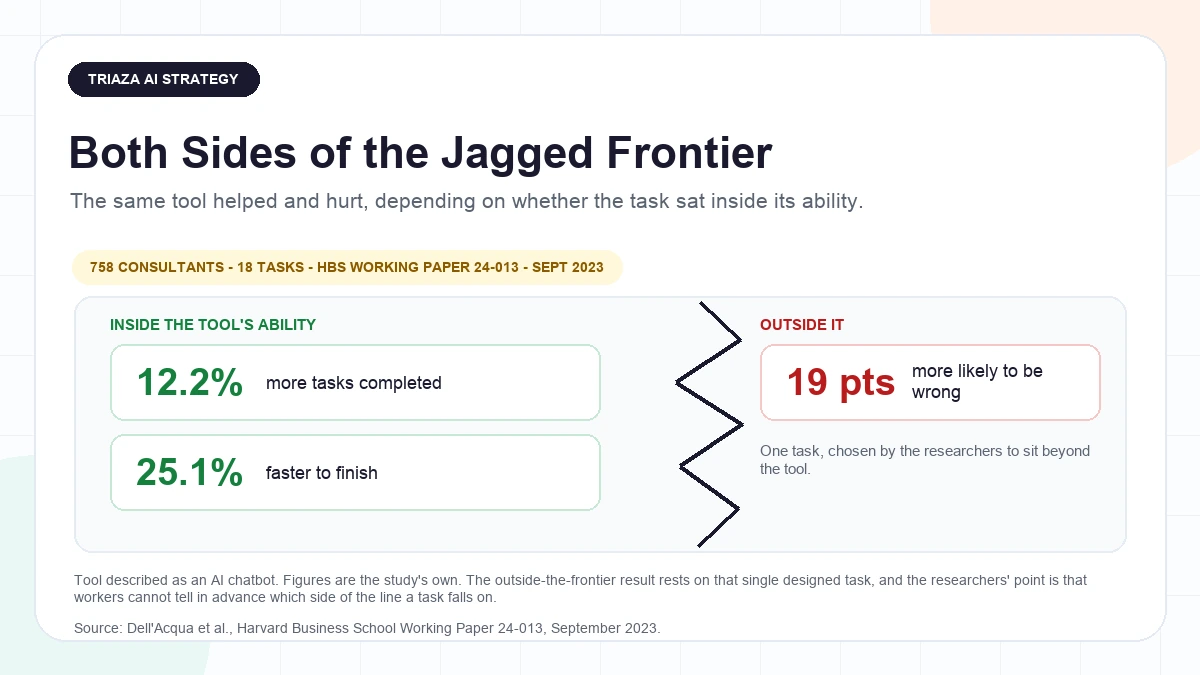
The most useful study on this ran with 758 consultants at Boston Consulting Group. Those given an AI chatbot completed 12.2% more tasks and finished 25.1% faster with higher-rated quality, on tasks inside the tool’s demonstrated ability. On one task the researchers deliberately designed to sit outside it, the same people were 19 percentage points more likely to produce an incorrect answer than colleagues working without the tool. That outside-the-frontier result rests on a single designed task rather than a broad sample, which the authors say plainly.
Their actual conclusion is the part that should change how you work. The boundary is jagged and invisible from where you stand. Two tasks that look equally hard to you sit on opposite sides of it, and nothing about the tool’s confidence tells you which is which.
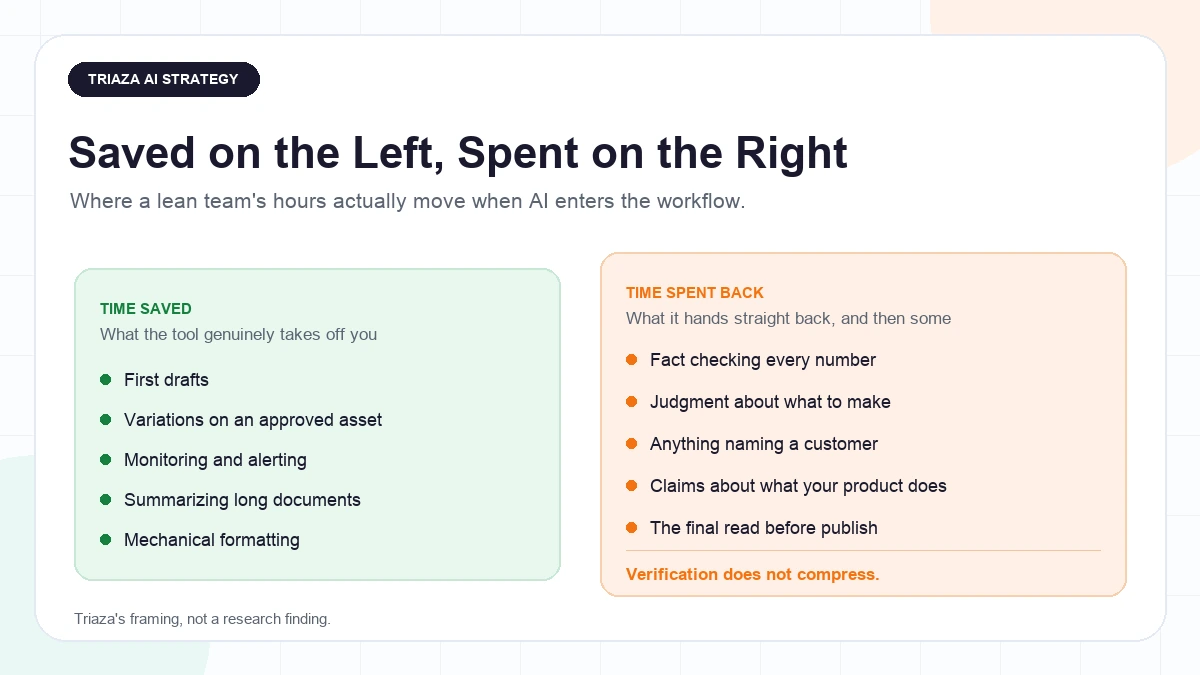
Verification Is the Work Now, and It Does Not Compress
A study of 319 knowledge workers describing 936 real examples of AI use at work found that people who reported higher confidence in the tool’s output reported less critical thinking about it, while higher confidence in their own ability went the other way. That is self-reported and correlational rather than an observed causal effect, and the authors frame the shift as critical thinking moving toward verification and oversight rather than disappearing.
Which is the honest accounting. The drafting hour you saved becomes a checking hour, and checking is harder to schedule because it has no visible output. If your process does not have a named place where verification happens, it is not happening.
The Gains Are Biggest for Your Least Experienced Person
Both controlled studies above found the same thing from different directions: large gains for novices, small or negligible gains for experienced high performers. On a team of one to three, that has an uncomfortable implication. If the founder is the best marketer in the building, the expected personal gain is at the low end of the published range. The tools pay off most when they let a junior person or a non-specialist produce work you would otherwise have to do yourself.
Sameness Is the Default Output
Go back to that 74.2% figure from Ahrefs, with all the detector caveats it carries. If most new pages already have machine assistance behind them, another competent AI draft is worth roughly nothing on the margin. The scarce thing is what a model cannot supply: what your company specifically knows, what your customers actually said, what you tried that did not work. Those are inputs, not outputs, and no tool generates them for you.
Adopting AI and Getting Value From It Are Different Milestones
The gap is wide and well documented. McKinsey’s survey of 1,363 respondents, fielded in early 2024, found 65% saying their organizations regularly used generative AI, roughly double ten months earlier, while only about half reported adoption across two or more functions; McKinsey’s own read was that most organizations were still early rather than capturing value at scale, and the figures are self-reported and skew toward larger companies.
The small-business picture looks similar. A survey of 947 US small businesses fielded in May 2025 and published this week by Reimagine Main Street with PayPal found that among the businesses already using AI day to day, 77% named marketing and customer engagement as where new AI solutions would have the greatest impact, while across the full sample 51% were classified as still testing without commitment, citing security, resources and unclear value as the barriers; those are self-reported attitudes with no margin of error disclosed, and the barrier figures describe only that undecided half.
Being in the majority that has adopted something is not the same as being in the minority getting a return.
What Google Actually Says About AI Content
Narrower than the rumor in both directions. Google’s February 2023 position is that using automation, including AI, to generate content whose primary purpose is manipulating rankings violates its spam policies, and that its guidance is about quality and intent rather than production method. That is not a penalty on AI writing and it is not permission to publish volume. It is a statement that the method is not the thing being judged, which is also the most recent dated statement on this we could confirm.
Five Places to Keep a Human, No Exceptions
This list is our judgment, not a research finding. Keep a person on anything with a number in it, anything that names a customer, anything that claims what your product does, anything legally load-bearing, and anything that will be the first thing a prospect ever reads about you. Those are the places where a wrong output is expensive and hard to spot, which is the same test as before.
A Starter Stack for a Team of One to Three
Three things, chosen by job rather than by brand.
One general assistant you actually learn. Depth beats breadth here. The difference between someone who has used one assistant seriously for six months and someone who has dabbled in four is not close.
One search visibility tool. Whatever gives you rankings, crawl health and some read on AI answer presence in one place. The AI features are new enough that they should not decide the purchase.
One automation layer. Either the AI already bundled in your CRM and email platform, or a general connector tool. This is the job where a lean team gets the clearest return, because it removes work that was never creative to begin with.
Turn On What You Already Own First
Before buying anything, spend an afternoon auditing the AI features inside software you already license. You have paid for them, the data is already in there, and switching one on is reversible in a way a new subscription is not.
What to Skip Until You Hire a Second Marketer
Dedicated AI writing platforms, if you already pay for a capable assistant. Anything sold as an autonomous agent that runs a channel for you, which as of now means trusting a new product in the exact conditions where the research says supervision matters most. Anything you cannot switch off in an afternoon.
A Thirty Day Sequence
Also ours, not sourced, and sized for roughly four hours a week.
Week one, list your six jobs and write one honest sentence about what each currently costs you. Week two, audit the AI features already inside your existing tools and switch on the two that map to your worst job. Week three, pick one job to accelerate and run it manually with an assistant, keeping a note of where you had to fix the output. Week four, read your notes and decide whether the fixing was smaller than the drafting. If it was not, that job is not ready, and knowing that is worth the month.
If you would rather not run that alone, that sequencing is the substance of our AI strategy and growth roadmap work.
Questions Lean Teams Ask About AI Tools
What does a two-person marketing team actually need? One general assistant used seriously, one search visibility tool, and one automation layer, plus whatever AI is already bundled into the CRM and email platform you pay for. Three purchases is a reasonable ceiling. Beyond that you spend more time administering the stack than using it.
Will Google penalize content my team wrote with AI? Not for using AI as such. Google’s stated position since February 2023 is that automation used primarily to manipulate rankings violates spam policy and that its guidance is about quality and intent rather than how content was produced. Publishing thin volume is the risk. The production method is not.
Do AI Overviews and AI Mode mean SEO is over? No, but the value is redistributing. Ahrefs measured 34.5% lower position-one desktop CTR when an AI Overview appears, on informational keywords and as a forecast comparison rather than an isolated measurement, since Search Console cannot separate those clicks. Amsive’s larger keyword set, its own proprietary data, found a 15.49% average drop that included an 18.68% gain on branded queries. Unaided informational rankings are worth less. Brand demand is not.
Which job should a small team automate first? Operations. Connecting your form to your CRM to your email tool removes work that was never creative and where a failure costs you actual leads. Content is the more tempting answer and the worse one, because a bad draft is cheap to catch and a broken lead handoff is not.
How do I know when a tool is making my work worse? Track the fixing, not the drafting. If the time you spend correcting output is not clearly smaller than the time you saved producing it, the tool is not paying for itself. In one field experiment, people using an AI chatbot on a task outside its capability were 19 percentage points more likely to be wrong than people without it, on a single task the researchers designed for that purpose, and they could not tell in advance which side of the line they were on.
Is a dedicated AI writing tool worth it if I already pay for a chat subscription? Usually not, at your size. The dedicated tools sell brand voice controls and team governance, and both matter more at ten writers than at one. Write your voice down first. If a general assistant with good instructions still misses, then look at a purpose-built tool.
How should a lean team track whether AI assistants recommend them? Manually, for now. There is no settled standard for attributing a visit that started inside an assistant, and the tools claiming to measure brand presence in AI answers are new enough that nobody has published independent accuracy data on them. Ask the ten questions that matter to your pipeline across the major assistants once a month and record who gets named.
If you want help deciding which of these jobs to accelerate first and which to leave alone, that is what our AI strategy and growth roadmap work covers, with content marketing as the follow-on once the priorities are set.