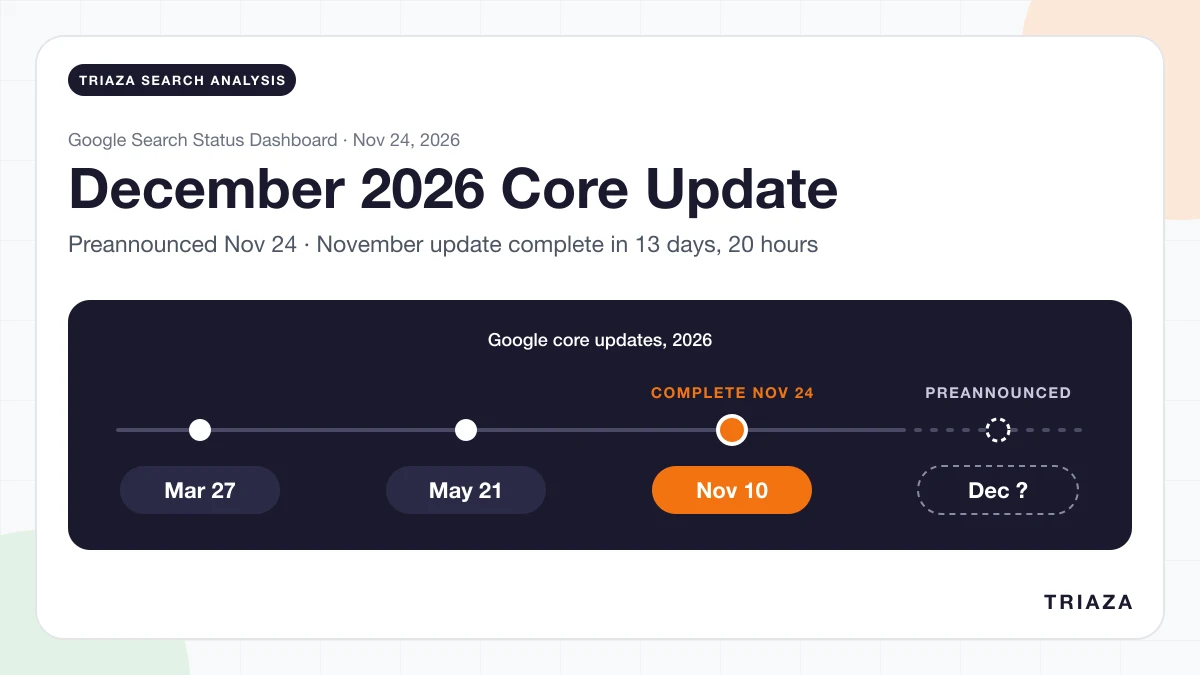
Google preannounced a December 2026 core update this morning, Tuesday, November 24, an hour after the November core update finished. A core update is a broad change to how Google ranks pages. None of the earlier core update entries on Google’s dashboard was posted ahead of the release, and this is the first core update entry this year to say what the update is about.
The new entry appeared on the Search Status Dashboard at 7:03 a.m. Pacific. It reads, in part: “Preannounced the December 2026 core update, which focuses on multiple improvements to how our systems understand and rank relevant content (including for longer and more complex questions), as well as improving personalized results for people who have personalization turned on.”
The November update had finished at 6:03 a.m. It started on November 10 at 10:06 a.m. Pacific, so the rollout took 13 days and 20 hours, just inside the “up to 2 weeks” Google estimated. It was the third core update this year. We covered the launch in our November 2026 core update post. This post covers what’s new today: the December notice, and what the published data does and doesn’t show about who lost in November.
If your traffic moved between November 10 and 24, don’t change anything yet. Google’s advice is to wait at least a full week after a rollout ends, and this year that week contains Thanksgiving, Black Friday, and Cyber Monday. Save your Search Console data now, compare November 25 through December 1 against November 3 through 9 once the data is in, and check the same holiday week last year before you blame the update. The December update has no start date, and a Google spokesperson has said it is “not imminent.”
Most of what’s being said about who lost in November comes from analysts and tool vendors. Google has said almost nothing, so further down I go through what each claim rests on.
What the December preannouncement says, and why Google made it
The full dashboard entry adds two more sentences to the one quoted above: “This core update applies to all locations and languages where Google Search is available, and our guidance about general core updates applies. This update is scheduled to be released in December 2026.”
It gives no date and no rollout length. Barry Schwartz at Search Engine Roundtable asked Google and reported the answer: “We don’t have a date yet – we will announce it as usual the day it starts rolling out. It’s not imminent.” He also wrote that the dashboard displayed the entry as active even though the update hasn’t begun, and that Google confirmed to him three times that it is not live.
The preannouncement arrived with new documentation. Google published a Search ranking hub today, which says: “To give site owners predictability and time to prepare, we publish advance notice of actionable policy changes and significant ranking updates on the Google Search Status Dashboard.” A companion page, How to stay informed on Google Search ranking updates, lists “Broad algorithmic updates (such as core updates) that may produce noticeable ranking shifts across many queries and sites” among the changes that get a notice. The same page says: “for changes where UK users may experience a significant ranking shift, we provide advance notice to site owners in accordance with CMA’s fair ranking conduct requirements for Google.”
The CMA is the UK’s Competition and Markets Authority. It announced a fair ranking conduct requirement for Google on June 17, and Search Engine Journal reported at the time that Google had six months to implement it. Schwartz’s reading is that Google “seems to be preannouncing some core updates because of the CMA UK’s requirements.” Google’s page stops short of saying that about December specifically, but the timing and the wording point the same way.
Schwartz called the preannouncement “new for Google” and noted that Google “has said numerous times already that it does not pre-announce core updates.” It isn’t the first advance word of any kind. Search Engine Journal recalled that in June 2019 Google’s SearchLiaison account announced a core update the day before it was released. A notice with a stated focus, published before the month the update is due, has no precedent that I can find on the dashboard.
One more new page matters if November hurt you. Google’s feedback page says verified site owners can use the Submit Feedback button in Search Console and tag the submission with the update’s hashtag, giving #NovemberCoreUpdate2026 as its example. It is not an appeal. The page says: “Submitting feedback doesn’t result in manual ranking adjustments for individual URLs.”
What December’s wording tells you
Google described multiple improvements to how its systems understand and rank relevant content, naming longer and more complex questions and personalized results. It didn’t explain either, and it hasn’t said which systems change.
On personalization, Google’s help pages describe what the setting does today. Signed-in users control it with a setting Google calls “Personalized Recommendations.” Google’s help page on personalization says: “Personalization doesn’t affect all search results,” and “The results you see are only reranked if doing so will provide information that’s likely to be more helpful to you.” Whether December’s change relates to that setting, to the opt-in Personal Intelligence feature in AI Mode (AI Mode is Google’s chat-style search), or to something else is not known, because Google hasn’t said.
One practical point follows regardless. Rank trackers, the tools that check where a site ranks by running searches automatically, query Google without anyone’s history, so they can’t see personalized results. Search Console can, because its position figure is an average over real impressions. Google’s documentation says as much: “For your specific search your position might be different than the average because of many variables, such as your search history, location, and so on.” If personalization does more in December, the gap between a tracked rank and what your customers see will widen, and Search Console becomes the better record.
On longer questions, Google has published one relevant number. On Alphabet’s third-quarter earnings call on October 28, Sundar Pichai said: “Queries in AI Mode are on average three times longer than traditional searches.” My read is that a page that answers one narrow question fully should be a better match for a long, specific query than a page that covers a topic in general terms. We covered how to structure pages that way in our guide to structuring content for AI citation.
Three core updates this year, and a fourth scheduled
From Google’s ranking release history, all times Pacific:
| Core update | Started | Finished | Google’s estimate | Rollout time | Days since the previous core update ended |
|---|---|---|---|---|---|
| March 2026 | March 27 | April 8 | “up to 2 weeks” | 12 days, 4 hours | 87 |
| May 2026 | May 21 | June 2 | “up to 2 weeks” | 11 days, 21 hours | 43 |
| November 2026 | November 10 | November 24 | “up to 2 weeks” | 13 days, 20 hours | 161 |
| December 2026 | Not announced | Not started | None given | Not started | Not known |
November was the eighth ranking update on the dashboard this year, after a Discover update in February, the two earlier core updates, and four spam updates. It also ended the longest quiet stretch for core updates in 2026. Between June 2, when the May core update finished, and November 10, Google ran three spam updates and no core update. The last of those, the September spam update, finished on October 8 after 13 days and 16 hours.
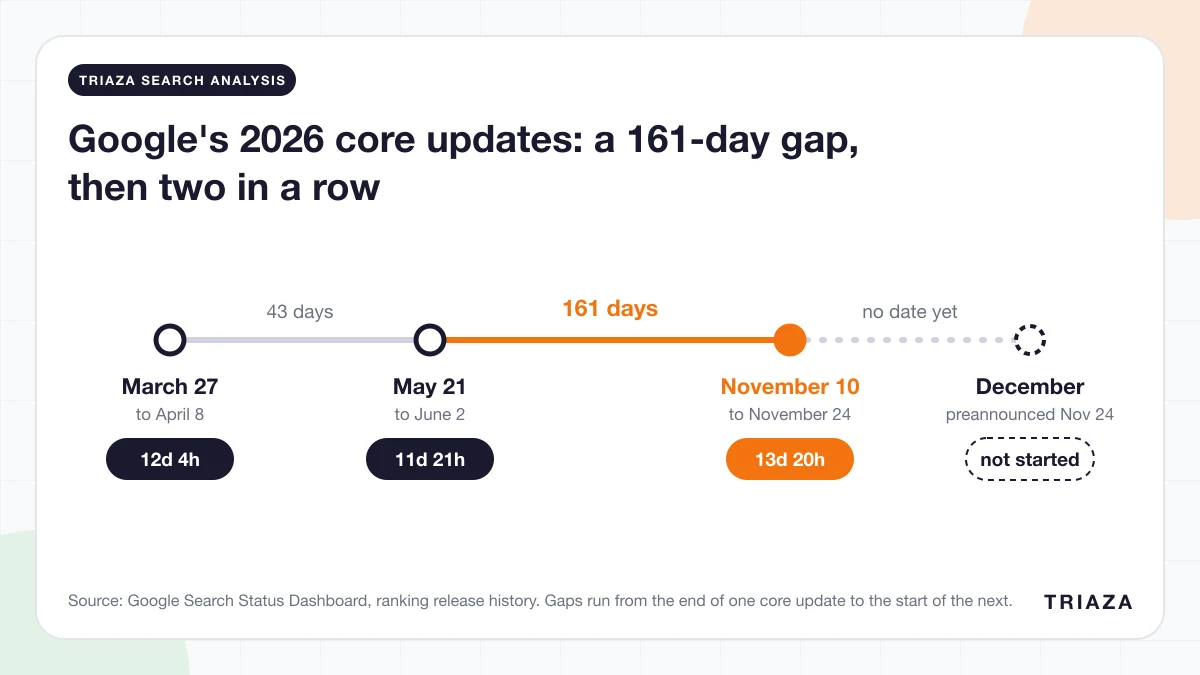
A core update in the month after another one is not new. The October 2023 core update ended on October 19 and the November 2023 update began 14 days later. The November 2024 update ended on December 5 and the December 2024 update began a week after that. The advance notice is the new part.
What Google said about the November update
Google’s record on the November update is three short statements. The dashboard entry on November 10 said: “Released the November 2026 core update, which applies globally and to all languages. The rollout may take up to 2 weeks to complete.” The completion note this morning said: “The rollout was complete as of November 24, 2026.”
The third came from Google’s LinkedIn post, as quoted by Search Engine Roundtable: “This is a regular update designed to better surface relevant, satisfying content for searchers from all types of sites.” Search Engine Journal pointed out on launch day that Google used the same sentence for the March core update, and that “no specific objectives are mentioned on either the dashboard entry or the LinkedIn post.”
There is no Search Central blog post about the November update. Google’s core updates documentation still carries a last-updated date of December 10, 2025. That page says core updates “are broad in nature, and don’t target specific sites or individual web pages.”
So Google has not said the November update was aimed at AI content, templated pages, lead generation sites, or any industry. Those descriptions come from other people, and some have more behind them than others.
Who lost in November, claim by claim
The rollout began on November 10, but the analyst Glenn Gabe and the tool vendor Sistrix both date the visible movement to about November 13, so that is where most of the published data starts.
A summary that spread on X today says the update hit sites with mass-produced AI content, repetitive templates, and low-value lead generation pages in finance, health, and law hardest, while official pages and pages with original data held steady or improved. Each part of that traces to a real source. None of the sources is Google, and each covers less ground than the summary suggests.
| Claim | Where it comes from | What the evidence is |
|---|---|---|
| Lead generation sites in finance, health, and law were the biggest losers | Sistrix, Steve Paine, updated November 24 | UK data only. A selected list drawn from 7,532 rising and falling domains, with sectors assigned by AI |
| Official sites and original data sources gained | The same Sistrix article | Eleven selected winners, most starting from a low Sistrix visibility score, between about 0.5 and 1.5 |
| Templated pages at scale fell | Lily Ray, in a November 23 LinkedIn post reported by Search Engine Journal | Six unnamed sites, Sistrix data checked against Ahrefs |
| Sites that scaled with AI content fell | Glenn Gabe on X, quoted by Search Engine Roundtable | A handful of unnamed example sites |
Lead generation in finance, health, and law
Sistrix’s sentence is: “The biggest losers are lead-generation sites in finance, health and law that use informational content to drive views for conversion.” Its table names UK examples, including totallymoney.com (down 59.75% in Sistrix’s Visibility Index, its score for how visible a domain is in Google’s results, between November 13 and 24), unbiased.co.uk (down 49.49%), and sprintlaw.co.uk (down 60.02%).
The same article also says: “Data is also making it clear that this core update is not targeted at any particular sector,” and “There’s no particular sector that has been affected more than others.” Both statements can be true: the first describes a group among the biggest individual losers on a selected list, and the second describes sectors as a whole. The summary on X kept the first and dropped the second.
Sistrix also flagged a false positive in its own report. The Guardian “dropped significantly since the start of the Core Update,” but a closer look showed it was “part of a longer-term trend.”
A German analysis points the same direction as the sector-average statement. Rheinwunder looked at 134 large German domains in Sistrix data, in an interim report written while the rollout was still running, and concluded: “Whole sectors barely move, Google reshuffles within them, and much of the loss reported so far happened before the start.”
Official sites and original data
Sistrix wrote that “many of the winners are the official site of something people search for by name,” listing a bar chain, a train operator, a charity, a school platform, and a manufacturer, and that “two more are original data sources”: a historical archive and a lottery results site.
The X summary turned that into official pages and original data having “held steady or improved,” which is broader than the source. Sistrix’s list is eleven hand-picked domains that rose between 31% and 179%, and most started with a Visibility Index between about 0.5 and 1.5, so a large percentage gain is a small absolute move. The biggest winner on the list, songmeanings.com, is a lyrics site, and Sistrix doesn’t put it in either group.
Templated pages
Lily Ray’s chart showed subfolders and subdomains on six sites that, in her words, “have been dropping fast since Google’s November core update started.” Search Engine Journal described the folders: each held one template repeated thousands of times, such as a page per word, per area code, or per “X vs Y” pairing. Ray wrote that most of the folders target searches “not closely related to the business offering,” and that within each site “the content section (blog, resources, etc.) is falling hard while the main product/brand pages stay strong.”
She called these “new examples of the exact same SEO issues that have been hurting sites during core updates for years.” Six sites is a small sample, and the sites aren’t named. It’s still the most specific published example, and it matches what Google’s own documentation describes.
AI content at scale
Glenn Gabe wrote on November 16 about two domains another analyst had spotted that “are dropping pretty heavily so far and were scaling heavily via AI-generated content.” On November 20 he shared a site that “surged recently and is dropping heavily with the broad core update. It scaled with commodity content, AI-generated content, etc.”
These are examples, and Gabe presented them as examples. No published study gives a rate or a sample for AI-generated content in this update. A thread on X that called mass AI pages “the main target” offered no data that I could find.
The X summary also credits Marie Haynes with stressing genuine utility over scaled, low-effort pages. I couldn’t find that statement. What I can trace to her this month is the bot-click analysis in the next section.
Why the November update is harder to read than most
Five things happened around the November rollout that can look like the update in a report.
Bot clicks in the “before” period. Some sites saw clicks in Search Console jump between October 31 and November 2 while impressions stayed flat. Marie Haynes analyzed the spikes for Search Engine Journal and concluded: “Whether this is external bot/agent retrieval or a Google logging bug counting automated fetches as clicks, it is not human traffic.” Google hasn’t explained them. If those three days are in your baseline, your “before” number is inflated and the update will look worse than it was.
A logging error in the Generative AI report. Google’s data anomalies page says: “A logging error caused a decrease in impressions on the Generative AI performance report in Search for data from November 9 - November 11, 2026. This issue affects data logging only.” That overlaps the first two days of the rollout. Google’s note names only that one report.
Movement before the update started. Search Engine Roundtable logged unconfirmed ranking volatility on October 27 and again on November 8 and 9, and in the second post said the October 27 movement “lingered on for like a full week.” Google confirmed neither. Rheinwunder’s finding that some early “losers” lost most of their visibility before November 10 fits with this. A drop that began before November 10 has some other cause.
Rank trackers have been unreliable. We covered Google’s blocking of scrapers in our September spam update post. It had not fully eased by mid-November, though Gabe wrote on November 20 that he had seen “much more accurate visibility numbers recently” as the tools filtered out bad results. Schwartz wrote on November 9 that “it is hard to trust the tools since they seem a bit off with all the Google blocking mechanisms in place,” and on November 16 that chatter about this update “has been more muted than most.” Gabe treated Search Console as “the source of truth” for the same reason, and from that data wrote, “I believe the update landed on Friday the 13th.”
A new AI model arrived two days into the rollout. On November 12, Google made a new Gemini model the default in AI Mode and began using it for harder questions in AI Overviews, the AI summaries above the regular results, according to Search Engine Roundtable. Google hasn’t tied that to the core update. If your clicks changed and your positions didn’t, a change in AI answers is one possible reason.
The first week after November’s rollout falls on Thanksgiving
Google’s core update guidance says: “We recommend waiting at least a full week after a core update completes before analyzing your site in Search Console. After a week, try comparing this week with a week before the core update started rolling out.” The new stay-informed page repeats it: wait until the update is marked complete, “plus at least a week of post-rollout data.”
On the November update’s dates, Search Engine Journal worked out that the first full week after completion is November 25 through December 1, and that a clean week before the rollout is November 3 through 9, which avoids the October 31 to November 2 click spike. The week after contains Thanksgiving on November 26, Black Friday, and Cyber Monday. A retailer may see that week run high and a B2B firm may see it run low, with or without an update.
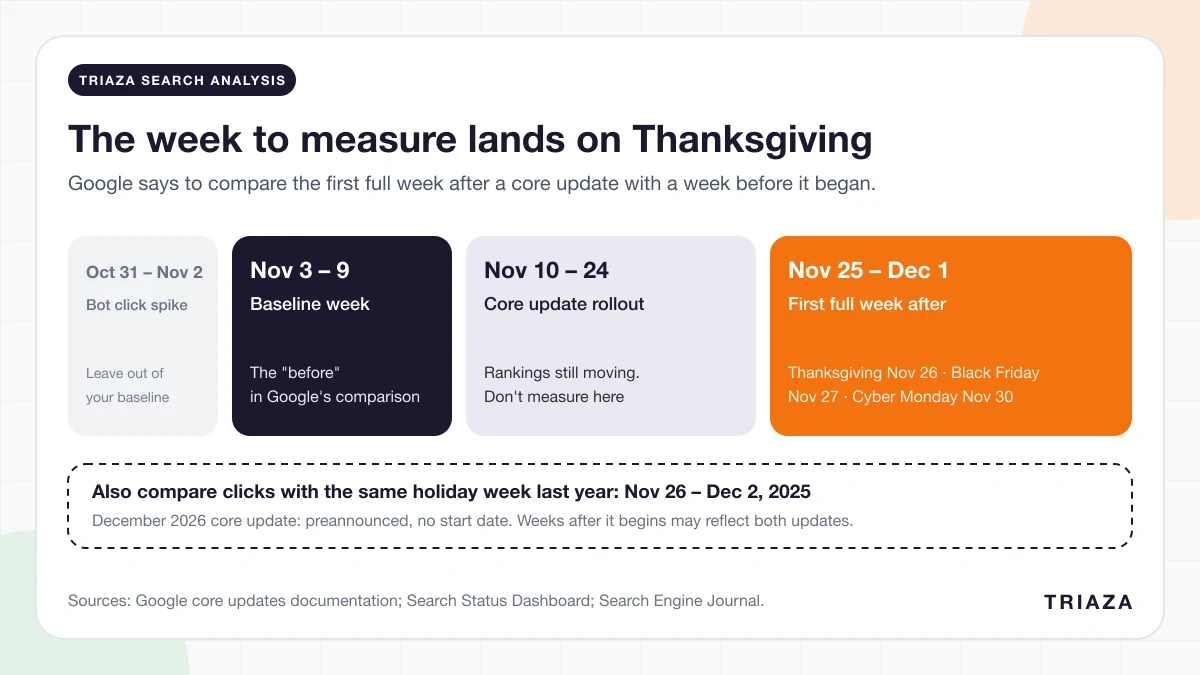
Here is how I’d handle it.
- Export now. Save the last three months of Performance report data by page and by query, so you have a fixed copy of the pre-update numbers to work from.
- Run Google’s comparison when the data is in. November 25 through December 1 against November 3 through 9, using the compare option in the Performance report’s date filter.
- Add a year-over-year check on clicks. Compare the same holiday week in 2025, which ran November 26 through December 2. Use clicks for this. Google’s anomalies page says a logging error prevented Search Console “from accurately reporting impressions from May 13, 2025 until April 27, 2026,” so last year’s impressions and average position aren’t a reliable baseline.
- Split the site by folder. Search Engine Journal’s suggestion is to use a page path filter to compare product pages against a templated content folder. Service pages work the same way. If one folder fell and the rest held, that tells you far more than the site total.
- Annotate the dates. Search Engine Journal suggests using Search Console’s custom annotations. Mark November 10, November 24, and the December start date when Google announces it.
Search Engine Journal noted that the December rollout “could begin as early as Dec. 1,” and that any week after it begins may reflect both updates. That is the outlet’s reasoning. Google’s own word is “not imminent.” Either way, the window for a clean read on November may be short, which is the reason to run the comparison as soon as the data is in.
What to do, by situation
Nothing moved, or a small dip. Google’s example of a small drop is going from position 2 to 4, and its advice is: “There’s no need to take drastic action (in fact, we recommend avoiding making changes to content that’s already performing well).” Save your data and leave the pages that are performing well alone.
A large drop concentrated in one folder. Google’s example of a large drop is position 4 to 29, and it calls for “a deeper assessment.” If the drop sits in a glossary, a set of comparison pages, or city pages built from one template, read Google’s self-assessment questions honestly. One asks: “Is the content mass-produced by or outsourced to a large number of creators, or spread across a large network of sites, so that individual pages or sites don’t get as much attention or care?” Another asks whether you are “using extensive automation to produce content on many topics.” The fix is to make fewer of those pages and make each one worth reading, or to retire the ones nobody would miss. Google’s page calls deleting content “a last resort,” and adds that if you’re considering deleting entire sections, “that’s likely a sign those sections were created for search engines first, and not people.” Our guide to building an AI content system covers how to use AI in content without ending up there.
A drop across informational pages on a finance, health, or legal site. Health and finance fall under topics Google describes as ones that could significantly affect people’s health, financial stability, or safety, where its systems “give even more weight to content that aligns with strong E-E-A-T.” That stands for experience, expertise, authoritativeness, and trustworthiness. Google’s sentence doesn’t name legal topics, but the same care makes sense there. Check who wrote each page, whether a qualified person reviewed it, and whether the page says anything a reader couldn’t get from the ten results above it. Sistrix’s examples are UK sites and a small group, so don’t assume you’re in it because of your industry. Look at your own pages.
A drop that started before November 10. Look at the September spam update, the unconfirmed October movement, or seasonality first. The spam update is a different kind of problem with a different fix, and we covered it in the September spam update post.
In every case, expect the timeline Google describes: “it could take several months for our systems to learn and confirm that the site as a whole is now producing helpful, reliable, people-first content in the long term. If it’s been a few months and you still haven’t seen any effect, that could mean waiting until the next core update.” With one scheduled for December, the next core update is closer than usual, though Google hasn’t said it will reassess sites on their changes. That isn’t an argument for rushing: Google’s page also warns against “quick fix” changes.
Questions site owners keep asking
When does the December 2026 core update start? Google hasn’t given a date. The dashboard says it is “scheduled to be released in December 2026,” and a Google spokesperson told Search Engine Roundtable that it’s “not imminent” and that Google will announce it the day it starts.
Why did Google preannounce the December core update? Google’s new documentation says it now publishes advance notice of significant ranking updates, and that it gives notice in line with the UK Competition and Markets Authority’s fair ranking conduct requirements when UK users may see a significant ranking shift. Google hasn’t said that requirement is the reason for this specific notice.
When did the November 2026 core update start and finish? It started on November 10, 2026, at 10:06 a.m. Pacific and finished on November 24 at 6:03 a.m. Pacific, according to Google’s Search Status Dashboard. The rollout took 13 days and 20 hours.
What did the November 2026 core update target? Google hasn’t said. It called it “a regular update designed to better surface relevant, satisfying content for searchers from all types of sites.” Analysts have published examples of templated pages, AI content produced at scale, and UK lead generation sites losing visibility, but those are samples and examples, not statements from Google.
Did the November core update penalize AI content? There’s no evidence of a penalty for AI content as such. Google’s policies are about purpose and value. Its spam policy on scaled content abuse covers pages “generated for the primary purpose of manipulating search rankings and not helping users,” and describes it as typically large amounts of unoriginal content that provides little to no value to users, “no matter how it’s created.” The examples analysts published involve sites that scaled up large volumes of templated or commodity pages.
How long should I wait before checking my traffic? Google recommends at least a full week after the rollout completes. For the November update that week is November 25 through December 1, which includes Thanksgiving, Black Friday, and Cyber Monday, so compare it against last year’s holiday week as well as against November 3 through 9.
Can I recover before the next core update? Sometimes. Google says some changes take effect in a few days, that it can take several months for its systems to confirm a site has improved, and that if nothing has changed after a few months, it may take the next core update.
Will personalization in the December update change my rankings? For any one searcher, it may change the order of some results. Google says personalization doesn’t affect all results and only reorders them when that’s likely to be more helpful. It hasn’t said what will change in December. Search Console’s average position already reflects what real searchers saw, so watch that instead of a single tracked rank.
What to do this week
Export your Search Console data today and annotate November 10 and 24. Run the comparison after December 1, by folder, with last year’s holiday week alongside it. If the numbers point at one template or one section, start on those pages before December’s update begins.
If you’d like a second set of eyes, our SEO service starts with that folder-by-folder read, and our AI content systems work is for teams that publish at volume and want each page to hold up.