The usual version of this decision happens in a board meeting. Someone says the company needs “a marketing person,” the founder opens a job req for a Head of Marketing, and four months later there’s one talented generalist trying to write the positioning, run the website, launch paid search, and clean up the CRM at the same time. Or the founder skips the hire, signs an agency retainer, and discovers that nobody inside the company can tell whether the agency’s monthly report means anything.
In both cases the option itself may have been fine. The mistake was treating “marketing” as one purchase when it’s at least three: someone to decide what to say and to whom, people to do the work, and someone accountable for whether it produced pipeline.
On fractional CMO vs marketing agency, the short answer depends on what you’re missing. If nobody at your company can set marketing strategy yet, buy strategy first: a fractional CMO, or an agency whose senior people will actually own the plan. If the strategy is settled and the bottleneck is output, buy execution from an agency or a specialist. Make your first full-time hire when you know which channel works and need someone to run it every day. In our view that usually comes after the other two.
Triaza is an agency, and we sell a fractional-team model to startups, so weigh what follows with that in mind. We say below where an agency is the wrong call.
What each option actually buys
Each option buys a different mix of four things.
Strategy is deciding the market, the message, the channels, and the budget. Execution is producing the website, content, campaigns, and reporting. Accountability is one person who owns the pipeline number and answers for it. Continuity is who still knows the history in 18 months.
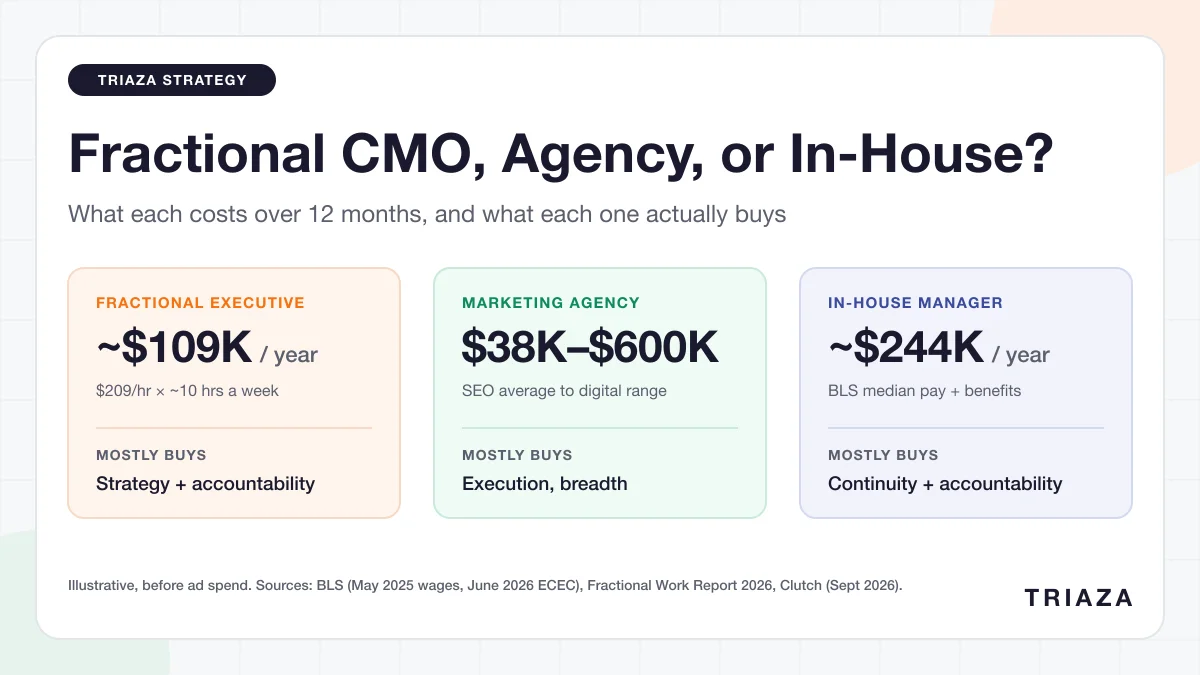
A fractional CMO is mostly strategy and accountability. You’re renting senior judgment for a slice of the week. Many won’t write your ads or build your landing pages, and the ones who do are usually selling a CMO-plus-team package, which costs more.
An agency is mostly execution, with as much strategy as its senior people bring. Good agencies can supply both, and the difference between a useful agency and a frustrating one is usually whether the person who sold you the retainer is still in the room after month two.
An in-house hire is mostly continuity and accountability. They learn the product, sit in on sales calls, and stay. What you can’t buy with one salary is breadth. A single marketer can’t be a strategist, a designer, a writer, and an ops person at once, no matter how good they are.
Fractional CMO vs marketing agency vs in-house: what each costs over 12 months
Price comparisons for this decision are mostly vendor marketing. Many of the ranges that rank for “fractional CMO cost” come from firms that sell fractional CMOs, and many agency ranges come from agencies. We’ve kept to figures we could trace to government data, a named survey, or a marketplace dataset, and labeled the vendor figures as vendor figures.
| Option | Basis for the figure | Source type | Monthly | 12 months |
|---|---|---|---|---|
| Marketing manager, fully loaded | BLS median wage grossed up by BLS benefits share | Government data (derived) | ~$20,300 | ~$243,500 |
| Marketing specialist, fully loaded | BLS median wage grossed up the same way | Government data (derived) | ~$9,600 | ~$115,000 |
| One-time cost to hire (non-executive) | SHRM average cost per hire | Survey | n/a | $5,475 |
| One-time cost to hire (executive) | SHRM average cost per hire | Survey | n/a | $35,879 |
| Fractional marketing executive, ~10 hrs/week | Reported hourly rate × typical posted hours | Marketplace survey (derived) | ~$9,060 | ~$108,700 |
| Fractional CMO firm retainer | One firm’s stated retainer range | Vendor-reported | $1,500 to $30,000+ | $18,000 to $360,000+ |
| SEO agency | Clutch average reviewed project | Marketplace | ~$3,200 | ~$38,400 |
| PPC agency | Clutch average reviewed project; ad spend inclusion unclear | Marketplace | ~$7,165 | ~$86,000 |
| Digital marketing agency, range | Clutch pricing range, ad spend excluded | Marketplace | $5,000 to $50,000 | $60,000 to $600,000 |
That table is arithmetic on published figures, not a quote from anyone. Your costs will differ by city, seniority, scope, and how much ad spend sits on top.
The in-house math
The Bureau of Labor Statistics puts the median annual wage for marketing managers at $166,790 as of May 2025. That’s wages only, national, across all industries, from the government’s OEWS survey. For the more junior hire, the BLS figure for market research analysts and marketing specialists is $78,760.
Salary is only part of what an employee costs. The BLS Employer Costs for Employee Compensation table for June 2026, released September 9, 2026, shows benefits at 31.5% of total compensation for private-industry management, professional, and related occupations. That’s a broad occupational group, not a marketing-specific number. Wages are the other 68.5%, so to gross a salary up to total cost you divide by 0.685:
- $166,790 ÷ 0.685 ≈ $243,500 a year, of which roughly $76,700 is benefits
- $78,760 ÷ 0.685 ≈ $115,000 a year
Treat both as illustrations. The lower all-private-industry benefits share of 30.0% in the same BLS release would put the manager at about $238,300 instead.
Then add the cost of finding the person. SHRM’s 2025 Benchmarking Report, from a survey of 2,371 members fielded January to March 2025, found an average cost per hire of $5,475 for non-executive roles and $35,879 for executive roles. Those are SHRM’s reported averages, not medians. A marketing manager in year one lands near $249,000 all in.
The table leaves out time. We found no sourced figure for how long a startup takes to fill and ramp a marketing role, so check how long your own last two hires took.
The fractional math
This is the least well documented of the three. The best dataset we found is the Fractional Work Report 2026 from Fractional Jobs, a marketplace. It surveyed 1,733 current, past, and aspiring fractional workers. Its rate table, based on 546 responses, shows marketing executives billing a mean of $209 an hour, against $223 across all executives. It also found the typical posting on its platform calls for about 10 hours a week. That hours figure covers every function, not just marketing.
Put those together and you get $209 × 10 hours × 52 weeks ≈ $108,700 a year. It’s a rough cross of two numbers from one vendor-run report, where the rates are what workers say they bill.
Retainer pricing varies much more. Chief Outsiders, a fractional CMO firm, says in a post last updated October 2026 that firms like it charge $1,500 to over $30,000 a month, which it equates to roughly $300 to $500 an hour. MarketerHire’s March 2025 post says fractional CMOs generally charge $200 to $350 an hour and ongoing support typically runs $5,000 to $10,000 a month, while noting those are industry averages rather than its own rates. Neither cites a survey.
We found no independent survey of what a fractional CMO costs. In practice the price moves with hours per week, whether the engagement includes anyone who executes, and how senior the person is.
The agency math
Agency pricing has better marketplace data, though none of it is specific to B2B startups under $20 million, and we didn’t find a source that is.
Clutch’s SEO pricing page, updated September 21, 2026, puts the average monthly cost of reviewed SEO projects at $3,199.19, and most SEO agencies on the platform bill $100 to $149 an hour. Ahrefs’ SEO pricing survey of 439 providers worldwide, last updated August 15, 2024 and so older than the Clutch figure, landed close by: a $3,209 average monthly retainer for agencies, about $1,348 for freelancers. For paid media, Clutch’s PPC figure is $7,165.33 a month on average, with no sample size disclosed. The page reminds buyers that agency fees are separate from ad spend, but it doesn’t say whether that project average includes any media.
For broader digital marketing retainers, Clutch’s range runs from $5,000 to $50,000 a month, drawn from 106,043 firms worldwide, and the page says ad costs aren’t included in those fees. Budget the media separately. Swydo’s 2026 agency pricing guide describes management fees of 20% to 30% of spend under $5,000 a month, falling to 10% to 15% above $50,000, with most agencies keeping $1,000 to $5,000 monthly minimums. That’s a practitioner benchmark, not a survey with a sample size.
Retainers aren’t the only way in. The Promethean Research 2025 Digital Agency Industry Report, whose sample leans toward larger North American agencies, found 95% of agencies offered projects and 91% offered retainers. Ask for a scoped project first.
How to choose by stage, sales motion, and product
Once you know the price ranges, three things about your company narrow the choice: its revenue stage, how it sells, and how hard the product is to explain.
By revenue stage
Pre-revenue to early revenue. You need a message that works more than you need a department. The founder is still the best salesperson, and marketing’s job is to give that founder a sharper story, a credible website, and a few assets that shorten sales calls. A light fractional engagement or a scoped agency project fits. A $243,500 full-time hire usually doesn’t, because there isn’t yet a proven channel for that person to run. Our positioning guide for new categories covers what that early message work involves.
Early traction, roughly seed to Series A. Now you need both a plan and output, and you likely can’t afford a senior leader plus a team. This is where a fractional CMO for startups, paired with execution help, or an agency that brings its own senior strategist, usually fits. Look for month-to-month or short terms.
Repeatable growth, roughly Series A and beyond. Once one or two channels reliably produce pipeline, the argument for in-house gets strong. You want someone who sits in pipeline reviews, knows the product deeply, and keeps the accumulated context. Outside partners shift to specialist work in channels you don’t want to staff yet.
By sales motion
If the founder still closes most deals, marketing’s first job is sales support. That means messaging, case studies, a website that backs up the pitch, and a CRM that captures what happens after a call. Strategy and craft matter more than volume, which favors a senior fractional leader or a small, senior agency team.
If you have a sales team with quota, marketing has to feed it, and the handoff to sales is where things break. Whoever you choose needs to own lead routing, qualification, and follow-up speed alongside the campaigns. We wrote a separate piece on CRM handoffs between marketing and sales because it’s a common place for outside partners and new hires to lose deals.
By product complexity
For AI and deep-tech companies, the product is usually hard to explain and the buyers are technical. That raises the cost of getting the message wrong and lowers the value of generic content. Whoever writes for you has to be able to interview your engineers and turn what they say into claims a technical buyer will believe. Ask any agency or fractional candidate for writing samples in a comparable technical category, and pass on the ones who can’t show any.
When you don’t need an agency
We sell agency services, and these are the cases where buying them is a mistake.
You probably don’t need an agency if:
- You don’t yet know what to say. An agency will produce content either way. If the positioning isn’t settled, you’ll pay for polished assets built on a message you’ll replace in six months. Fix the message first, with a fractional strategist, a positioning project, or the founders in a room.
- You have one channel that works and someone who can run it. Adding an agency to a working, well-staffed channel mostly adds coordination.
- Your total budget can’t cover both fees and media. If a PPC agency’s fee would eat most of the ad budget, you’re paying for management of spend too small to learn from. Run it yourself, or buy a few hours of expert setup and review.
- Nobody internal can review the work. An agency needs someone on your side who can say “this is wrong” about the product and the customer. Without that person, you’ll get work that looks professional and says nothing specific.
The same test applies to the other two. Skip the fractional CMO if the strategy is clear and you’re short on hands, and hold off on the full-time hire if you can’t describe the job beyond “do marketing.”
Hybrid models and how to hand off cleanly
Many companies in this range end up with a combination. Two patterns come up often.
Fractional leader plus agency execution. The fractional CMO sets strategy and holds the agency accountable, and the agency does the work. The risk is gaps between them, where each assumes the other owns reporting or lead follow-up. Name one owner for each metric in writing.
Agency plus first in-house hire. Your first marketer becomes the editor and strategist, and the agency keeps the production capacity so that one person isn’t stuck doing four jobs. Over time, the hire decides which work to bring in-house.
In either pattern, the handoff problems that hurt most are about access: who holds the accounts and files when a partner leaves. Before any partner starts, make sure your company owns:
- The CRM and every contact, deal, and activity record in it, with admin access held by an employee
- Ad accounts for Google, LinkedIn, Meta, and any others, created under your company’s business manager with your billing, and the partner added as a user
- Analytics and tag management, owned by your company, with the partner as a user
- The domain, website hosting, and CMS logins
- Brand assets: source design files, fonts, logo files, and the brand guide, delivered in editable formats
- Content: drafts, briefs, and any research, stored in your company’s drive rather than the partner’s
When a partner creates an ad account under its own agency account, the campaign history, audiences, and conversion data can stay with them when you leave. Of everything on this list, that’s the hardest to fix later, and setting the account up under your company from the start prevents it.
Red flags in each model’s contract
In-house. There’s no contract to read, so look hard at the job description. If it asks one person to own brand, content, paid, SEO, events, and marketing ops, you’re hiring for a team. Expect either burnout or a narrow set of things done well.
Fractional CMO. Watch for undefined hours or deliverables (“strategic guidance” with no cadence), no named owner for execution, and long notice periods. The Fractional Work Report found most fractional engagements run six to twelve months across all functions, so a long initial term deserves a hard look and an exit clause. Be cautious, too, of a fractional leader who will only work with their own preferred vendors and discloses no referral fees.
Agency. Watch for long initial terms with no exit for underperformance, ad accounts or analytics set up under the agency’s ownership, reporting that shows activity (posts published, impressions) without any link to pipeline, and a senior team in the pitch that you never see again. If the agency takes a percentage of ad spend, ask what it does to your fee when it recommends spending more. Our 14 tips for choosing an SEO agency goes deeper on vetting questions, and most of them apply to any agency.
Questions founders ask about fractional CMOs, agencies, and hiring
Is a fractional CMO cheaper than a marketing agency?
Not necessarily, because they buy different things. At the Fractional Work Report’s average marketing rate of $209 an hour for the typical posted 10 hours a week (a figure that covers all functions), a fractional executive costs roughly $108,700 a year. An SEO agency at Clutch’s average costs about $38,400 a year for execution in one channel.
How much does a fractional CMO cost per month?
Published ranges run from about $1,500 to more than $30,000 a month, per Chief Outsiders, with MarketerHire calling $5,000 to $10,000 typical. Both are vendors, and no independent survey of fractional CMO retainers exists that we could find. The main drivers are hours per week, seniority, and whether any execution is included.
When should a startup hire a full-time marketer instead?
When you have at least one channel that reliably produces pipeline and need someone to run and improve it every day. Before that, a full-time hire tends to spend the first months working out the strategy that a fractional leader or a strategy-first agency could have delivered faster. A marketing manager at the BLS median wage, grossed up for benefits, costs roughly $243,500 a year, so the role should have a clear job.
How long do fractional CMO engagements usually last?
Most fractional engagements run six to twelve months, and 60% last six months or longer, according to the Fractional Work Report 2026. That’s across all fractional engagements, not marketing alone. Plan for a defined handoff at the end, either to a full-time hire or to a longer arrangement.
Should I hire a marketing agency or build in-house?
If you need several skills at once (writing, design, paid, ops) and can’t justify several salaries, an agency is usually the practical way to get them. If you need deep product knowledge and daily work with sales, in-house is the better fit over time. Many companies use an agency for breadth now and let their first hire decide later what to bring inside.
Do agency retainers include ad spend?
Usually not. Clutch’s digital marketing pricing data states that advertising costs aren’t included in agency fees. Paid media agencies often charge a management fee on top, which Swydo puts at 10% to 30% of spend depending on volume, with monthly minimums. Budget media as its own line, as we explain in our startup marketing budget guide.
Can a fractional CMO and an agency work together?
Yes. The fractional leader sets strategy and holds the agency to it, and the agency supplies the people who execute. It works when one person owns each metric and your company, not either partner, owns the accounts and data.
What happens to my data if I leave an agency?
That depends on who owns the accounts. If your CRM, ad accounts, analytics, and website were set up under your company with the agency as a user, you remove their access and keep everything. If the agency created them under its own logins, you may lose campaign history and audiences. Check ownership before you sign.
Making the call for 2027
Before choosing, write down which of the four things you’re short on: strategy, execution, accountability, or continuity. It’s usually one or two, which tends to rule out at least one option.
If the gap is strategy, start with a fractional leader or a strategy-first engagement, and don’t hire until the plan names a channel. If it’s execution, buy it from people who’ve done it in your category. If you already have a working channel and the budget for a full-time marketing manager at about $243,500 a year fully loaded, hire, and give that person an agency or specialists to lean on so they aren’t a one-person department.
If you’re early and short on both strategy and hands, that’s the gap our fractional marketing team for startups is built to fill until you’re ready to hire.