A manufacturing website rarely has one reader. An engineer may be comparing dimensions and materials. A buyer may be checking lead times, certifications, and supplier risk. A dealer may need product training, approved collateral, and a clear service path. When all three land in the same generic resource library, useful content can become difficult to find and maintain.
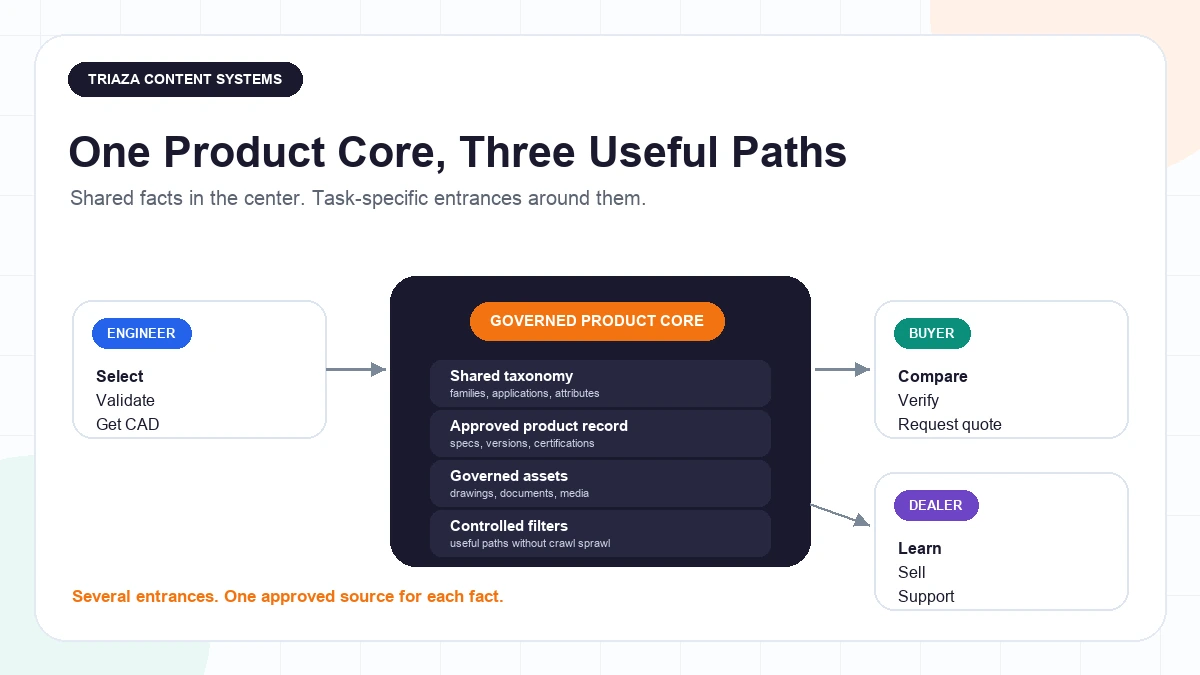
A manufacturer should build one governed content hub around shared product and application data, then give engineers, buyers, and dealers task-specific ways into it. The goal is not three separate libraries. It is one reliable information system with clear paths to specifications, commercial details, channel resources, ownership, revision history, and the next useful action.
That model sounds simple until a team inventories the real content. Product pages live in the content management system. Specifications sit in PDFs. Drawings live in a CAD library. Certifications are maintained by quality or compliance. Warranty language has another owner. A distributor feed may use different field names. A dealer portal may carry an old brochure because nobody knew the product record changed.
The work reaches beyond a website redesign. It decides how product information is structured, approved, reused, found, and retired.
Why A Generic Resource Library Breaks Down
Most resource libraries are organized around file type. They have sections for brochures, videos, manuals, case studies, and downloads. That structure may reflect how the marketing team produced the material, but it does not reflect why a visitor needs it.
An engineer does not usually arrive thinking, “I need a PDF.” The engineer needs to determine whether a product fits an assembly, material, load, environment, code, or application. A buyer is not looking for a brochure category. The buyer needs evidence about availability, terms, certification, supplier continuity, or total operating implications. A dealer may need a training module, product comparison, installation answer, current image, or approved claim for a customer conversation.
File-type navigation can force visitors to translate their tasks into the company’s internal filing system. It also encourages duplication. The same dimensions may be typed into a product page, a datasheet, a dealer sheet, and a comparison table. Every copy becomes another place where a correction can be missed.
Research from GlobalSpec and TREW Marketing helps explain why this matters before a sales conversation. In their 2024 self-report survey of engineers and technical buyers, respondents said an average of 66% of the buying process for significant work-related purchases happened online before they chose to speak to someone at the company, and 77% said at least half happened online first. The question base was 842. The report says more than 900 qualified respondents participated globally, but questions were optional, question bases varied, and the public report does not disclose recruitment, sampling method, field dates, response rate, weighting, or margin of error. These are self-reported findings, not a universal measure of every industrial purchase.
The practical implication is narrower than the statistic. The website must help a technical buyer make real progress without waiting for a representative to explain where the current drawing or compatibility table is stored.
Start With One Shared Product And Application Core
The durable center of the hub should describe what the company makes and where it is used. Audience labels can help people start, but they should not define three different versions of the catalog.
A useful shared core usually has several layers:
- Product family. Use the stable grouping a customer recognizes.
- Application. Describe the job, assembly, environment, or system where the product is used.
- Product record. Keep identity, model, SKU, dimensions, materials, performance values, compatibility, certifications, warranty, status, and approved media together.
- Technical assets. Connect datasheets, drawings, CAD or BIM files, installation instructions, safety information, test reports, and application notes where relevant.
- Commercial context. Add availability, lead-time ranges, minimum order details, quote path, service options, and approved total-cost inputs when the company can publish them.
- Channel resources. Provide training, approved collateral, campaign kits, pricing or rebate rules, service contacts, and product-change notices.
- Governance. Record the source owner, technical approver, product version, last verified date, next review, and retired or superseded state.
This is a planning framework, not a required schema. A manufacturer with twenty products will not need the same information model as a manufacturer with twenty thousand configurable components. A building-product company may organize around assemblies, code reports, architect specifications, and installation conditions. A process-equipment company may lead with flow, pressure, temperature, material compatibility, and service conditions.
The test is whether the core can answer the common questions once. If the same approved performance value must be typed separately into six systems, the team does not have one product-information core. It has six copies and a reconciliation problem.
Test The Model With One Product Family
A practical architecture should work against a real product before it becomes a sitewide diagram.
Choose a family that has several models, meaningful technical differences, active buyer questions, and at least one dealer or distributor path. Avoid the easiest family. A single product with one PDF will not expose the naming, filtering, ownership, and revision problems the hub needs to solve.
Build a working table with one row for each important field:
- Field name
- Customer-facing label
- Definition and unit
- Allowed values or format
- Product and region scope
- Authoritative source system
- Source owner
- Technical approver
- Public, partner-only, or internal state
- Outputs that use the field
- Change trigger
Then select a small set of decisions to test. An engineer might need to determine whether one model fits an application and retrieve the correct drawing. A buyer might need to confirm certification scope and ask for a quote with the right configuration attached. A dealer might need to compare two options and send the current installation guide.
Walk each task from the visitor’s starting language. Do not begin from the proposed navigation. If the engineer says “corrosion-resistant exterior fastener” while the catalog says only “Series 480,” the model needs an application or attribute path that connects those terms. If the buyer needs a regional certification but the record stores only one global certification field, the model has hidden a scope problem. If the dealer cannot tell whether the image is approved for the current product version, the asset record is incomplete.
The pilot should also expose which work belongs outside the website. A product information management system may hold structured attributes. Product lifecycle management may control engineering revision. Enterprise resource planning may supply availability or order status. The content management system may assemble public pages. A dealer portal may handle partner-specific terms. The hub is the connected experience and governance model, not necessarily one software application.
Document those boundaries. “Single source of truth” is not useful when nobody can name the source for a field.
Keep Product Facts Separate From Audience Explanation
One product fact can support several explanations without becoming several facts.
Suppose a product has an approved operating-temperature range. The engineer view may place it beside material and performance conditions. The buyer view may use it to explain whether a lower-cost option fits the project. The dealer view may include it in a comparison and training module. All three should read from the same approved value and scope.
The surrounding explanation can differ. Engineers may need test conditions. Buyers may need the consequence for selection. Dealers may need a question to ask before recommending the product. This is adaptation, not duplication, as long as the underlying value remains governed.
The distinction matters during review. A technical approver should not have to reapprove an unchanged value every time marketing changes a heading. A publishing owner should not be allowed to change the value because a sentence reads more smoothly. Define which parts are controlled facts, approved claims, audience explanation, and presentation.
Give Engineers A Path From Selection To Validation
An engineer-facing path should help a person move from a problem or application to a shortlist, then from that shortlist to evidence.
The first page does not need every technical detail. It needs enough structured information to establish relevance and link to the deeper material. Product-family and application pages can explain what belongs, what does not, which conditions matter, and which attributes distinguish the options. A comparison or configurator can then narrow the field. The product record should lead to the current drawing, datasheet, certification, installation details, and a route to application engineering when a published answer is not sufficient.
In the same GlobalSpec and TREW Marketing report, among 448 respondents whose most recent major work purchase was hardware, datasheets at 56%, technical-publication articles at 37%, and CAD drawings at 31% were the three most-selected valuable content forms. Respondents could select all that applied. The three figures are the highest aggregate selections for the hardware subgroup, not three personally ranked choices, observed download behavior, or evidence that a format caused a purchase.
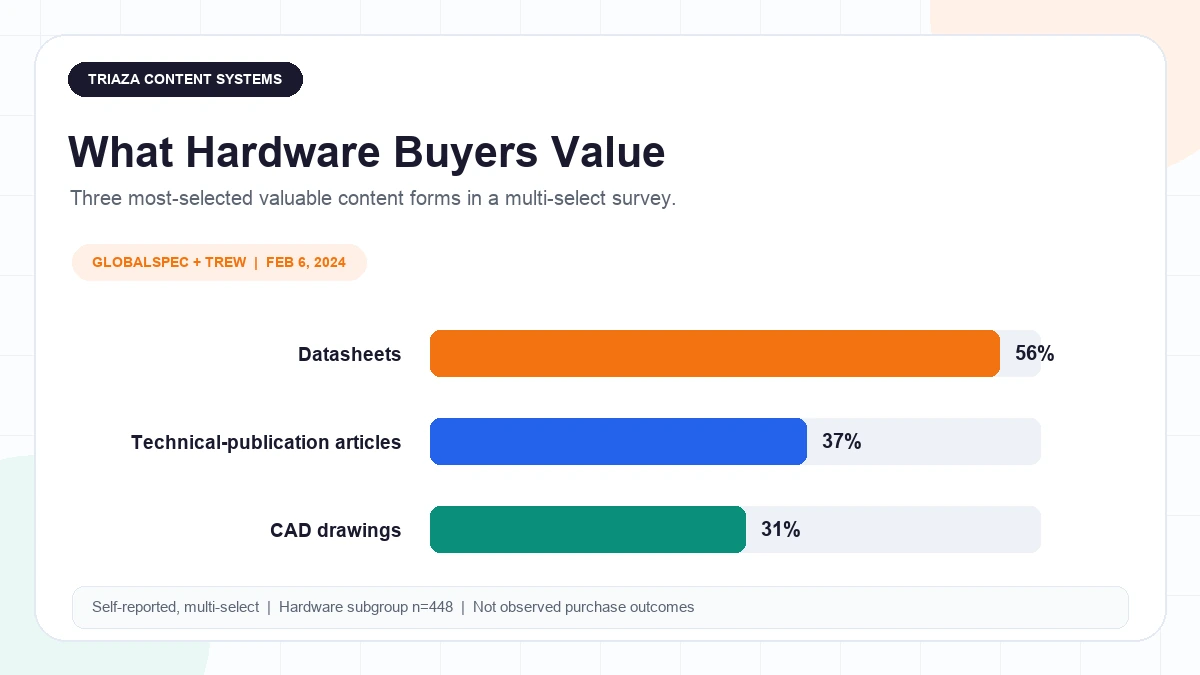
Those findings support a content path, not a file dump. A datasheet should link to the product page that supplies context. A drawing should identify the product version and dimensions it represents. A technical article should connect the application question to relevant products without pretending to replace the drawing or specification. A product page should point to the current asset and explain when a reader needs to contact an engineer.
Make Product Search Work Like An Engineering Question
Catalog search often fails when it accepts only a part number or internal product name. Engineers may begin with a material, function, mounting style, capacity, dimension, environmental condition, or compatible system.
Layer One and Channel Marketing Group reported in research published June 30, 2022 that only 23.4% of respondents rated finding a specific product on a manufacturer’s site relatively easy or very easy. The study gathered more than 260 online survey responses and 30 interviews overall, but it did not publish the item-level base for the 23.4% result. Its qualitative findings and recommendations discuss filters by product attributes, material, function, and application, along with specifications, dimensions, safety and application information, BIM or CAD files, configurators, and comparisons.
That research was vendor-commissioned and exploratory. Recruitment, response rate, weighting, geography, interview protocol, and qualitative coding are not disclosed. Fifty-seven percent of participants had fewer than five years of experience, and most worked from home at least some of the time during end-2021 fieldwork. The findings should guide questions for a manufacturer to test with its own users, not become a universal catalog recipe.
A useful product finder starts with the attributes a person knows before knowing the SKU. It also handles vocabulary. Customers may use a trade name, standard term, regional name, old model number, or application phrase that does not match the internal taxonomy. Synonyms and cross-references help the search system translate without changing the approved product name.
Keep Conditions Beside The Technical Claim
A performance value without conditions can create false confidence. The record should identify the test condition, unit, standard, material, configuration, temperature, tolerance, or other boundary needed to interpret the value.
This does not require putting an entire test report on every category page. The short value should link to the evidence and limitations that make it usable. If a compatibility table is a screening tool rather than an engineering recommendation, say so. If a certification applies only to specific models, assemblies, or installation conditions, make that scope visible before the download.
Technical content should state precisely where each claim applies. It does not need promotional language added to the specification.
Give Buyers A Path From Shortlist To Approval
Procurement and business buyers may read some of the same product pages as engineers, but they are often answering a different set of questions:
- Can the supplier provide the product in the required window?
- Is the quote comparable with the alternatives?
- Are the required certifications current and in scope?
- What creates cost after the initial purchase?
- What is the warranty or service model?
- What happens if a component, material, or location becomes unavailable?
- Is the company information sufficient for supplier verification?
Thomas reported in a May 27, 2021 article based on a poll of more than 400 verified, registered buyers on the Thomas Network that delivery performance, availability, and lead times ranked first among its four highlighted shortlisting factors. Price ranked second. Current quality certifications and verified company information completed the group. Thomas does not publish percentages, question wording, response distribution, geography, or full sampling details, so this is directional evidence from buyers on its sourcing network rather than a universal ranking for every manufacturing purchase.
A buyer path should therefore connect the technical record to the commercial and supplier evidence the company is approved to publish. That may include standard lead-time ranges, availability language, certification records, warranty terms, quality documentation, facility or location facts, continuity planning information, and a clear quote process.
Do not invent public specificity because a buyer would find it useful. If pricing depends on configuration and the company has not approved public ranges, explain the variables and provide a quote path. If live inventory is not reliable, do not label a static quantity “in stock.” A hub is valuable only if the information can be maintained.
Separate Purchase Price From Operating Inputs
A buyer may need more than unit price to compare options. Freight, installation, energy use, maintenance, consumables, expected service life, downtime, warranty, training, and disposal may affect the decision. Publish only the inputs the company can support.
Avoid a universal return-on-investment calculator unless the assumptions are visible and relevant. A useful calculator lets the buyer replace default assumptions with known values, shows what is and is not included, and does not turn a scenario into a promised result.
The same principle applies to comparisons. A product comparison should use meaningful decision attributes and a consistent source. It should not mark the company’s own product as the winner in every row. When a lower-cost or simpler option fits, saying so can save both the buyer and the sales team a poor-fit conversation.
Give Dealers A Path From Product Knowledge To Customer Support
Dealers and distributors do more than relay brochures. They may sell, configure, stock, quote, install, service, train, and support the product. Their content path has to connect current product facts to the work they perform.
Salesforce’s 2024 Trends in Manufacturing report says 80% of surveyed manufacturers sold through distributors, dealers, or franchises. The report ranks customer service and support coordination first among partner-channel priorities, followed by sales and marketing coordination, partner training and performance management, price protection and rebate management, and channel incentives and loyalty programs. In a separate multi-response chart with no published item-level base, 46% cited improved partner-channel communications as a factor driving operational change. That result may describe only respondents making partner-channel changes and should not be read as 46% of all manufacturers.
The report is a Salesforce-produced, double-anonymous survey of 830 manufacturing decision makers across ten named markets or market groups, fielded from May 30 to late June 2024. Recruitment, response rate, weighting, questionnaire wording, uncertainty, and item-level bases are not disclosed. The priority list is ranked without percentages. The report also contains a one-day discrepancy in its stated fieldwork end date, which is why the draft uses “late June.”
The defensible lesson is not that every manufacturer needs the same portal. It is that channel content should reflect operational coordination, not just promotion.
A dealer path may need:
- Current product facts, images, drawings, and approved claims
- Product comparisons and selection guidance
- Installation, service, troubleshooting, and escalation material
- Training modules and release notes
- Localizable campaign assets with clear editing limits
- Pricing, rebate, incentive, and eligibility rules where appropriate
- Stock, availability, backorder, and replenishment information when the systems support it
- Product-change, substitution, and discontinuation notices
- A named contact for technical, order, warranty, and marketing questions
The manufacturer should also decide which information is public, which requires a partner login, and which belongs in a controlled business system rather than the content hub. A public product page may carry current specifications and approved imagery. Partner pricing, account-specific terms, open orders, or incentive status may require authentication.
Make Dealer Assets Reusable Without Making Them Uncontrolled
A downloadable presentation or social graphic can help a dealer sell. It can also carry an obsolete claim for years.
Every channel asset should identify the product version, approved use, owner, and review state. Editable templates need locked facts and clear fields a partner may change. A dealer should be able to find the newest asset without comparing filenames such as final, final2, and approved-new.
When a product changes, the hub should notify the right partners and mark the old asset as superseded. Do not simply delete every old file. A distributor page, saved email, or customer document may still link to it. The old URL can point to a replacement notice that explains which product or document is current.
Use Audience Entrances Without Building Audience Silos
“For Engineers,” “For Buyers,” and “For Dealers” can be useful starting points. They should not become locked rooms.
Nielsen Norman Group warns that audience-based navigation often, not always, hurts usability because people may span categories or need content across segments. Its companion guidance adds that people may not identify with the organization’s labels and that audience paths work better when groups are clear and distinct and users are not trapped in one section.
Manufacturing roles overlap. An application engineer may need lead-time information. A procurement manager may need the certification scope. A dealer may specify a product for a project and need CAD. A contractor, architect, owner, installer, or service technician may not identify with any of the three headline labels.
Treat audience entrances as curated views over the shared information model:
- The engineer view emphasizes selection, application, technical evidence, drawings, and validation.
- The buyer view emphasizes comparison, supplier evidence, availability, terms, and approval.
- The dealer view emphasizes training, reuse, customer support, channel rules, and updates.
All three should lead back to the same authoritative product record. A visitor should be able to move between views without restarting the search.
Task labels may work better than role labels in parts of the hub. “Select a Product,” “Verify Compliance,” “Get Drawings,” “Compare Options,” “Install and Service,” and “Sell and Support” tell visitors what can be accomplished without requiring them to choose an identity.
Design The Taxonomy Around Stable Differences
A taxonomy is the set of categories and attributes used to organize the content. Start with the durable differences among products and applications rather than the current navigation.
Begin with a sample of real decisions. Ask engineering, product, sales, support, and channel teams:
- What does a customer know before knowing the product name?
- Which attributes eliminate an option?
- Which attributes matter only for comparison?
- Which application terms appear in conversations but not in the catalog?
- Which product names have changed?
- Which documents are shared across a family, and which are model-specific?
- Which facts vary by region, configuration, or product version?
- Which terms are internal jargon?
Product families should be stable enough to support navigation. Attributes should support filtering and comparison. Applications should connect a problem or assembly to suitable families. Document types should remain an access route, not the only way to understand the catalog.
Avoid turning every attribute into a category. Material, capacity, voltage, mounting, finish, rating, certification, and compatibility may be useful filters. If every combination creates a permanent page, the site can multiply into thousands of thin or empty variations.
Control Faceted URLs Before They Multiply
Filters help people narrow a large catalog. Search crawlers can also follow those filter combinations if the site exposes each state as a discoverable URL.
Google says in its dated December 17, 2024 Search Central post on faceted navigation that faceted navigation can generate a near-infinite number of URLs. Google describes overcrawling of URLs that are not useful to search users and slower discovery of important new content. It calls faceted navigation “by far the most common source of overcrawl issues site owners report to us.”
That prevalence statement is limited to issues voluntarily reported by site owners to Google. The post provides no count, denominator, observation period, or evidence that those reports represent all sites or crawl problems. It addresses crawl behavior, not whether people find filters usable, and it does not promise that controlling facets improves rankings.
The content and SEO teams should decide which filtered views deserve stable landing pages. A product family by one high-value application may answer a real search and buyer need. A combination of six minor attributes may exist only as an interface state.
Document the rule before launch:
- Which filters change the URL?
- Which combinations can be crawled?
- Which views receive unique explanatory content?
- Which canonical page represents a family or application?
- How are empty and discontinued combinations handled?
- How will the team monitor crawl activity and index coverage?
This is where content architecture and search engine optimization meet. The human filter design and the crawl design are related, but they are not the same problem.
Build A Governed Product Record
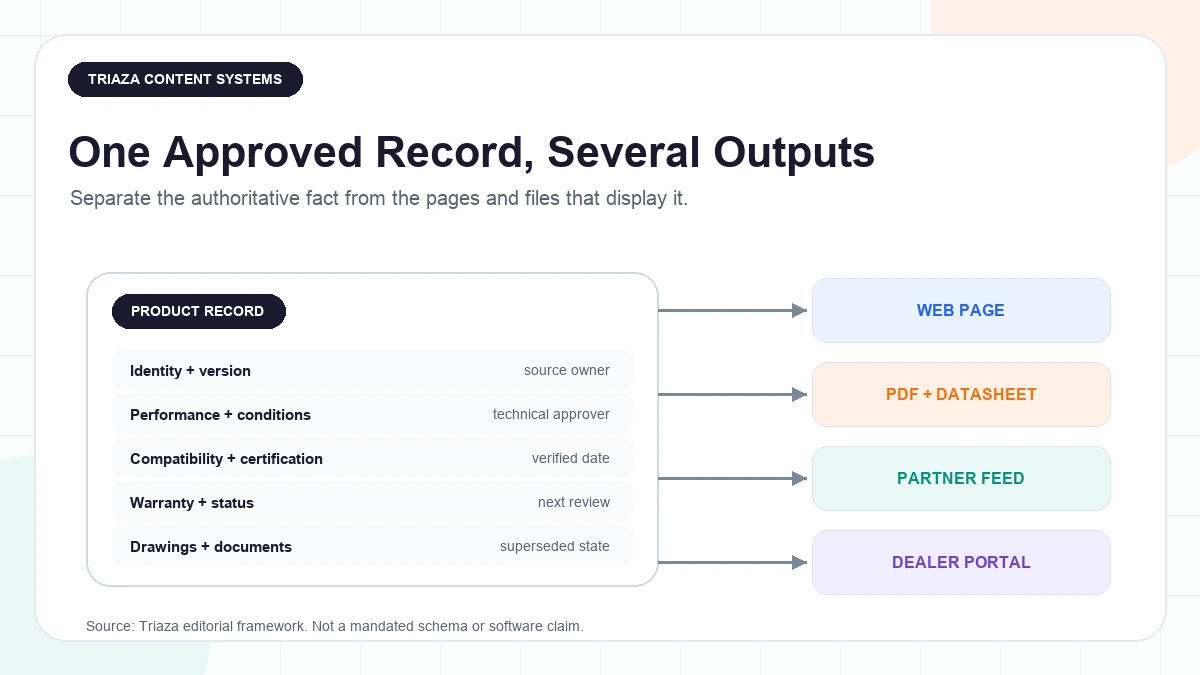
The website does not have to be the master system for every fact. Product information may originate in product information management, product lifecycle management, enterprise resource planning, a content management system, a digital asset manager, or a controlled engineering repository.
The hub needs to know which system and owner are authoritative for each field.
A governed product record may include:
- Product identity, family, model, and SKU
- Approved short and long descriptions
- Materials, dimensions, performance values, and units
- Applications, compatibility, and exclusions
- Certifications, standards, and expiration or revision details
- Warranty, service, and approved commercial information
- Images, diagrams, video, CAD or BIM, and technical documents
- Region, language, channel, and configuration scope
- Product version and effective date
- Source system and source owner
- Technical approver and publishing owner
- Last verified date and next review trigger
- Superseded-by, discontinued, or retired state
This field list is not a public markup requirement. It is an operating checklist. Schema does not correct an unapproved or outdated fact. A fresh date does not make an old drawing current. The team must resolve the source before it formats the output.
Separate Source Ownership From Publishing Ownership
The person who publishes a page may not be authorized to change a performance value. The engineer who approves the value may not own the page, dealer feed, or translation.
Assign both roles. The source owner confirms what is true. The publishing owner confirms where the approved fact appears. A change request should identify affected outputs before it closes.
This mirrors the named handoff discipline in Triaza’s guide to building an AI content system. The manufacturing version adds product version, technical approval, and downstream channel impact to the editorial gate.
Use Change Events, Not Arbitrary Freshness
Important assets should update when the underlying reality changes. Common triggers include:
- Engineering change
- New or expired certification
- Material or supplier change
- Warranty or service revision
- Packaging or labeling change
- New model, substitution, or discontinuation
- Installation or safety correction
- Regional availability change
- Dealer-program or pricing-rule change
Some low-risk explanatory pages may use a periodic review. High-risk product facts need event-based updates. Triaza’s website maintenance checklist offers one internal framework for assigning ownership and recurring checks, but its cadence is not a universal manufacturing standard.
Keep a record of what changed and which outputs were updated. Revision history helps an engineer confirm the current drawing, a dealer replace an old sheet, and the content team understand whether a page needs a substantive update or only a routine review.
Decide What To Gate
Technical content often becomes a lead-generation argument: if an asset is valuable, require a form. That choice should consider the visitor’s task and the company’s follow-up capability.
Keep foundational selection information open when hiding it would prevent a qualified person from evaluating fit. Product specifications, basic drawings, installation conditions, certifications, and current document status often need to be findable and shareable. A gated consultation, custom configuration, detailed project review, or account-specific resource may make sense when the company can provide a real next step.
Ask four questions before gating an asset:
- Does the visitor need this information to determine basic fit?
- Is the asset safe and approved for public distribution?
- Will the company do something useful with the submitted information?
- Does the form request match the value and sensitivity of the asset?
Do not gate a PDF only because the current platform makes forms easy. Do not leave account-specific pricing, controlled drawings, or confidential technical material open because a public library is convenient.
Measure Retrieval And Use, Not Just Pageviews
A content hub can have more useful measures than total traffic. Start with the tasks the hub is intended to support.
For engineers:
- Successful product-finder sessions
- Use of meaningful filters
- Datasheet and CAD retrieval by product family
- Searches that return no result
- Requests for application help after technical review
- Document-version or compatibility lookups
For buyers:
- Visits to availability, certification, warranty, and supplier-verification material
- Quote starts from a product or application context
- Comparison-tool completion
- Use of approved total-cost inputs
- Questions that reveal missing commercial information
For dealers:
- Training completion
- Retrieval of current collateral
- Use of product-change notices
- Partner searches with no useful result
- Support escalation by issue type
- Adoption of current rather than superseded assets
Treat each as an operational signal, not a sale. A CAD download does not prove specification inclusion. A certification-page visit does not prove approval. A dealer asset download does not prove it was used. Connect content activity to qualified inquiries, CRM records, partner feedback, and sales use only where the systems and consent support that connection.
The manufacturing-content survey from Content Marketing Institute and MarketingProfs shows why governance and measurement deserve their own workstream. Across several separate questions in its 2024 self-report research among manufacturing marketers, respondents reported challenges including creating action-driving content at 66%, consistency at 54%, creating the right content for the audience at 45%, repurposing at 42%, aligning content with the buyer journey at 50%, and workflow or approvals at 41%. Among reasons respondents said their strategy was not as effective as it could be, 47% cited a weak connection to the customer journey. In a separate question, 54% said they lacked a scalable content-creation model. The article reports an overall manufacturing subsample of 104 but no question-specific bases, so each percentage cannot be assumed to use all 104 respondents. Half the sample worked at organizations with at least 1,000 employees. The public article does not disclose the sampling frame, weighting, response rate, or margin of error. These reported problems do not prove that a hub solves them.
The response is to define the content system around real product and channel work. Repurposing becomes safer when outputs share an approved source. Measurement becomes more useful when it reports whether a person found the right record or completed a task.
Avoid The Failure Modes That Recreate The Old Library
A new hub can inherit the same problems under better labels. Watch for these patterns during design and migration.
Three Audience Homepages With Three Copies Of The Facts
The team creates an engineer page, buyer page, and dealer page, then copies the same specifications and descriptions into each one. The paths look segmented, but every update still requires several edits.
Keep the approved fields in the shared record. Let each audience page assemble, explain, and link to them according to the task.
One Giant Product Page That Tries To Serve Everyone
The opposite mistake is forcing every drawing, certification, commercial note, training file, comparison, and service answer onto one page. The shared record does not require a shared presentation.
Use a clear summary, structured attributes, and routes to deeper material. Progressive detail is useful when the links and labels tell the reader what comes next.
A Search Box That Hides A Weak Taxonomy
Search can help with synonyms and part numbers. It cannot reliably compensate for products that lack consistent attributes, documents without product relationships, or categories that mean different things across business units.
Fix the information model first. Then use search to help people cross vocabulary gaps and find known items.
Filters That Exist Only Because The Data Field Exists
An internal field is not automatically useful to a customer. A filter for an obscure code may add noise, while an application, compatible system, or common material term remains missing.
Choose filters from real selection decisions. Test whether each one narrows the catalog in a way the visitor understands. Keep low-value internal attributes out of the public interface even if they remain in the record.
PDFs That Become The Only Product Record
PDFs are useful for controlled, printable, and shareable documents. They are a poor substitute for structured product relationships and clear web navigation.
Keep important selection facts and document status visible on the page. Link the PDF to the product version and provide a stable place to find the replacement when it changes.
A Migration That Copies Every Obsolete Asset
Moving an old file into a new folder does not make it current. Before migration, classify each asset as current, needs review, superseded, historical but still needed, or safe to retire.
Do not discard historical manuals or discontinued-product information that customers still need. Mark them clearly and separate them from current selection paths.
Analytics That Reward Volume Instead Of Resolution
If the scorecard rewards pageviews and downloads alone, the team may create more pages and gate more files without helping visitors complete a task.
Pair traffic measures with successful retrieval, failed search, current-asset use, qualified inquiry context, and partner feedback. The goal is not to make the library look busy.
Roll Out The Hub In Four Practical Phases
Do not begin by migrating every file. Start with one product family important enough to expose the problems and bounded enough to finish.
Phase 1: Inventory The Decisions And Sources
Choose one family and list the questions engineers, buyers, and dealers need to answer. Map each answer to its current source, owner, approval state, and output.
Capture contradictions without resolving them silently. If the product page and datasheet disagree, both should be flagged for the authorized owner. The content team should not choose the more convenient number.
Phase 2: Build The Shared Record And Paths
Define the product fields, applications, filters, documents, and audience shortcuts. Create one family page, one application path, a small set of product records, and the three role or task views.
Test with people who perform the work. Ask an engineer to find a drawing and validate compatibility. Ask a buyer to locate certification and lead-time information. Ask a dealer to find training and the current approved comparison.
Record where terminology, filters, or ownership fail.
Phase 3: Connect Outputs And Change Control
Link web pages, PDFs, partner feeds, and portal assets to their approved sources. Define how a change moves through technical approval, publishing, translation, channel notification, and retirement.
Decide what happens to old URLs and documents. A visible replacement notice is usually more useful than a dead end.
Phase 4: Expand By Evidence
Add the next family after the first model works. Reuse the information model where the products share real attributes. Change it where another family has different applications, standards, or channel needs.
Use search logs, failed tasks, dealer questions, support cases, and sales feedback to prioritize. A large migration count is not evidence of a useful hub.
The Hub Is An Operating System For Product Information
A manufacturing content hub should make technical information easier to find, commercial information easier to evaluate, and partner information easier to reuse without creating separate versions of the product truth.
The architecture is one shared core with several entrances. The operating discipline is named ownership, technical approval, visible versioning, controlled distribution, and retirement. The measurement is whether people can complete the tasks the hub was built to support.
If your product pages, technical library, and dealer resources no longer agree, Triaza can help map the audience paths, source owners, and content structure before the next migration. Learn more about Triaza’s approach to marketing for manufacturers and content marketing.
Frequently Asked Questions
Should A Manufacturing Content Hub Be Organized By Audience Or Product?
Use product family, application, and approved product attributes as the shared core. Add audience and task entrances for engineers, buyers, and dealers. The same person may need information from several paths, so audience labels should help people start without restricting the rest of the library.
What Content Do Engineers Need From A Manufacturer?
Engineers often need structured product facts, dimensions, materials, performance conditions, compatibility information, datasheets, drawings, CAD or BIM files, certifications, application guidance, comparisons, and a route to technical help. The exact set depends on the product, application, industry, and risk.
What Information Do Industrial Buyers Need?
Buyers may need availability and lead-time context, price or quote variables, current certifications, supplier-verification information, warranty and service terms, continuity information, and supported lifecycle-cost inputs. Publish only details the company can keep accurate, and route account-specific terms through a controlled process.
What Should A Dealer Or Distributor Portal Include?
A partner path may include current product data, approved images and claims, comparisons, training, installation and service material, product-change notices, pricing or incentive rules, availability information, and named escalation contacts. Account-specific or confidential information should remain behind appropriate access controls.
Should Manufacturers Gate Datasheets And CAD Files?
Gate content only when the restriction serves a real business, safety, access, or follow-up need. Foundational selection material often needs to be open and shareable. Custom engineering review, controlled drawings, account-specific pricing, or other sensitive resources may require a form, login, or direct review.
How Do Filters Affect Manufacturing SEO?
Filters can help people narrow a complex catalog, but crawlable combinations can multiply into many low-value URLs. Decide which filtered views deserve stable landing pages and which should remain interface states. This is crawl-management work, not a ranking switch or a promise of better search performance.
Who Should Own Manufacturing Product Content?
Assign a source owner for the fact and a publishing owner for each output. Technical changes should identify affected pages, documents, feeds, and partner assets before the work closes. High-risk product facts need event-based updates, while lower-risk explanatory content can use a defined review schedule.
How Should A Manufacturer Measure A Content Hub?
Measure whether people find the right product, document, drawing, certification, or partner asset and whether they complete the intended task. Track failed searches and outdated-asset use. Treat downloads and pageviews as signals, then connect them to qualified business outcomes only where the systems and consent support that analysis.