A five-star rating can look like the end of a process. For the business collecting it, that rating is usually the product of several decisions: who received the request, what the message promised, whether an employee or relative was involved, which reviews were displayed, and whether the quote later appeared in an advertisement.
That full chain is what businesses need to inspect under the Federal Trade Commission’s Consumer Reviews and Testimonials Rule. The rule was published in the Federal Register on August 22, 2024 and took effect on October 21, 2024. By July 2025, it was an operating requirement, not a new announcement to watch from a distance.
The FTC’s Consumer Reviews and Testimonials Rule prohibits specified deceptive practices around fake reviews, sentiment-conditioned incentives, insider reviews, review suppression, company-controlled review properties, and fake social indicators. Businesses should audit how they request, reward, moderate, reuse, and monitor reviews, while preserving neutral customer feedback and clear disclosures.
This guide provides general educational information, not legal advice. The rule turns on facts such as who acted, what they knew, how a message was presented, and whether a representation was material. Get qualified legal advice for a specific review program, campaign, vendor, or dispute.
What The Fake Reviews Rule Covers
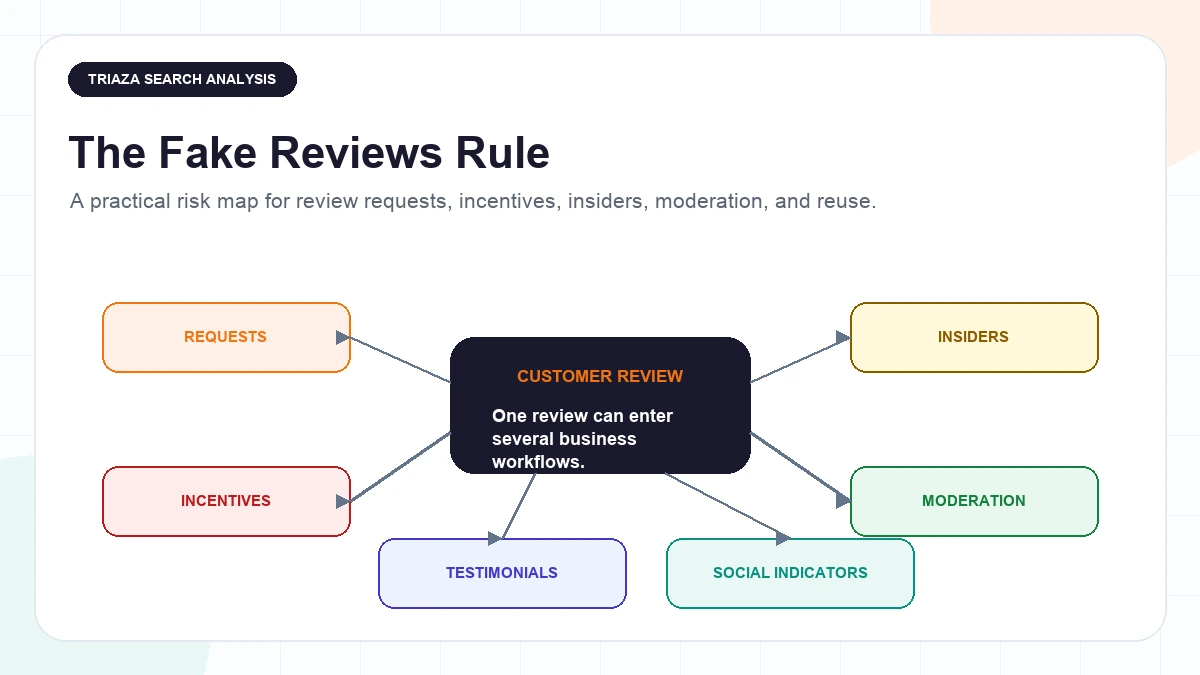
The rule is broader than buying a batch of obviously fabricated five-star reviews. It reaches six operating areas that can sit in different parts of a company.
First, it addresses fake or false consumer reviews and testimonials. A business cannot write, create, or sell a review or testimonial that materially misrepresents whether the person exists, whether the person used or experienced the product or service, or what that experience was. Buying a false consumer review and using a false testimonial in marketing trigger different provisions and knowledge standards. For example, the rule covers purchasing false consumer reviews and disseminating false consumer or celebrity testimonials when the business knew or should have known about the material misrepresentation.
Second, the rule addresses incentives tied to sentiment. A business cannot offer compensation or another incentive in exchange for a consumer review that must be positive or negative, whether that condition is stated plainly or implied by the request.
Third, it covers certain insider reviews and testimonials. The details depend on whether the person is an officer, manager, employee, agent, or covered relative, how the review was requested or used, what the business knew, and whether the relationship was otherwise clear to the audience. This is not a blanket rule that every employee review is automatically unlawful. It is a reason to stop treating insider reviews as ordinary customer proof.
Fourth, the rule addresses materially false independence claims about some company-controlled review sites or entities. The exact provision is narrower than the shorthand “do not own a review site.” It concerns a business materially misrepresenting that a site, organization, or entity it controls provides independent reviews or opinions, other than consumer reviews, about a category that includes the business or what it sells.
Fifth, the rule covers specified forms of review suppression. That includes certain unfounded legal threats, physical threats, intimidation, and knowingly or recklessly false public accusations used to stop or remove a consumer review. It also covers a business materially representing that a dedicated review section shows most or all submissions while withholding reviews because of their rating or negative sentiment.
Sixth, it covers certain sales and purchases of fake social media indicators such as fake followers or views. The seller and buyer provisions are not identical, and both include qualifications involving knowledge, materiality, and commercial influence. A suspicious follower count is not enough by itself to establish a violation. Buying indicators known or reasonably knowable as fake to materially misrepresent commercial influence is the kind of conduct the rule targets.
Those categories share a theme. The rule is aimed at manufactured or distorted proof. It is not a ban on asking customers what they think, responding to complaints, moderating spam, or publishing authentic testimonials.
Start With A Map Of Your Review Workflow
Most compliance problems are hard to see when each department owns one small step. Customer success sends the request. Marketing writes the incentive copy. A contractor handles replies. The website team selects testimonials. Someone else buys a follower package. Each action can look routine in isolation.
Draw the workflow from the customer’s experience instead. Start with the event that makes someone eligible for a request, then follow the review through every place it can travel.
Your map should answer these questions:
- What event triggers a review request?
- Which customers receive it, and which customers do not?
- What does the email, text message, QR card, receipt, or script say?
- Is any discount, gift card, entry, loyalty credit, or refund connected to the request?
- Can employees, relatives, agents, creators, or vendors receive the same request?
- Where is the review first posted?
- Does anyone approve, delay, challenge, reorder, hide, or remove it?
- Can the review be selected for an advertisement, landing page, sales deck, email, or social post?
- Which third parties touch the process?
- Who owns correction and escalation when something looks wrong?
Do not begin with a policy template. Begin with what the company actually does. A policy that says “we welcome all feedback” is not useful if the automation sends the public review link only after a customer chooses the smiling face. A vendor agreement that says “authentic reviews only” is not useful if nobody knows how the vendor recruits reviewers or what signals it promises.
The first deliverable is a one-page flow. Put every message, incentive, decision point, platform, and owner on it. That gives legal counsel or a responsible operator something concrete to inspect. It also reveals where a marketing shortcut has quietly become a company practice.
This kind of review belongs in the same recurring maintenance rhythm as consent language, forms, tracking, and other trust-sensitive website elements. Our website maintenance checklist explains how to turn those checks into an owned schedule instead of waiting for a complaint to expose the gap.
Fix The Review Request Before It Reaches A Customer
A neutral request asks a real customer to describe a real experience in the customer’s own words. It does not tell the customer which opinion will earn a reward, and it does not route only likely praise to the public platform.
The FTC staff Q&A says generalized requests to purchasers receive exemptions from specified provisions of the rule. The same guidance says asking only customers the business thinks are happy is not specifically prohibited by the rule, but may violate the FTC Act. It can also fall outside the generalized-solicitation protection. The FTC itself warns that the Q&A is staff guidance, not definitive or comprehensive advice and not a safe harbor, so treat the examples as practical interpretation rather than a substitute for the final rule.
Review gating often appears as a user-experience improvement. A survey asks, “How did we do?” A high score opens a public review link. A low score opens a private support form. The unhappy customer can still complain, but not in the place where future buyers will see it. That workflow is a selection system based on expected sentiment.
Replace it with two independent paths:
- Give every eligible purchaser the same neutral opportunity to leave a review.
- Give every customer an easy way to reach support, regardless of whether the experience was positive or negative.
Those paths can appear in the same follow-up, but one should not be the reward for choosing a happy response. If the company needs a private satisfaction survey, keep it separate from the decision about who receives a public review request.
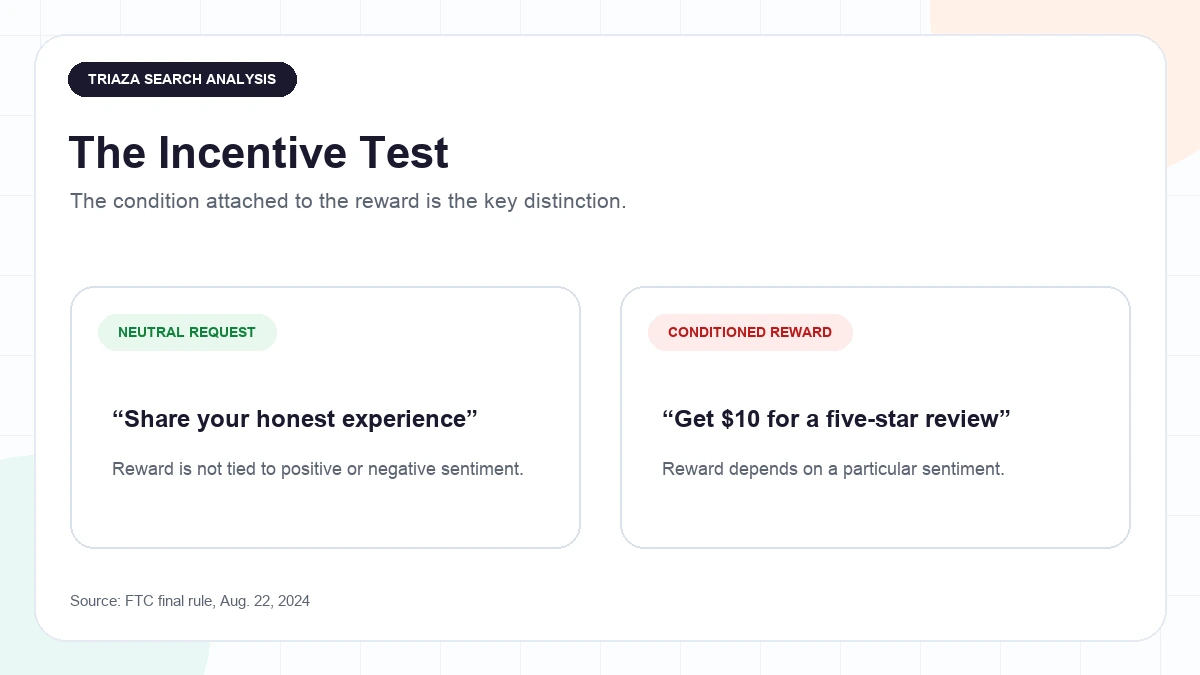
Audit the actual language, not just the automation diagram. “Share your honest experience” is neutral. “Tell everyone how much you loved your visit” implies the desired sentiment. “Leave a five-star review and receive a coupon” states the condition directly. Small phrasing choices can change what the offer means.
Review templates need another boundary: help with access, not opinion. It is reasonable to give a customer the direct platform link or explain where to find the review form. Supplying polished praise for the customer to paste can turn a real transaction into a misleading account of someone else’s experience. The safest default is to ask for the customer’s own words and avoid suggested claims.
If an AI tool drafts review-request copy, keep it inside the same human claims review applied to any other public message. Our guide to building an AI content system explains why generated text should be treated as source material that still needs an accountable reviewer. The tool does not know which customers receive the message, what the incentive does, or whether the request creates a sentiment condition.
Fix Incentives And Giveaways
The cleanest incentive rule is simple: never make compensation depend on a positive or negative consumer review.
The final rule prohibits incentives expressly or implicitly conditioned on a particular sentiment. That means a direct five-star requirement is a problem, but so is copy that communicates the condition without using the word “condition.”
Consider these two requests:
- “Leave an honest review and receive a $10 account credit, whether your experience was positive or negative.”
- “Tell people how much you loved us and receive a $10 account credit.”
The first does not condition the incentive on sentiment. That does not make it automatically compliant. The incentive may need to be disclosed, a platform may have its own policy, and the aggregate presentation could still mislead. The second request connects the reward to praise. Adding “incentivized review” to the resulting post does not undo the condition.
Build a written incentive rule that covers every format, not just the marketing team’s preferred channel. Include coupons printed on receipts, contest entries offered by staff, refunds proposed during support calls, loyalty points triggered by automation, creator payments, and vendor-run sampling programs.
The rule should state:
- The incentive cannot depend on a rating or sentiment.
- The customer must be free to describe the actual experience.
- Any required disclosure must be clear where the audience sees the review.
- The destination platform’s policy must be checked before the offer runs.
- Marketing, customer support, and vendors cannot create side offers outside the approved workflow.
- Someone must review aggregate effects, not only individual posts.
That last point matters because a disclosed connection can still be missed by people who see only the average star rating. The FTC staff Q&A warns that even disclosed insider reviews may raise broader FTC Act concerns if they materially increase an aggregate rating and consumers do not see the individual disclosures. The same reasoning is useful when evaluating a large incentive program. A company should not stop at “each review has a label” if the overall presentation still gives a misleading impression of independent customer sentiment.
Audit Employees, Relatives, Agents, And Creators
Insider reviews are not one category with one answer. The final rule distinguishes among officers, managers, employees, agents, and immediate relatives. Paid influencers require separate testimonial and endorsement analysis. The solicitation, disclosure, knowledge, and remediation facts matter.
An officer or manager who writes a review or testimonial about the business or what it sells generally needs to disclose the material relationship clearly and conspicuously, unless the testimonial context already makes the relationship clear. A business that disseminates an insider testimonial without the necessary disclosure faces a different knowledge analysis. A manager asking employees or relatives for reviews creates still another set of duties and exceptions.
Do not solve that complexity with “employees may never review us” or “disclosure makes every insider review fine.” Build a process that identifies the relationship before the content is used.
Start with a short intake for any review or testimonial the business plans to feature:
- Who wrote it?
- Did the person buy, use, or experience the product or service?
- Is the person an owner, officer, manager, employee, agent, contractor, creator, or relative of someone inside the business?
- Was the person paid, given a product, or promised anything?
- Who requested the statement?
- Did the business write or edit any part of it?
- Where will it appear?
- What disclosure will be unavoidable to the audience?
The disclosure must be placed for people, not for a compliance archive. The FTC staff Q&A says a disclosure in the first line of a text review can be unavoidable, while a hyperlink is avoidable because the reader must act to see it. The guidance also cautions that a built-in platform tool can be inadequate if its presentation is fleeting, too small, low contrast, or easy to miss. That does not mean every disclosure must always be the first line. It means the relationship cannot be hidden behind an action or presentation people are likely to miss.
Generalized purchaser requests matter here too. If a company sends the same neutral request to a broad group of actual purchasers and an employee happens to be among them, that is different from a manager directing the employee to write praise. Preserve the recipient list and the request copy so the company can show what happened.
Paid influencers need separate handling. The FTC staff Q&A treats a hired influencer’s promotional post as a celebrity testimonial rather than a consumer review. The insider provision’s use of “agent” is narrower and can cover representatives of advertising, public relations, or review-management firms rather than paid influencers as a class. Missing creator disclosures can still raise FTC Act issues even when a specific insider-review provision does not apply.
Write one policy for insiders and another for creators. Give both a named owner. When the company learns that a covered relationship was omitted, correct or remove the content promptly and document the remedial step.
AI Does Not Create A Review Or A Safe Harbor
The rule does not need a separate category for every tool that can fabricate proof. Its central questions already cover the problem: does the reviewer exist, did that person use or experience the offering, and does the review materially misrepresent the experience?
The Federal Register rule specifically addresses reviews that materially misrepresent those facts. AI use alone is neither the trigger nor an exemption.
That distinction prevents two bad policies.
The first is “AI-generated reviews are banned, so AI-assisted reviews are safe if a human clicked generate.” A human approval step does not create an underlying customer or experience. If the review describes a person who does not exist or an experience that did not happen, the tool is not the important fact.
The second is “any AI help makes a real customer’s review illegal.” The sources do not establish that categorical rule either. A customer might use spelling assistance, translation, or dictation while describing a real experience. The legal issue is the covered material misrepresentation, not the mere presence of software.
For a practical company policy, draw the line around authorship and truth:
- Do not generate customers, transactions, experiences, ratings, or quotes that did not exist.
- Do not give a customer a polished endorsement and ask for a signature.
- Do not change the meaning of a review during editing.
- Do not translate in a way that strengthens the sentiment or adds a claim.
- Keep the original statement when the business plans to edit, translate, or excerpt it.
- Require a human to verify that a promotional testimonial still reflects the person’s actual experience.
The same policy should cover synthetic avatars and dramatizations. The FTC staff guidance says there is no blanket ban on AI-generated stock avatars, while warning that the underlying testimonial can still be fake or false and the use can raise broader deception issues. Do not present a virtual speaker as a real customer unless the audience can understand what the speaker is and the underlying statement is properly supported.
Treat A Featured Review As A Testimonial
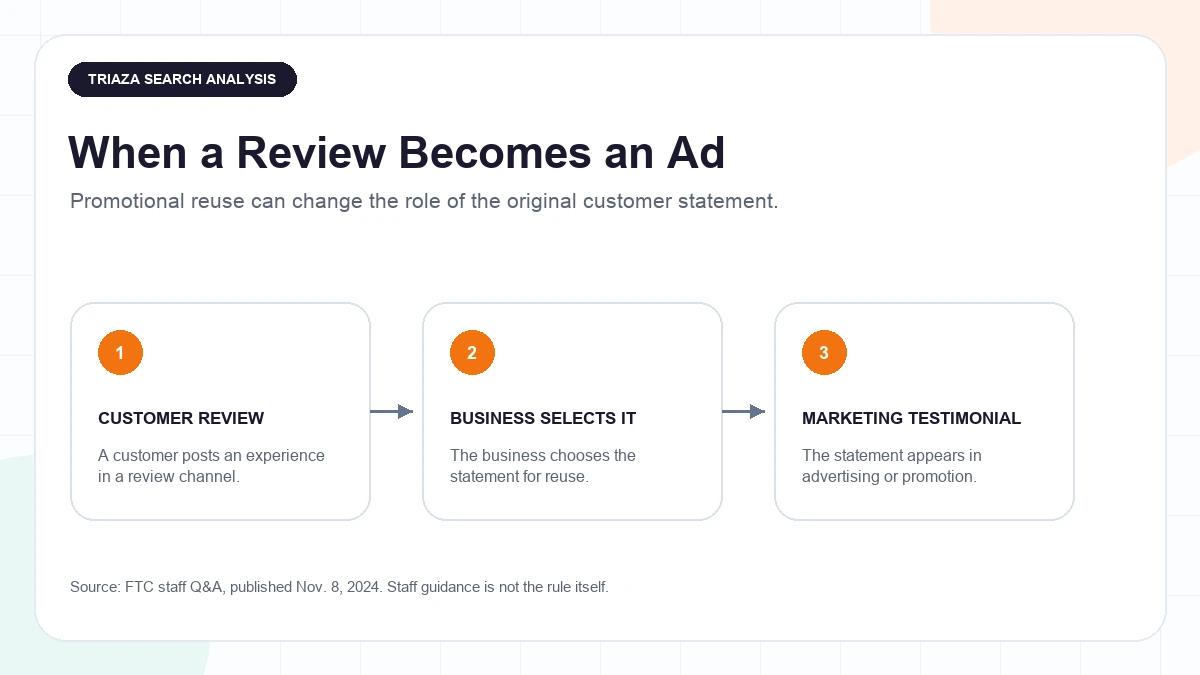
The review-hosting exception is easy to overextend. A retailer that merely provides the technical place for customers to submit and read reviews is in a different position from a business that selects one review and places it in an advertisement.
The FTC staff Q&A says a consumer review featured in advertising or marketing becomes a testimonial, so the mere-hosting exception does not apply. That does not make every featured review unlawful. The material falsity and knowledge requirements still matter. It means the business has moved from hosting customer speech to disseminating promotional proof.
Inventory every place customer language appears outside the original review platform:
- Homepages and service pages
- Paid advertisements
- Organic social posts
- Sales presentations and proposals
- Email campaigns
- App-store graphics
- Case studies
- Product packaging
- Video montages
- Comparison pages
- Creator briefs
For each use, preserve the original review, reviewer identity record, date, source platform, permission if needed, and any material connection. Compare the excerpt with the full review. A short pull quote cannot change a qualified experience into an unqualified endorsement.
Do the same check on star ratings. If the rating displayed in an advertisement came from a filtered subset, an old period, or a different product, the problem is not solved by attaching a real review underneath it. The presentation needs to reflect what the audience is likely to understand.
Website teams should add testimonial inventory to the startup website launch checklist. The trust section of a site often changes late in a build, when a placeholder logo strip or sample quote is replaced quickly. That is exactly when provenance, permission, disclosure, and wording checks get skipped.
Keep response templates separate from testimonials. A brand voice system can help customer-service teams answer reviews consistently, but it should not be used to rewrite what the customer supposedly said. One governs the company’s response. The other is evidence attributed to someone else.
Replace Suppression Tactics With Neutral Moderation
Negative reviews create three different jobs: determine whether the content violates a neutral policy, resolve the underlying customer problem when possible, and decide how the business will respond publicly. Combining those jobs into “make the review disappear” is where risk grows.
The final rule does not prohibit every moderation decision. A business may apply legitimate, sentiment-neutral criteria to positive and negative reviews alike. It can address spam, content about the wrong business, personal information, threats, harassment, and other defined categories when the criteria and application do not turn on whether the reviewer liked the experience.
The rule does prohibit specified coercive conduct. Unfounded or groundless legal threats, physical threats, intimidation, and certain knowingly or recklessly false public accusations cannot be used to prevent or remove a consumer review. A legitimate legal claim is not converted into a violation simply because it concerns a review, but the factual and legal basis needs to exist.
The completeness provision is separate. If a business represents that a dedicated review section contains most or all submissions, it cannot create that impression while withholding reviews because of rating or negative sentiment. Sorting five-star reviews first is not automatically the same as suppressing them. Neutral organization can still become deceptive if it makes negative reviews unreasonably hard to find, so presentation deserves a broader FTC Act review even when the specific rule provision does not decide the issue.
Write a moderation policy with three columns:
- The rule, such as no personal information or content unrelated to the transaction.
- The evidence needed to apply it.
- The action, such as redact, hold for review, remove, report to the platform, or leave published and respond.
Apply the same standard to praise and criticism. If profanity is permitted in a five-star review, it should not suddenly become disqualifying in a one-star review. If a review about shipping is on topic when positive, it should not be rejected as irrelevant when negative.
Customer service can still contact a dissatisfied reviewer. The FTC staff Q&A says the rule does not prohibit trying to resolve the reported issue or simply asking a satisfied customer to update a review. The same guidance warns that paying to remove or change a truthful negative review may violate the FTC Act because it may distort what customers think. Use “may” here. The staff answer is not a categorical statement that every resolution or incentive violates the rule.
A safe response path is operational, not argumentative:
- Acknowledge the reported issue without disclosing private information.
- Move account-specific details into a private support channel.
- Investigate the transaction.
- Offer the remedy the company would offer whether or not a public review existed.
- Once resolved, tell the customer they may update the review if they choose.
- Do not condition a refund, cancellation, or ordinary remedy on removal or praise.
- Escalate threats, defamation claims, safety issues, and suspected fraud to qualified counsel.
Check Company-Controlled Review Properties
Some businesses create directories, awards, comparison sites, or “independent” rankings that include their own products. Others license a badge from a vendor they control or fund. The problem is not ownership by itself. It is the materially false impression of independence within the scope of the rule.
Create an inventory of every property that presents reviews, rankings, opinions, awards, or comparisons:
- Who owns the domain and entity?
- Who funds it?
- Who chooses the criteria?
- Does the business or its product appear in the covered category?
- What does the page say or imply about independence?
- Is the relationship clear before a person relies on the rating or badge?
Do not overstate the provision. The final text refers to reviews or opinions other than consumer reviews. A retailer does not violate this section merely because it hosts consumer reviews on a site it controls. Other sections can still apply if the business creates, buys, distorts, or suppresses those reviews.
This is another place where internal names can hide the real issue. A team may call a page an “editorial resource,” “community choice,” or “partner award” even though the business chooses the winners. Review what a reasonable visitor will understand, not what the project folder calls it.
If independence is central to the property’s value, verify genuine separation or remove the independence claim. A disclosure may clarify ownership, but it is not an automatic cure for a materially false impression of independence. A disclosure placed after the ranking cannot repair a first impression that already did the persuasive work.
Vet Purchased Reviews And Fake Social Indicators
Outsourcing does not turn manufactured proof into authentic proof. The rule can reach review brokers, reputation-management companies, agencies, and other commercial actors depending on what they create, sell, buy, or distribute.
The FTC staff Q&A says a business that merely hosts consumer reviews does not have a general duty under the rule to investigate every submission. It draws a different line around purchased reviews. Obvious warning signs can support a conclusion that the buyer should have known the reviews were fake or false. The staff examples include reviews appearing too quickly to reflect real use, an unusual burst in a short period, or reviews referring to the wrong product.
Turn those examples into vendor due diligence without pretending they are a complete test:
- Ask exactly how reviewers are recruited.
- Require proof of a real purchase or experience.
- Ban generated or prewritten customer accounts.
- Ban rating or sentiment conditions.
- Require disclosure of incentives and material connections.
- Ask how the vendor detects duplicate identities, impossible timing, and wrong-product content.
- Preserve samples and approval records.
- Give the business audit and termination rights.
- Investigate red flags rather than accepting a volume guarantee.
Do not buy a service whose value proposition depends on certainty about ratings it cannot honestly control. “One hundred five-star reviews in thirty days” is not a reputation strategy. It is a promise to manufacture the outcome before any customer has described an experience.
Fake social indicators deserve the same scrutiny. The final rule distinguishes between selling or distributing indicators that can be used to materially misrepresent commercial influence and buying or procuring indicators that do materially misrepresent it. Knowledge and commercial purpose matter. A creator with some fake followers does not automatically make every brand that hires the creator liable under this rule.
Ask vendors and creators for the information needed to judge the audience honestly. Look for implausible spikes, recycled comments, bot-like accounts, and engagement that does not match the stated reach. Those signals are reasons to investigate, not a verdict by themselves.
This fits naturally with a broader social presence operating system: owned access, consistent publishing, community response, measured promotion, and clear vendor accountability. The goal is not a larger-looking number. It is a public footprint the business can explain and defend.
Build A Review Governance Process Someone Owns
A policy becomes useful when it changes who can approve what. Put the review program under one named owner with authority to stop a campaign, correct a testimonial, request vendor records, and escalate a legal question.
The owner should maintain eight small artifacts.
A Neutral Request Template
Use one approved version for email, SMS, QR cards, printed receipts, and staff scripts. Adapt the delivery format without changing the sentiment-neutral meaning.
An Incentive Rule
List what the company may offer, what disclosure review is required, which platforms allow the program, and the bright-line ban on conditioning compensation on positive or negative sentiment.
An Insider Disclosure Rule
Define the relationships that require review, the intake questions, acceptable disclosure patterns, and what to do when an undisclosed insider review appears.
A Testimonial Reuse Check
Require the original source, reviewer identity record, real-experience confirmation, material-connection check, faithful excerpt, destination, and approval owner.
A Moderation Policy
List neutral criteria, evidence, actions, appeal or escalation steps, and how the business avoids representing a filtered collection as complete.
A Negative Review Response Path
Separate support resolution, public response, platform reporting, and legal escalation. Make clear that ordinary remedies are not conditioned on changing the review.
A Vendor Standard
Put recruitment, authenticity, incentives, disclosures, fake social indicators, monitoring, records, audit rights, and termination into the contract and operating review.
A Decision Log
Record non-routine cases: an employee review, a translated testimonial, a platform dispute, an incentive campaign, a suspicious vendor batch, or a request to remove criticism. The log does not need personal data beyond what the business lawfully needs. It needs enough context for the next reviewer to understand the decision.
Review the system on a schedule and after any complaint, platform suspension, acquisition, agency change, or new incentive program. The workflow will drift. Staff will reuse old request copy. A vendor will add a new feature. A page will pull a testimonial into a new placement. Governance is the repeated check that catches those changes.
Run A 30-Minute First Pass
A complete legal review can take longer, but a small team can expose the most urgent operating gaps in half an hour. The purpose of this pass is triage. It does not decide a close legal question, and it does not replace counsel.
Minutes 1 Through 5: Pull The Live Request
Open the exact email, SMS, survey branch, QR destination, and staff script customers receive today. Do not rely on the version in the policy folder. Highlight any phrase that asks for praise, a rating, or a positive story. Mark every incentive and every branch that changes the public review link based on a satisfaction response.
The output is one screenshot or export of each live request plus a list of sentiment conditions to remove.
Minutes 6 Through 10: Check Who Gets Asked
Look at the recipient logic. Confirm that eligibility is based on a real purchase or experience rather than an expected opinion. Check whether complaint status, survey score, refund request, employee status, or a support agent’s judgment changes who receives the public review opportunity.
The output is a plain sentence describing the eligibility rule. If nobody can write that sentence, the automation is not ready to defend.
Minutes 11 Through 15: Inventory Incentives And Insiders
List every coupon, credit, contest entry, product sample, refund, or staff bonus connected to a review. Then search recent reviews for owners, managers, employees, agents, creators, and familiar relatives. This is not an instruction to investigate every hosted review. It is an audit of programs and relationships the business already knows it created.
The output is an incentive list and an insider queue for disclosure or legal review.
Minutes 16 Through 20: Find Promotional Reuse
Search the website, active ads, social scheduler, sales deck, and email templates for customer quotes and star ratings. Match each item to an original review. If the source, reviewer, experience, permission, or material connection cannot be found, pause that promotional use until the record is complete.
The output is a testimonial register with a source link and owner for every active use.
Minutes 21 Through 25: Inspect Moderation And Responses
Pull three recent decisions involving a critical review. Record whether the business responded, challenged, delayed, removed, or asked for a change. Compare each action with a written, sentiment-neutral policy. Flag any ordinary refund, cancellation, or remedy that depended on removing or improving a review.
The output is a short exception list. Patterns matter more than polished explanations written after the fact.
Minutes 26 Through 30: Assign The Fixes
Give every issue an owner and a date. Stop any live five-star incentive first. Then correct disclosure gaps, pause unverified testimonials, replace review gating, document moderation criteria, and request records from questionable vendors. Send unresolved legal questions to counsel with the workflow map and evidence already attached.
The first pass succeeds when the company knows what is live, what is paused, who owns each correction, and which questions need legal judgment. A generic policy acknowledgement is not the outcome.
What Enforcement Looked Like By July 24, 2025
The rule gives the FTC a path to seek civil penalties for knowing violations. As of the article date, the inflation-adjusted maximum was $53,088 for the applicable knowing rule violation, effective for penalties assessed after January 17, 2025. That is a statutory maximum, not an automatic charge for each review. Courts decide the number of violations and the penalty and may impose much less after considering the legal factors.
A bounded search of the FTC’s public press-release, rulemaking, review-tag, and publicly indexed complaint surfaces found no publicly announced civil-penalty case charging a violation of Part 465 by July 24, 2025. That is a documented absence from specified public surfaces. It is not proof that no investigation, warning, nonpublic matter, or other review-related enforcement existed.
The closest in-window example is useful because it shows why the distinction matters. On July 14, 2025, the FTC announced a proposed settlement with NextMed. The agency alleged that the company generated fake positive reviews, used testimonials from people who were not clients, selectively challenged critical reviews, and connected refunds or gift cards to changing or removing negative reviews. The proposed matter included a $150,000 payment expected to fund refunds, not a Part 465 civil penalty, and the order was not yet final on the article date. The complaint relied on the FTC Act, the Electronic Fund Transfer Act, and Regulation E.
Do not read the absence of a public Part 465 penalty case as permission to wait. The rule was effective. The FTC was continuing to bring review-related cases under other authority. Build the review system before a complaint, vendor failure, or platform suspension forces the issue.
Questions Businesses Keep Asking
Can a business still ask customers for reviews? Yes. The rule does not prohibit generalized, sentiment-neutral requests to real purchasers. The FTC staff Q&A says requests only to customers expected to be happy are not specifically prohibited by the rule but may violate the FTC Act and may fall outside specified generalized-solicitation exemptions. The guidance is context-specific and provides no safe harbor.
Can a business offer an incentive for an honest review? The rule does not categorically prohibit a neutral incentive. It prohibits compensation or another incentive expressly or implicitly conditioned on a positive or negative consumer review. A neutral program can still require disclosure, conflict with a platform’s rules, or create a misleading aggregate impression, so review the full program rather than only the request sentence.
Does disclosure make a five-star incentive acceptable? No. The FTC staff Q&A says disclosure does not cure an incentive conditioned on a five-star review. The condition itself is the problem under the rule. The answer is staff guidance, not a safe harbor, but it follows the final rule’s express and implied sentiment-condition language.
Can employees or relatives review the business? Do not use a blanket yes or no. The final rule contains different provisions for officers, managers, employees, agents, and covered relatives. Material relationship, solicitation, knowledge, disclosure, hosting, and remedial steps can change the analysis. If the company plans to use an insider statement, identify the relationship and get specific legal review.
Can a business remove spam or abusive reviews? The rule does not categorically ban moderation. A business can apply legitimate, sentiment-neutral criteria equally. It cannot materially represent a dedicated review section as showing most or all submissions while hiding reviews because of rating or negative sentiment. Specific threats, intimidation, and knowingly or recklessly false public accusations used to prevent or remove a review are also covered.
Does a business have to investigate every review it hosts? The FTC staff Q&A says no general duty exists under the rule for a business merely hosting consumer reviews, assuming it did not write or buy them. That answer does not extend to every testimonial, purchased review, or company-created review. Clear red flags around purchased reviews can support a should-have-known finding.
What changes when a review is reused in advertising? A consumer review selected for advertising or marketing becomes a testimonial, according to the FTC staff Q&A, so the mere-hosting exception no longer applies. That does not make the testimonial automatically unlawful. The business should verify the person, actual experience, wording, material connections, and applicable knowledge conditions before using it.
Are AI-assisted reviews automatically prohibited? No categorical answer is supported. AI use alone is not the legal trigger, and it is not an exemption. The covered issue is whether the review materially misrepresents the reviewer’s existence, use, or experience. Do not generate a customer or experience that did not exist, and do not treat software assistance as proof that a real statement is accurate.
Is $53,088 automatically charged for every fake review? No. The 2025 figure was a maximum civil penalty for applicable knowing rule violations and was effective for penalties assessed after January 17, 2025. Courts decide the number of violations and the amount and may impose less. It is not an automatic per-review invoice.
Make The Next Review Request Defensible
The fastest useful audit is not a legal memo. It is a side-by-side comparison of what the company says it does and what customers actually experience.
Pull the last review request, the incentive terms, the recipient logic, three recent moderation decisions, every testimonial currently used in marketing, and each vendor contract touching reviews or social indicators. Put an owner beside every decision point. Fix the neutral request and any sentiment-conditioned reward first. Then work through insiders, testimonial reuse, moderation, independence claims, and vendors.
If the workflow spans several tools or teams, Triaza’s Social Presence work can help map the operating process, response templates, ownership, and measurement around the public channels. The legal conclusions still belong with qualified counsel. The marketing job is to make sure the real process is visible enough to review and disciplined enough to follow.
For a trade-specific operating model, the guide to local SEO and reputation monitoring for home contractors connects neutral review requests with Business Profile accuracy, service areas, project proof, and recurring monitoring.
Authentic reviews do more than reduce compliance risk. They give the business unedited evidence about what customers value, where the experience breaks, and which promises the marketing can honestly make. A review program should preserve that signal, not manufacture a cleaner version of it.