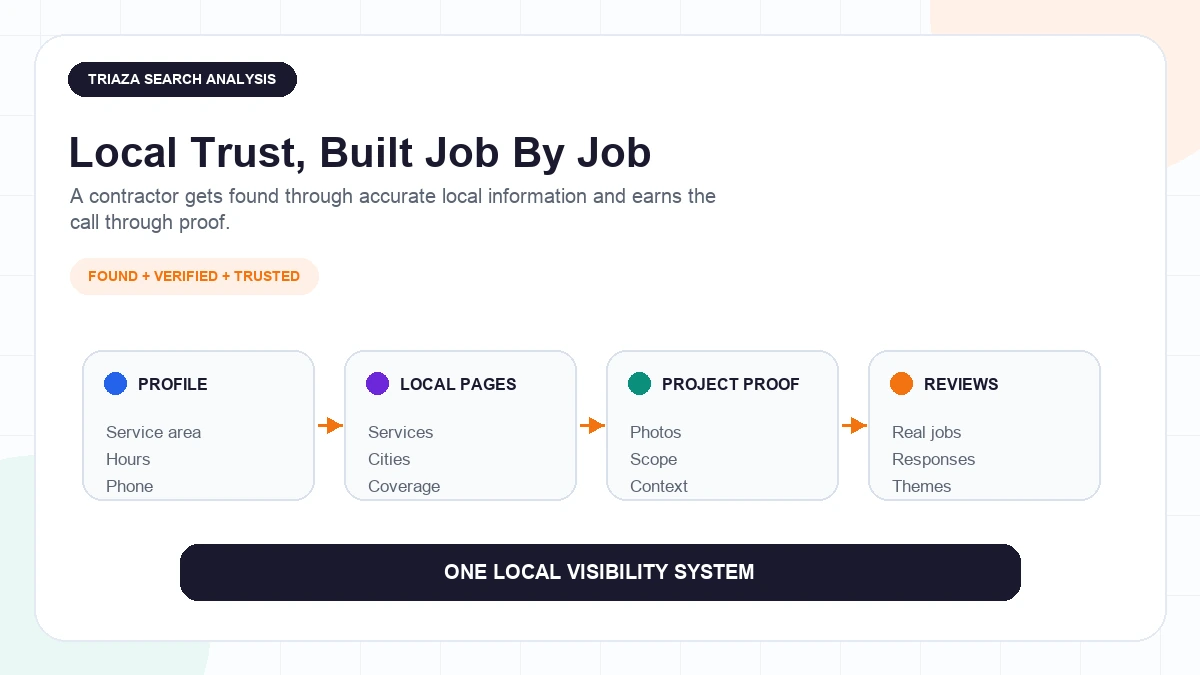
A homeowner searching for a roofer, electrician, remodeler, or HVAC company is not only looking for a nearby name. They are trying to reduce risk before they invite someone onto the property or commit to an expensive project.
That decision starts before the phone call. The homeowner sees a Google Business Profile, a set of local pages, project photos, ratings, review responses, service details, and basic facts about the company. If those pieces disagree, look neglected, or feel manufactured, the business has a trust problem even when its workmanship is excellent.
Local SEO for home contractors is the system that keeps a Google Business Profile, service area pages, project proof, business details, and reviews accurate and useful. Reputation monitoring closes the loop by catching bad information, unanswered feedback, and trust gaps before they cost the business a qualified call.
The practical goal is not to chase every possible directory or publish dozens of city pages. It is to make the contractor easy to understand, easy to verify, and easy to contact in the places where homeowners actually compare options.
Local Visibility And Reputation Are One System
Local SEO and reputation management often live with different people. An SEO vendor edits service pages. An office manager answers reviews. A field supervisor takes project photos. The owner updates holiday hours when someone remembers. Each action can help, but the homeowner sees the combined result.
Google described its July 2025 local results as mainly based on relevance, distance, and popularity. In the page’s Prominence subsection, Google said the number of websites linking to a business and the number of reviews it has contribute to prominence, and that more reviews and positive ratings can help local ranking. It also said a business cannot request or pay for better local ranking. That wording was recorded in a dated July 15, 2025 documentation comparison linking to Google’s guidance.
Those statements do not provide a formula. They do explain why a contractor cannot separate visibility from reputation. Relevance depends on describing the real work clearly. Distance depends on the searcher’s location and cannot be negotiated. Popularity and prominence involve signals that include links and reviews, but Google gives no review threshold, weight, or guaranteed improvement.
The safest operating model is to improve what the company controls:
- Describe the core business and actual services accurately.
- Set the profile up for the way customers interact with the business.
- Keep phone, hours, website, and service areas current.
- Publish pages that help a homeowner choose a service and understand coverage.
- Collect authentic reviews without selecting for praise.
- Respond to feedback and look for repeated operational problems.
- Turn completed jobs into useful, specific project proof.
That is less exciting than a ranking trick. It is also the work that remains useful when a platform changes a label or interface.
Set Up The Business Profile For The Way You Work
A home contractor can be a storefront business, a service area business, or a hybrid. The profile should reflect the real operating model.
If customers do not visit the company at its address and the crew travels to customer locations, the business should not present a home address, mailbox, or unstaffed office as a storefront. Google’s dated location data model says a customer-location-only business should not set a storefront address. Google’s earlier service area announcement explained that plumbers, electricians, landscapers, and similar businesses could define coverage by cities or postal codes instead of showing a static address. The Google location resource was updated October 16, 2024, and the service area feature explanation dates to January 22, 2019.
By June 25, 2025, a contemporaneous documentation comparison reported that Google had added a rule against using countries or states as service areas while retaining the guidance that the overall service area should stay within about two hours of driving time from the business base. That is an approximate boundary, not a promise that every town inside it will rank or that every town outside it is forbidden. The dated report preserves the wording and document change.
For a contractor, that leads to four practical checks.
Use The Real Operating Address Model
If the company has a staffed showroom, shop, or office that receives customers during stated hours, the profile can reflect that storefront. If customers never visit, hide the address and configure the service area. A hybrid business should describe both accurately.
Do not rent an address solely to create another map point. Even apart from platform enforcement, it produces a bad customer experience. Someone may drive to a location that cannot help them, or assume a crew is based nearby when it is not.
Keep The Service Area Credible
List the cities or postal areas the company actually serves. Coverage should match dispatch reality, travel time, licensing limits, and the kind of job the company will accept.
A broad radius can look like growth on a map while making the operation worse. Leads arrive from places the crew cannot serve profitably. Response time stretches. Reviews start mentioning lateness or scheduling confusion. The SEO setting has become a reputation problem.
Separate The Core Business From The Service List
The primary business category should describe what the company is. The service list explains what it does. A plumbing company may offer water heater installation, drain clearing, repiping, and emergency repair, but those services do not need to be stuffed into the business name.
Use the profile fields for their intended purpose. This makes the listing easier for a homeowner to scan and reduces the risk of edits or inconsistencies when another vendor touches the profile.
Treat Hours As Customer Information
Regular hours, after-hours coverage, appointment windows, seasonal hours, and holiday closures need an owner. If the profile says open but no one answers, the customer does not experience that as a metadata error. They experience it as an unreliable contractor.
Add the profile to the same recurring maintenance calendar used for the website, forms, phone routing, and tracking. The website maintenance checklist provides the broader rhythm. The profile should not be a separate asset that only gets attention after something breaks.
Build Service And City Pages With Real Local Utility
A Business Profile is not a replacement for a useful website. The profile can show the company, reviews, photos, and contact options. The website has to explain the work well enough for someone to decide whether the contractor fits the project.
Start with service pages. Each core service should answer:
- What problem does this service solve?
- What kinds of properties or projects fit?
- What is included and what is not?
- Which areas receive the service?
- What affects scheduling?
- Which permits, inspections, or preparation steps may apply?
- What proof can the company show from similar work?
- What should the homeowner do next?
Then decide whether separate city pages are useful. A page should exist because the location changes the answer, not because a keyword tool produced a list of suburbs.
Google’s dated doorway-page post warned about pages that funnel visitors to the useful part of a site, duplicate existing location aggregations to capture more traffic, lack clear unique value, or exist as hard-to-navigate islands. That Google Search Central post was published March 16, 2015. It does not say that every city page is spam. It gives a useful test for whether the page serves the visitor or only the search footprint.
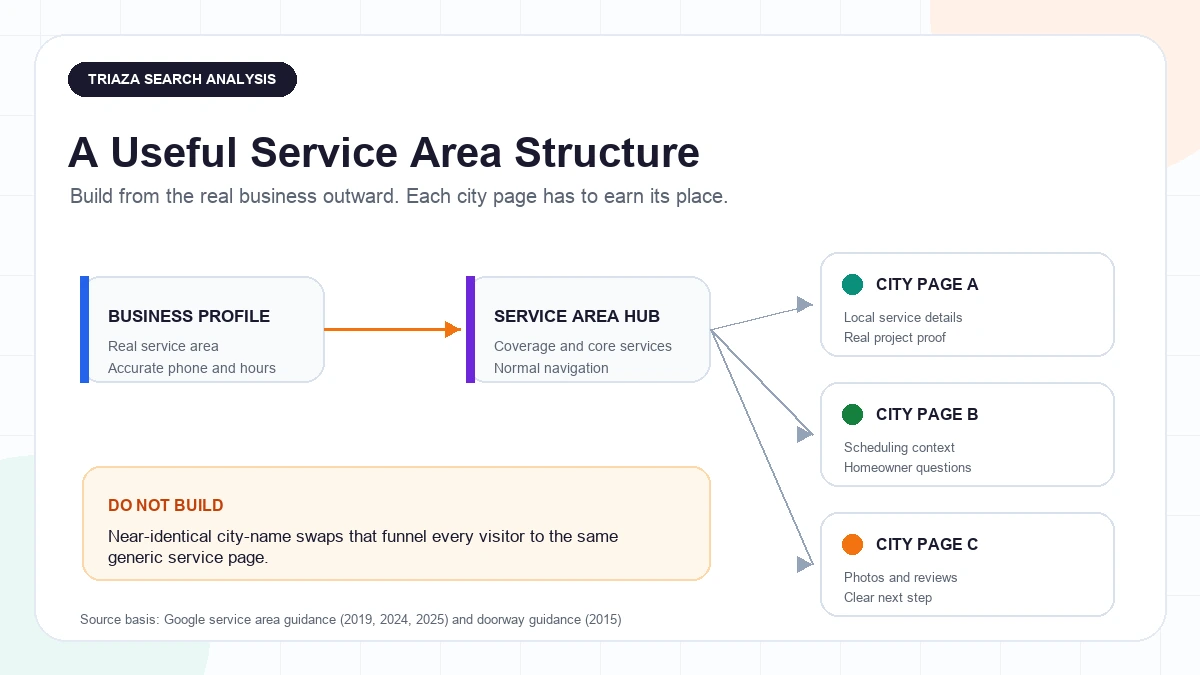
A useful city page might include:
- Services genuinely available in that city
- Travel, scheduling, or emergency coverage differences
- Permit or property context that materially affects the work
- Real projects completed nearby, with permission to identify the area
- Photos from those projects
- Review excerpts tied to real customers and used with appropriate permission
- Questions that homeowners in that market repeatedly ask
- Links to the relevant service pages and the main coverage page
The page should be reachable through normal navigation or contextual links. If it is an isolated page that differs only by the city name, it is not doing enough work for the reader.
Do not invent local proof to make a page feel specific. If the company has not completed a project in that city, say what is true about coverage and service. A clear coverage statement is better than a fabricated local story.
Turn Completed Projects Into Searchable Proof
Contractor marketing has an evidence advantage. The work produces visible changes. The problem is that many teams leave the evidence scattered across technicians’ phones, text threads, review platforms, and old social posts.
Create a simple project closeout routine. Before the job is archived, capture the details that will help the next homeowner evaluate the company:
- The service and property type
- The customer problem in plain language
- The scope completed
- Materials or systems used when useful
- General location, with the customer’s privacy protected
- Before, during, and after photos when appropriate
- Scheduling or access constraints that explain the process
- The customer’s permission for any testimonial or identifiable image
This is not about turning every job into a case study. A short project record can supply a gallery caption, service-page example, city-page proof block, sales follow-up, and social post without rewriting the facts each time.
Tinuiti said it surveyed 1,000 US homeowners in February 2025. When respondents chose the three qualities most important when hiring a home-services company, licensed and insured status and the best prices were selected most often. Good online reviews ranked third and were the only other quality selected by at least 30%. Overall, 58% preferred a specialist for each area of need rather than one provider for multiple services. These are findings among Tinuiti’s respondents, and the public page does not disclose recruitment, weighting, a confidence interval, or a margin of error. The study was published March 19, 2025.
The practical implication is not that every contractor should compete on price. It is that the site should make basic trust and fit easy to evaluate. If licensing or insurance information can be stated publicly and accurately, explain where it applies. If the company specializes, show the actual work that supports that position. If financing is available, describe it carefully without hiding terms or making approval promises.
Houzz gives a similar recommendation from a platform perspective. In dated guidance, it recommends showing high-quality photos of past projects that resemble the work homeowners are seeking, adding room and style descriptors so the projects can surface in relevant Houzz searches, and pairing those photos with client reviews that describe what it is like to work with the professional. That is Houzz Pro guidance from June 7, 2024, not a causal study proving that a certain photo count creates leads.
Use descriptors that help a human understand the project. “Kitchen remodel in Mesa” is more useful than “Project 47.” “Standing seam metal roof replacement after wind damage” tells the homeowner what kind of work the crew performed. The caption should add context instead of repeating the file name.
Keep the claims proportionate to the evidence. A photo shows that a project existed. It does not prove that the work lasted ten years, that the customer was satisfied, or that every future project will have the same result. A review can describe the customer’s experience. It should not be edited into a guarantee.
Ask For Reviews Without Selecting For Praise
The best review system is ordinary enough to run after every eligible job. It does not depend on a technician remembering which customer seemed happiest. It starts from a clear completion event and sends a neutral request.
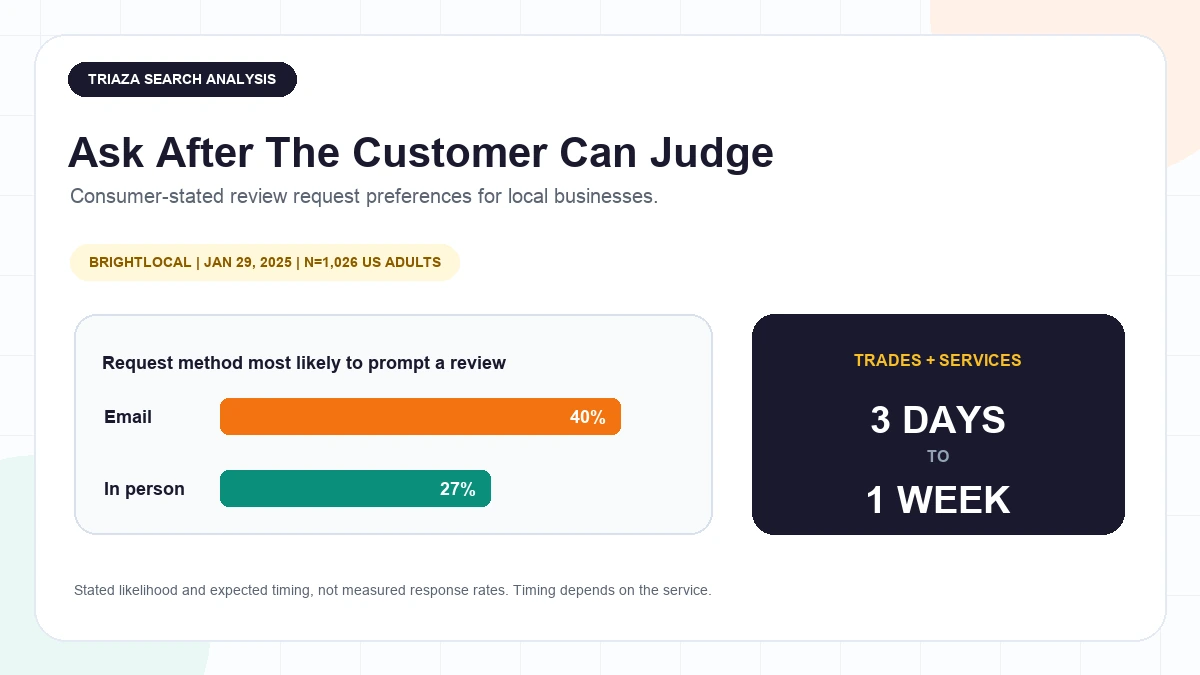
BrightLocal’s 2025 survey used a representative SurveyMonkey panel of 1,026 US adults. It reported that 96% were open to writing a business review. Forty percent chose email as the request method most likely to prompt them, and 27% chose an in-person request. For trades and service businesses, respondents generally expected the request three days to one week after the experience. These are stated preferences and expected timing, not measured response rates. The survey was published January 29, 2025.
That timing is a useful starting point, not a rule for every trade. A homeowner may be able to judge a drain clearing immediately. A roofing, waterproofing, or HVAC installation may need more time. Ask after the customer has enough experience to say something meaningful, while the job is still easy to remember.
A review request should be short:
Thanks for trusting us with your project. If you have a moment, please share an honest review of your experience. Your feedback helps our team improve and helps other homeowners understand what working with us is like.
Send the same neutral opportunity to the eligible customer group. Do not send the public review link only after someone chooses a happy survey response. Do not provide a five-star script for the customer to paste. Do not make an ordinary warranty response, refund, or service remedy depend on deleting criticism.
The FTC’s Consumer Reviews and Testimonials Rule was published August 22, 2024 and became effective October 21, 2024. It prohibits a business from offering compensation or another incentive for a consumer review when the incentive is expressly or impliedly conditioned on the review expressing a particular positive or negative sentiment. The Federal Register final rule controls the legal statement.
FTC staff guidance explains limited exceptions under specified rule sections for generalized requests to purchasers, such as asking all recent customers for reviews. The same guidance says asking only customers expected to be happy is not specifically prohibited by the rule, but could still violate the FTC Act. The FTC’s November 2024 Q&A says plainly that the staff guidance is not definitive or comprehensive and does not provide a safe harbor.
This article is general educational information, not legal advice. Review incentives, employee reviews, vendor programs, testimonial reuse, suppression disputes, and customer contracts can turn on details that need qualified legal review. The full fake reviews rule guide covers those workflow issues in more depth.
Monitor What Homeowners Actually See
Reputation monitoring is not a daily star-rating check. A contractor needs to watch the whole public decision surface.
Business Information
Check the business name, phone, website, hours, service areas, categories, and service descriptions. Compare the profile with the website and important listings. The goal is not to hit a citation quota. It is to stop a homeowner from finding conflicting contact or coverage information.
BrightLocal’s September 2023 survey used a representative sample of 1,138 US-based consumers. It reported that 62% agreed that incorrect information on a business-information site would stop them from using the business. Incorrect or inconsistent address information would make 46% lose trust, while 45% said the same about a phone number. Question-level base sizes were not published, and the address and phone responses were part of a multiple-response question. These findings describe stated trust, not a search ranking factor. The report was published October 11, 2023.
When the information differs, fix the source that owns the error. Do not hide the mismatch with extra pages or more keywords.
Review Flow
Track new reviews, unanswered reviews, repeated themes, and sudden changes. Separate three questions:
- Does the review describe a real customer experience?
- Does it reveal an operational problem the company should fix?
- Does it violate the platform’s content policy?
A low rating is not itself a policy violation. A detailed complaint about lateness, cleanup, billing, communication, or workmanship is operating data. Route it to the person who can investigate the job, then answer without exposing private customer information.
Look for repeated language across several reviews. One complaint can be an outlier. Five complaints about missed arrival windows may show that dispatch promises do not match capacity. The review response cannot solve that. The scheduling process has to change.
Review Responses
Respond to the person and the future reader. A useful response acknowledges the issue, avoids arguing about private facts in public, and gives a clear path to continue the conversation.
Do not write every response from the same template. Repeated, generic replies can make the profile look unattended even when someone is technically answering. Mention the service or concern when appropriate, but do not add details the reviewer did not make public.
Positive reviews deserve real responses too. Thank the customer without turning the reply into a promotion. If the review mentions a technician, project type, or useful part of the process, recognize that detail.
Photos And Project Proof
Review the photo set as a homeowner would. Does it show the services the company wants more of? Are the newest images real and clear? Do captions explain the work? Are old logos, uniforms, trucks, or phone numbers still visible?
Project proof ages in two ways. The image can become visually stale, and the service can change. A company that no longer offers a certain repair should not keep featuring it as a core capability without context.
Local Pages
Check whether service and city pages still match coverage and operations. Remove claims that crews no longer support. Consolidate thin pages when several locations now have the same generic copy. Add real project evidence where the company has earned it.
Do not change publication dates to make an old page look fresh. If the page receives a meaningful update, describe or record that update honestly. Fresh dates are not a substitute for current information.
Plan Before Seasonal Search Windows
Contractor demand is not one season. The timing depends on trade, weather, urgency, planned maintenance, and the homeowner’s own schedule.
Tinuiti’s March 2025 study found that April through June was the most common specified provider-search window across the eight service categories it measured. However, among respondents who hire companies in each category, lawn care was the only category where April through June responses exceeded no specific time frame. That means the self-reported provider searches were often spread through the year rather than concentrated in one universal peak.
Among respondents who said they hire seasonal home-service providers, more than 60% preferred booking more than one week ahead, including 28% who preferred at least one month of notice. Those figures apply to the seasonal-provider subgroup, whose exact size was not disclosed, and they describe stated booking preferences rather than measured market demand. Both findings come from the Tinuiti study of 1,000 US homeowners surveyed in February 2025.
The operating lesson is to prepare before the calendar turns. If a contractor expects spring demand, the profile, service pages, photos, review flow, and response process should be ready weeks earlier. Waiting until calls rise means the team is trying to repair the public proof while also handling the busiest schedule.
Use three planning windows:
- Six to eight weeks before the expected rise: audit profile facts, coverage, service pages, forms, and phone routing.
- Three to four weeks before: publish current project proof, refresh photos, and confirm review requests are working.
- During the busy period: monitor response time, missed-call handling, review themes, and changes in lead quality.
For urgent trades such as plumbing, electrical, HVAC, or restoration, the year-round path matters just as much. Emergency service information should be accurate every day the company claims to provide it.
A 30 Day Contractor Local Visibility Plan
Do not try to fix the entire local footprint in one afternoon. Sequence the work so each step improves the next.
Week 1: Fix The Facts
Verify the Business Profile, website, main directories, phone routing, hours, service areas, and contact forms. Decide who owns each field. Record the correct version of the business name, address model, phone, website, and coverage.
If the company is a service area business, confirm that the profile does not expose an address customers cannot visit. Remove locations the crew does not serve. Check whether the website makes coverage clear without claiming every town in the state.
Week 2: Fix The Pages
Inventory the core service pages and city pages. Keep pages that answer a distinct customer question. Improve pages that have real value but weak proof. Consolidate pages that are only city-name swaps.
Add clear paths from the coverage hub to useful city pages and from those pages to the relevant services. Test each call button, form, and phone number on mobile.
The broader startup website launch checklist is useful when the site itself is new or being rebuilt. For an established contractor, this pass should usually be a targeted correction rather than a full redesign.
Week 3: Build The Proof Library
Collect recent projects and organize them by service, location, property type, and permission status. Choose a small set with clear photos and accurate context. Add them to the pages where they help a homeowner evaluate fit.
Create the closeout checklist for future jobs. Make the field team responsible for capture and the marketing owner responsible for permission, labeling, and publication.
Week 4: Standardize Reviews And Monitoring
Choose the eligible customer event that triggers a request. Write one neutral email and one in-person script. Decide when a reminder is appropriate. Do not select recipients based on expected praise.
Create a weekly review queue and a monthly profile audit. Give recurring issues an operational owner. A reputation report that never reaches dispatch, customer service, or the field team is only a marketing artifact.
This is the point where local SEO work and social presence support should connect. Search finds the gaps, reputation monitoring explains how customers experience them, and the operating team fixes the source.
The Standard Is Clear, Current, And Credible
A contractor does not need a perfect rating, a page for every suburb, or a constant stream of promotional posts. It needs a public footprint that makes sense.
A credible footprint has a business description and service area that match operations, pages that answer real homeowner questions, project photos that show real jobs, reviews from real experiences, and a response process that catches problems instead of hiding them.
That is the system worth maintaining. Triaza’s home contractor marketing work connects the website, local visibility, and proof layer when those pieces have grown apart.
If your profile, local pages, and review process tell three different versions of the business, Triaza can help you map the gaps and turn them into one maintainable local visibility system.
Questions Home Contractors Ask About Local SEO And Reviews
Should a home contractor show its address on Google Business Profile?
Only when customers can actually visit the staffed location during the stated hours. For a business that travels to customers and does not receive them at its address, Google’s October 16, 2024 location resource supports using a service area without showing a storefront address. The area should reflect real coverage, not a rented mailbox or an address created only for map visibility.
Do reviews improve a contractor’s local ranking?
A July 15, 2025 documentation comparison recorded that Google’s local ranking guidance said review count and positive ratings can help local ranking within its discussion of prominence, but Google published no review threshold, weight, or guaranteed result. Reviews also influence customer trust and reveal operational problems. Contractors should ask real customers neutrally and monitor the feedback rather than trying to manufacture a rating target.
How soon after a project should a contractor ask for a review?
BrightLocal’s January 2025 survey of 1,026 US adults found that consumers generally expected a trades or service business to ask three days to one week after the experience. That is a stated preference, not a universal rule. Ask after the customer has enough time to judge the specific work.
Can a contractor offer a discount for a five-star review?
No. The FTC final rule, effective October 21, 2024, prohibits incentives expressly or impliedly conditioned on a consumer review expressing a particular positive or negative sentiment. Other neutral incentive programs can still raise disclosure, platform-policy, and FTC Act issues, so get legal review before using one.
Does every city in a service area need its own page?
No. Create a city page when it gives a homeowner distinct, useful information such as actual service availability, local project proof, scheduling context, or location-specific questions. Google’s 2015 doorway-page guidance warns about funnels, duplicated location aggregations, pages without clear unique value, and navigational islands. A city-name swap is not a local strategy.
What should a contractor monitor each month?
Check Business Profile facts, service areas, categories, hours, phone, website, recent reviews, response status, recurring complaints, project photos, core service pages, city-page accuracy, mobile contact paths, and lead-quality notes. Assign an owner to fix each source. Monitoring only helps when the correction reaches the profile, page, or operation that caused the problem.